Ancient text
On the Syrian Goddess
A text for line-by-line reading, with transliteration, translation, and resources.
Second-century CE Greek text attributed to Lucian, describing Syrian Hierapolis and its sanctuary traditions.
Last reviewed:
Text
On the Syrian Goddess is a Greek text describing worship and traditions at Syrian HierapolisSyrian Hierapolis, ManbijAncient northern Syrian city, also called Bambyce, associated with the sanctuary described in On the Syrian Goddess.Glossary · Click to read the explanation in the Roman period. It is attributed to LucianLucian of SamosataLucian of Samosata was a second-century CE writer in Greek, associated with Samosata on the Euphrates.Glossary · Click to read the explanation, though the attribution is debated. Its narrator distinguishes observations from stories heard from worshippers and others. [1]
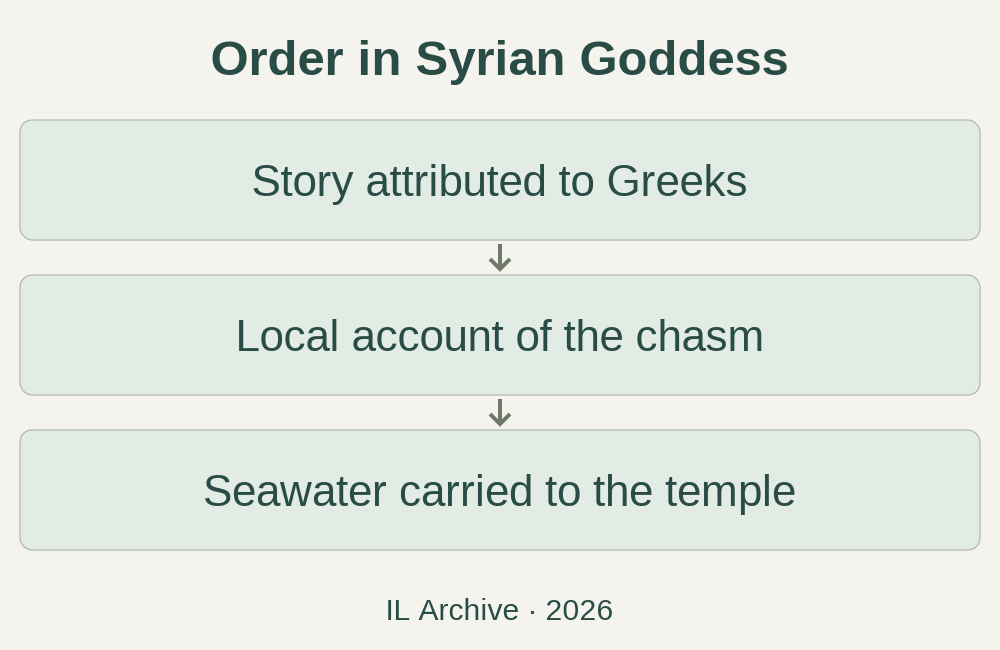
Sections 11–13 present a DeucalionDeucalion in Greek Flood TraditionsDeucalion and Pyrrha in Greek and Latin flood accounts: genealogy, survival, stone-born people, local traditions and Near Eastern parallels, with attention to variant sources and dates.Glossary · Click to read the explanation story heard from Greeks, followed by a local chasm and seawater rite. Their ordering distinguishes layers of storytelling rather than directly reporting a worldwide flood. [1][2]
References and notes
- On the Syrian Goddess 11–13, translated by Herbert A. Strong, with an introduction by John Garstang, 1913: complete reading of the Greek-attributed and local sanctuary accounts in these sections. On the Syrian Goddess 11–13, translated by Herbert A. Strong, with an introduction by John Garstang, 1913: complete reading of the Greek-attributed and local sanctuary accounts in these sections. Return to the text ↑
- Hayes and Nimis, 2012: Greek and comments for 11–13, pp. 16–18 and 20–21, PDF pages 37–39 and 41–42; selected reading, not the whole volume. Hayes and Nimis, 2012: Greek and comments for 11–13, pp. 16–18 and 20–21, PDF pages 37–39 and 41–42; selected reading, not the whole volume. Return to the text ↑
Archive records may be reviewed and refined as better evidence or sources become available. Suggest a correction
Suggest a correction · Suggest a source for this record
Cite this record
IL Archive, «On the Syrian Goddess», https://ilarchive.com/en/texts/on-the-syrian-goddess-text
Continue reading