Ancient text
Palmyrene Aramaic Inscriptions
A text for line-by-line reading, with transliteration, translation, and resources.
- Names
- Palmyrene Aramaic inscriptions · Palmyrene epigraphy · Tadmorean inscriptions
- Region
- The Levant
In the oasis city of Palmyra, inscriptions in a distinctive Aramaic script recorded family ties, civic decisions and honors for merchants. Inscriptions with Greek or Latin show how the language served different readers at home and abroad.
Estimated reading time: 4 min Published Last reviewed:
Share article
Text
Introduction
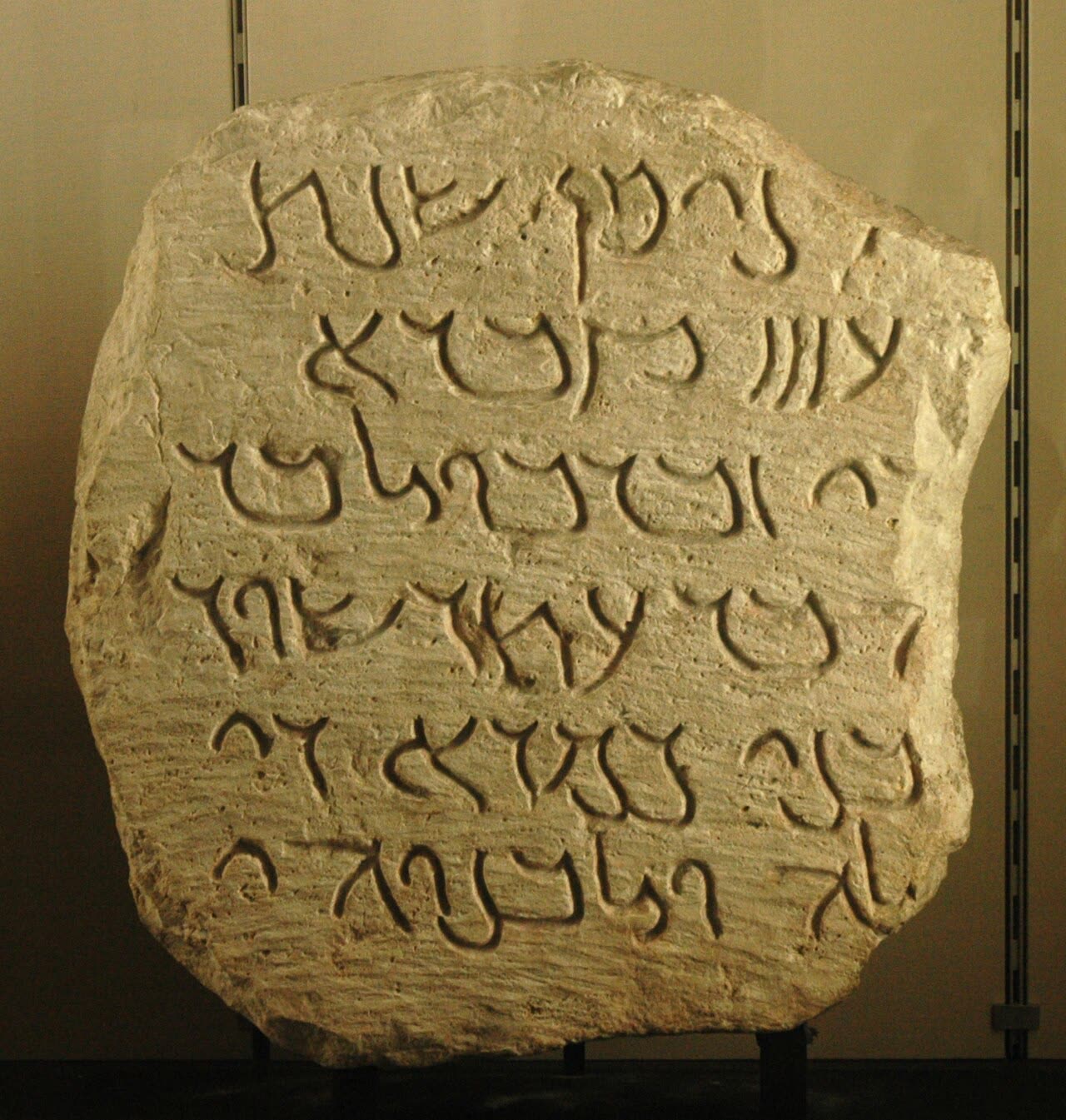
Palmyrene Aramaic survives in inscriptions carved on tombs, portraits, altars, buildings and public monuments. The name refers to the regional form of Aramaic used in Palmyra, ancient Tadmor, and to the distinctive script in which these texts were written. Examples from the late first century BCE through the third century CE record family ties, civic regulations and honors paid to merchants. Some objects also carry Greek or Latin, and the versions on a bilingual stone can give different details about the same people or event. [1] [2] [3]
Names and family on stone
A limestone slab from Palmyra in the Louvre, AO 2205, gives an early dated example. The museum places it in 4 BCE. The remaining text states a month and year and identifies the tomb as that of Zabdibol, whose lineage includes a man of the Komre group. The stone is incomplete, and the Louvre leaves a gap in the genealogy. The surviving words identify the burial place through a date, a name and a family with a continuing claim to use it. [2]
A different object, a second- or third-century funerary relief at the Metropolitan Museum of Art, names another Zabdibol and three of his children. The man reclines in a banquet scene, and the inscription runs through five generations of his paternal ancestors. Its combination of named figures and a long genealogy is one way a family could identify itself within a communal tomb. Limestone reliefs also sealed burial compartments and could bear much shorter inscriptions. The Palmyra Portrait Project counted more than 1,100 funerary inscriptions in Palmyrene Aramaic in the material it examined. Its published survey identified 37 objects with Greek, Latin or bilingual inscriptions, a small group within the funerary corpus. [4] [5]
When the city wrote in two languages
In 137 CE the city set up a tariff on stone in Greek and Palmyrene Aramaic. The text gave rules for dues on goods entering and leaving the city and on activities within it. John F. Matthews reads the document as an effort to reduce disputes by having the council publish both revised rules and the older provisions they superseded. The tariff distinguishes loads by the means of transport and addresses subjects as varied as animals for slaughter and unguent carried in goatskins. Its provisions give a view of local commerce and services at a different scale from the records of long-distance caravans. [1] [6]
Publishing both languages made sense for a text that regulated transactions in a place where civic writing used Greek and Aramaic. The arrangement also matters to modern editors. Matthews points to passages where a damaged or abbreviated part of one version can be understood through the other. The two texts can preserve different amounts of evidence, so a modern translation of the tariff may draw on both. The Greek and Palmyrene versions are part of the original civic act as well as sources for recovering its terms. [1] [6]
The separate honorific inscriptions of commerce show a different use of bilingual writing. A console from the Temple of Bel, dated to 24 CE in Greg Fox and Sam Lieu's edition, names a man honored with a statue. The Palmyrene version credits merchants in BabylonBabylonBabylon is an ancient city in central present-day Iraq, south of BaghdadGlossary · Click to read the explanation and describes his support for the temple, including money given from his own resources. The Greek calls the dedicators the people of Palmyra and gives a brief statement of his benevolence. The difference lets readers see how two versions of one honor could describe its sponsors and the cause for gratitude with different levels of detail. [7]
A line of Palmyrene in Roman Britain
The tombstone of Regina from South Shields, Roman Arbeia, carries Latin and Palmyrene. The Latin gives Regina's age as thirty, identifies her as a Catuvellaunian and calls her the freedwoman and wife of Barates, who is described as a Palmyrene. The single Palmyrene line names Regina as the freedwoman of Barates and ends with a short expression of grief. There is no age or tribal affiliation in that line. Its words use a familiar form of commemoration with a personal name, a relationship and a lament. [8]
The fact that the inscription was carved in Britain places the Palmyrene form at a great distance from its city of origin. The edition of Roman Inscriptions of Britain notes the confident lettering of the Palmyrene line and a less regular Latin text, on which editors differ about the grammar. The museum's reading of the portrait identifies features that can be compared with Palmyrene stones alongside local elements of the monument. What the texts securely give is a name and relationship in both languages, with additional information in the Latin. [8] [9]
Bilingual stones also mattered after antiquity. The Getty Research Institute traces the decipherment of Palmyrene in 1754 in part to comparison with Greek versions. The same comparison remains a way to study how an ancient community distributed information between languages. In Palmyra, a public tariff could be extensive in both, while a dedication might provide context in one version and a short public statement in the other. At South Shields the two languages serve a similarly particular balance of legal status, origin and mourning. [1] [6] [7] [8]
References and notes (9)
- Getty Research Institute, The Legacy of Ancient Palmyra Trade, Inscriptions and Deciphering Palmyrene sections, with bilingual corpus and tariff context. Return to the text ↑
- Musée du Louvre, Inscribed funerary slab AO 2205 Object data and translation, inscription date, name, tomb and genealogy. Return to the text ↑
- Palmyra Archaeological Museum, The Inscriptions Overview of objects carrying Palmyrene Aramaic, and Greek and Latin epigraphy. Return to the text ↑
- The Metropolitan Museum of Art, Art of the Ancient Near East Object 28, gravestone 02.29.1, relief description and translation of the family inscription. Return to the text ↑
- Palmyra Portrait Project, Palmyrene Funerary Sculptural Representations with Greek, Latin and Bilingual Inscriptions Project report giving the comparison and linking the Raja and Yon catalogue. Return to the text ↑
- J. F. Matthews, The Tax Law of Palmyra: Evidence for Economic History in a City of the Roman East Journal of Roman Studies 74, introduction, discussion of revised and older rules and the bilingual text, and commentary on taxable goods. Return to the text ↑
- Greg Fox and Sam Lieu, Select Palmyrene Inscriptions on Commerce Introduction and entry G2, side-by-side renderings of the honorific console dated 24 CE. Return to the text ↑
- Roman Inscriptions of Britain, RIB 1065, Funerary inscription for Regina Find context, Latin and Palmyrene edition, translations and the addenda on lettering and grammar. Return to the text ↑
- North East Museums, The Regina Tombstone Object description, museum interpretation of the stylistic features and treatment of the two inscriptions. Return to the text ↑
Archive records may be reviewed and refined as better evidence or sources become available. Suggest a correction
Suggest a correction · Suggest a source for this record
Cite this record
IL Archive, «Palmyrene Aramaic Inscriptions», https://ilarchive.com/en/texts/palmyrene-aramaic-inscriptions