Entity · Concept
Building biography
A reference page linking a name, group, or concept to the materials that discuss it.
Reading a building through construction, use, transformation and closure, rather than as a fixed plan.
Text
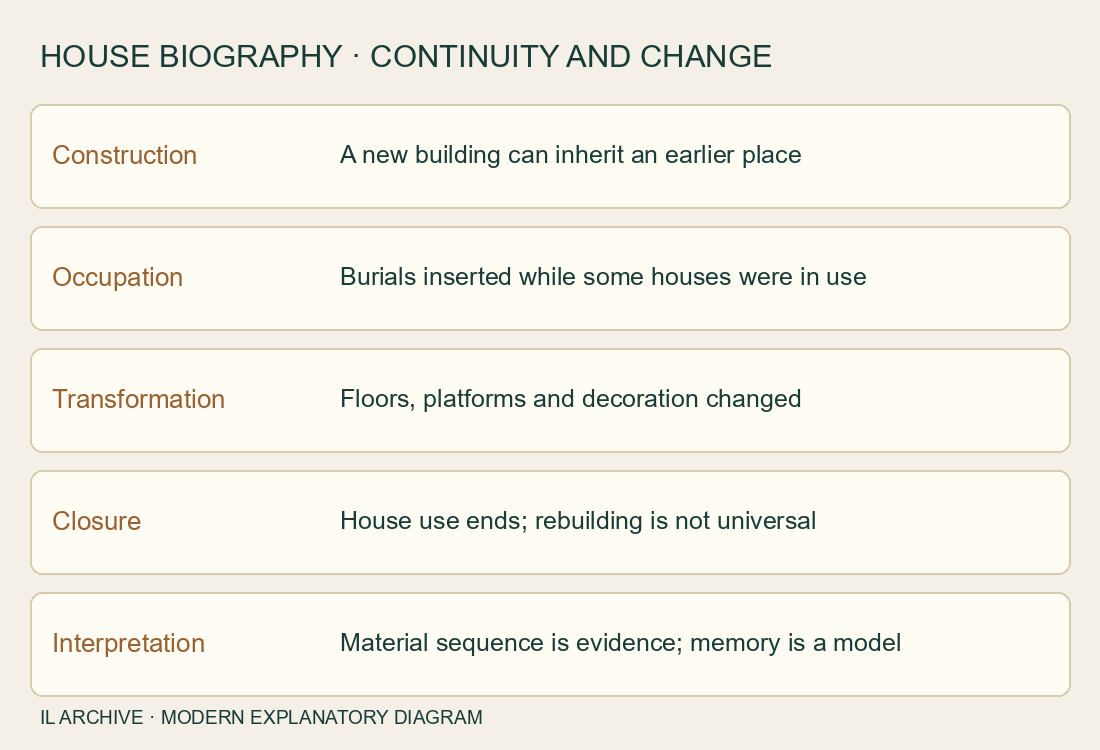
A building biography is an archaeological approach following change through time: what preceded construction, how floors, platforms and activities were arranged, what was added or removed, and how use ended. At ÇatalhöyükÇatalhöyükA Neolithic site in central Anatolia where domestic houses combined dwelling with burial, symbolism and social memory.Glossary · Click to read the explanation it relates plastering, decoration, burial and domestic work, preventing an excavated state from standing for a house’s entire lifetime.[1][2]
The approach neither personifies buildings nor establishes their occupants’ beliefs. Sequences require stratigraphy, dating and contextual evidence. Building 42 provides a grave older than its first plaster surface, followed by domestic use; identifying a sacred founder would be an additional interpretation. The modern diagram presents analytical stages, not a reconstruction of one excavated house.[3]
References and notes
- Kevin Kay (2020). Dynamic Houses and Communities at Çatalhöyük: A Building Biography Approach to Prehistoric Social Structure. Cambridge Archaeological Journal 30(3), 451–468. DOI: 10.1017/S0959774320000037. Publisher abstract only: biographies of four contemporary buildings and changing roles and connections. Full paper not read; the abstract does not assume fixed house groups. Return to the text ↑
- Scott D. Haddow et al. (2025). Bodies in buildings: Human remains and the life histories of houses at Neolithic Çatalhöyük. Archaeological Research in Asia 41, 100598. DOI: 10.1016/j.ara.2025.100598. Author-university abstract only: most burial during occupation and remains incorporated into building biographies. Full PDF unavailable; Building 42 details rely on direct 2004 field reports. Return to the text ↑
- Gareth Chaffey & Simon McCann (2004). Excavations of the South Area: Building 42. Çatalhöyük Archive Report 2004. Field report: F1517, adult woman holding the skull, neonate above, below first plaster in older midden. Locating the building because of the grave is an interpretation, not proof of sacrifice or ownership. Return to the text ↑
Research history
Substantive changes are retained here. Minor copy edits remain in the internal operational log.
-
Substantive record update
Suggest a correction · Suggest a source for this record
Cite this record
IL Archive, «Building biography», Edition 2, https://ilarchive.com/en/entities/building-biography