Entity · Concept
Social memory
A reference page linking a name, group, or concept to the materials that discuss it.
How a group forms relationships to the past through narratives, practices, objects and places.
Text
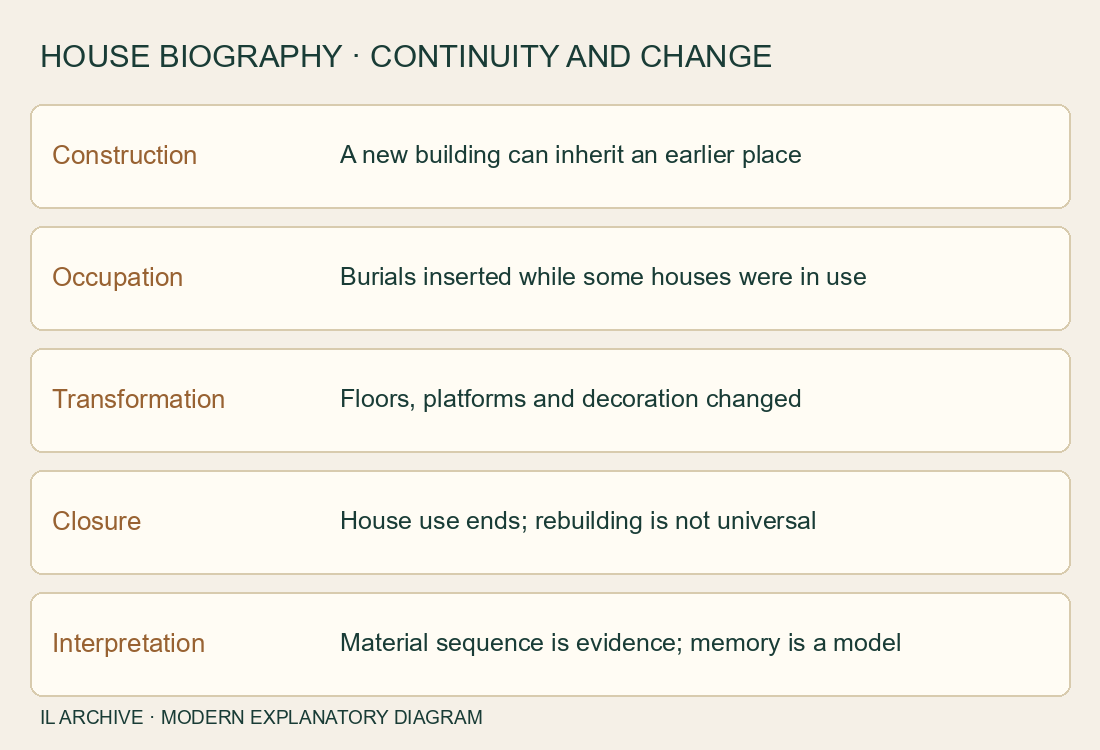
Social memory concerns how people give the past a presence within collective life. It may involve narratives, but does not require written texts: repeated building, repair and retention of remains or symbols can help maintain continuity recognised by participants. Hodder and Cessford used the concept to interpret daily practice at ÇatalhöyükÇatalhöyükA Neolithic site in central Anatolia where domestic houses combined dwelling with burial, symbolism and social memory.Glossary · Click to read the explanation; history-house models link certain buildings to accumulated burials, decoration and rebuilding.[1][2]
Material continuity is an observation; memory is an inference requiring context and comparison. A repeated wall does not reveal what every individual remembered, and pigment on bone does not establish ancestor worship. Research connecting burial pigments and wall painting illustrates the testing of material associations while leaving social meanings open. The diagram is modern and explanatory.[3]
References and notes
- Ian Hodder & Craig Cessford (2004). Daily Practice and Social Memory at Çatalhöyük. American Antiquity 69(1), 17–40. DOI: 10.2307/4128346. Publisher abstract only, not the full article: continuity of house practices and social memory are the authors’ interpretation, not inhabitants’ recorded beliefs. Return to the text ↑
- Ian Hodder & Peter Pels (2010). History houses: A new interpretation of architectural elaboration at Çatalhöyük. In Religion in the Emergence of Civilization, pp. 163–186. DOI: 10.1017/CBO9780511761416.007. Publisher chapter summary only, not the full chapter. Elaborate buildings sometimes had more burials and some were repeatedly rebuilt; all traits need not coincide. The term is a modern model. Return to the text ↑
- Eline M. J. Schotsmans et al. (2022). New insights on commemoration of the dead through mortuary and architectural use of pigments at Neolithic Çatalhöyük, Turkey. Scientific Reports 12, 4055. DOI: 10.1038/s41598-022-07284-3. Publisher full text: selected introduction, results and discussion. 62/567 include direct pigment or pigmented items; 36/567 have direct traces. Associations of wall layers with primary and tertiary deposits are statistical, not proven causation or a uniform cycle. Return to the text ↑
Research history
Substantive changes are retained here. Minor copy edits remain in the internal operational log.
-
Substantive record update
Suggest a correction · Suggest a source for this record
Cite this record
IL Archive, «Social memory», Edition 2, https://ilarchive.com/en/entities/social-memory