Artifact
The Red Crown of Lower Egypt
An object record bringing together its image, metadata, rights, and context.
- Names
- Deshret · Dšrt · Red Crown · Red Crown of Lower Egypt
- Region
- Egypt
The Red Crown has a high back and a projecting curl. Egyptian artists used its form to mark authority in Lower Egypt. Pyramid recitations, guardian figures, and small amulets attest to its ritual power.
Estimated reading time: 5 min Published Last reviewed:
Share article
Photograph
The Metropolitan Museum of Art, Open Access, Public domain
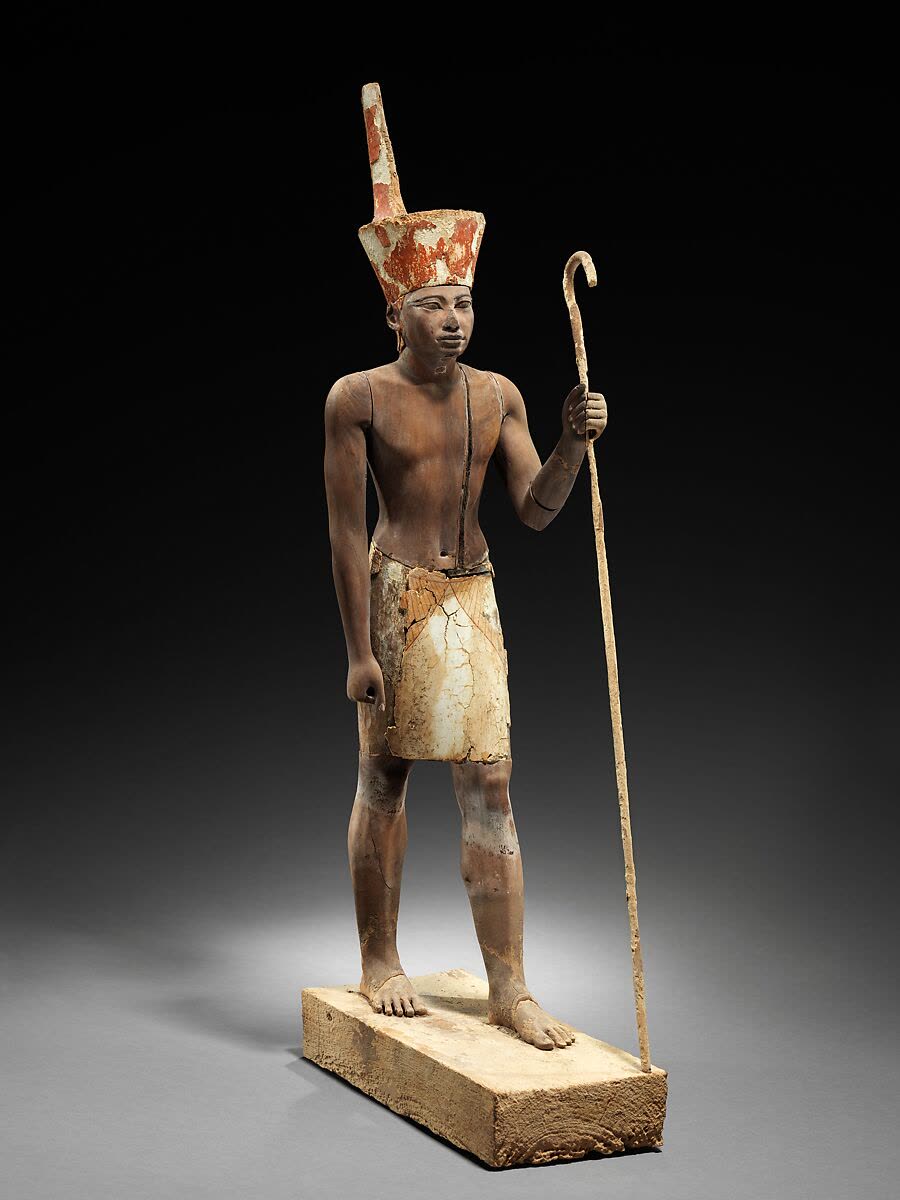
Painted cedar guardian wearing the Red Crown, from the Middle Kingdom tomb of Imhotep at Lisht South. The Metropolitan Museum of Art, 14.3.17
Object recordObject details
- Title
- The Red Crown of Lower Egypt
- Region
- Egypt
- Rights
- Public domain
Text
Introduction
The Red Crown, or deshret, was a form of Egyptian royal headgear associated with the north of EgyptEgyptEgypt lies mainly in northeastern Africa and includes the Sinai Peninsula in AsiaGlossary · Click to read the explanation, especially the Nile Delta. Its low body, tall rear projection, and curl in front gave artists a recognizable outline. The same form could identify a king, mark a protective deity, or lend its power to the deceased. The surviving evidence includes representations made in clay, stone, wood, and faience, a material covered with a colored glaze. [1] [2] [3]
An early image from Upper Egypt
An early image of the crown survives on a piece of pottery from Naqada, south of the Delta in Upper Egypt. G. A. Wainwright examined the fragment now in the Ashmolean Museum as 1895.795 and described its connection with grave 1610. The motif stands in relief on the side of a red vessel with a black rim. Its outline includes the upright rear element and the forward curl. Toby Wilkinson assigns the vessel to late Naqada I and discusses the possibility that the crown form originated as the headgear of local rulers. [4] [5]
The Naqada find establishes that people in the south knew this form before the rise of the First Dynasty. Its later association with the Delta is clear in historical Egyptian images and treatments of kingship. The original significance of the Naqada motif and the steps by which the form acquired its northern affiliation remain open. The fragment gives a place and context for an early representation, and the object’s original users left the meaning of the image unstated. [1] [4] [5]
Narmer and the two crowns
On a ceremonial palette found at Hierakonpolis, Narmer wears the Red Crown in a scene of royal procession. His small figure appears near the top of the face with two long-necked creatures crossing their necks below. The other face shows him in the tall White Crown, later associated with Upper Egypt. The Egyptian Ministry of Tourism and Antiquities presents a possible reading of the palette as a commemoration of unification. Wilkinson allows for scenes of symbolic or ritualRitualAn organised or distinguished practice meaningful to a community; it may leave traces, but its form alone does not reveal an associated doctrine.Glossary · Click to read the explanation action as well as scenes that might refer to particular events in the consolidation of the state. [5] [6]
The juxtaposition gives evidence for the use of two different crowns in the image of a single ruler by the beginning of dynastic history. Another object from Hierakonpolis, Narmer’s ceremonial macehead, depicts him wearing the Red Crown. Egyptian artists also combined the two forms in a single headdress. Called the Double Crown or pschent, it gave visible expression to the claim that one sovereign held authority in both Upper and Lower Egypt. The two forms continued to have their own places in representations of gods and kings. [2] [5]
An address to the crown
The texts in the pyramid of Unis give the crown an active part in the dead king’s progress. In James P. AllenJames P. AllenEgyptologist and Brown professor emeritus, studying ancient Egyptian language, literature and religion, including the Pyramid Texts.Glossary · Click to read the explanation’s translation, the section called Commendation to the Red Crown begins as the doors of the horizon open. The deceased approaches in purity and with fear or awe, and the address gives the crown such titles as Fiery One and Great of Magic. The recitation then identifies the approaching figure with Horus. [7]
The next recitation separately addresses the Curl. It asks for Unis to share the crown’s capacity to inspire fear and acclaim, and for his staff and scepter to place him at the head of the living and of the transfigured dead. It also describes the curl and Unis as emerging in one another. Allen’s translation gives this detail of the outline an explicit part in the ritual. The same element that helps a viewer identify the crown in an image is invoked as a source of the king’s renewed power. [7]
Guardians and amulets
The painted cedar guardian in the cover image comes from a chamber cut into the enclosure wall of the tomb of Imhotep at Lisht South. It stood behind a shrine associated with Anubis, alongside a companion figure wearing the White Crown. The Metropolitan Museum of Art sees royal facial features in its sculpture and identifies its kilt as divine. It suggests that the pair protected the sacred object housed in the shrine and may have served in a funerary ceremony before being deposited. Together the two figures placed the crowns of both regions around an object used in a private official’s burial. [8]
Wadjet, the cobra goddess associated with the protection of Lower Egypt, could also appear wearing the Red Crown. Smaller forms of the crown served as amulets. The Met’s example 10.130.1822 is a Late Period faience piece 2.6 centimeters high. The museum explains that crown amulets could confer royal power and status on someone identified after death with OsirisOsirisOsiris was an ancient Egyptian deity associated with the dead, life after death, renewal, and kingship. His roles appear in changing funerary texts, rituals, and judgment scenes, notably the weighing of the heart.Glossary · Click to read the explanation. A second Met example illustrates an additional distinction between the name of the crown and the appearance of its miniature versions. The crown commonly appears red in art, and faience amulets reproducing its shape are often green. [1] [2] [3]
The painted crown on the Lisht figure and the glazed amulets preserve the choices of individual makers. The Egypt Exploration Society notes that the crowns worn by pharaohs themselves have yet to be recovered and mentions fabric, leather, and woven plant fibers as possibilities. The evidence thus establishes a durable silhouette and several settings in which it conveyed power. The materials and structure of the full-sized headgear remain uncertain. [1] [2] [3] [8]
References and notes (8)
- The Metropolitan Museum of Art, Amulet of a Crown of Lower Egypt, object 572111 Object description, crown form, deshret name, and contrast in pigments between depictions and green amulets Return to the text ↑
- Egypt Exploration Society, The Royal Crowns of Egypt Red Crown, White Crown, the Double Crown, Wadjet, and the discussion of possible materials Return to the text ↑
- The Metropolitan Museum of Art, Amulet: Crown of Lower Egypt, 10.130.1822 Object information and the funerary significance of crown amulets Return to the text ↑
- G. A. Wainwright, The Red Crown in Early Prehistoric Times, Journal of Egyptian Archaeology 9 pp. 26–27, the pottery fragment Ashmolean 1895.795 and grave 1610 Return to the text ↑
- Toby A. H. Wilkinson, Early Dynastic Egypt pp. 48–49 and 192–195, Naqada sherd, hypotheses about the palette, and crown depictions Return to the text ↑
- Egyptian Ministry of Tourism and Antiquities, Narmer Palette Collection description and interpreted imagery of the palette Return to the text ↑
- James P. Allen, The Ancient Egyptian Pyramid Texts, second edition, SBL Press Unis, p. 42, Commendation to the Red Crown, recitations 220–221 Return to the text ↑
- The Metropolitan Museum of Art, Guardian Figure, 14.3.17 Description, provenance, object information, role of the companion figure, and public-domain image Return to the text ↑
Archive records may be reviewed and refined as better evidence or sources become available. Suggest a correction
Suggest a correction · Suggest a source for this record
Cite this record
IL Archive, «The Red Crown of Lower Egypt», https://ilarchive.com/en/artifacts/red-crown-of-egypt
Continue reading