Entity · Deity
Khepri and the Newborn Sun
A reference page linking a name, group, or concept to the materials that discuss it.
- Names
- Kheper · Khepera · Kheprer · Khepri
- Region
- Egypt
Egyptian texts and images show the sun coming into being as Khepri, often in the form of a scarab. The same image expresses renewal in royal pyramid spells, funerary objects and solar scenes.
Estimated reading time: 5 min Published Last reviewed:
Share article
Text
Introduction
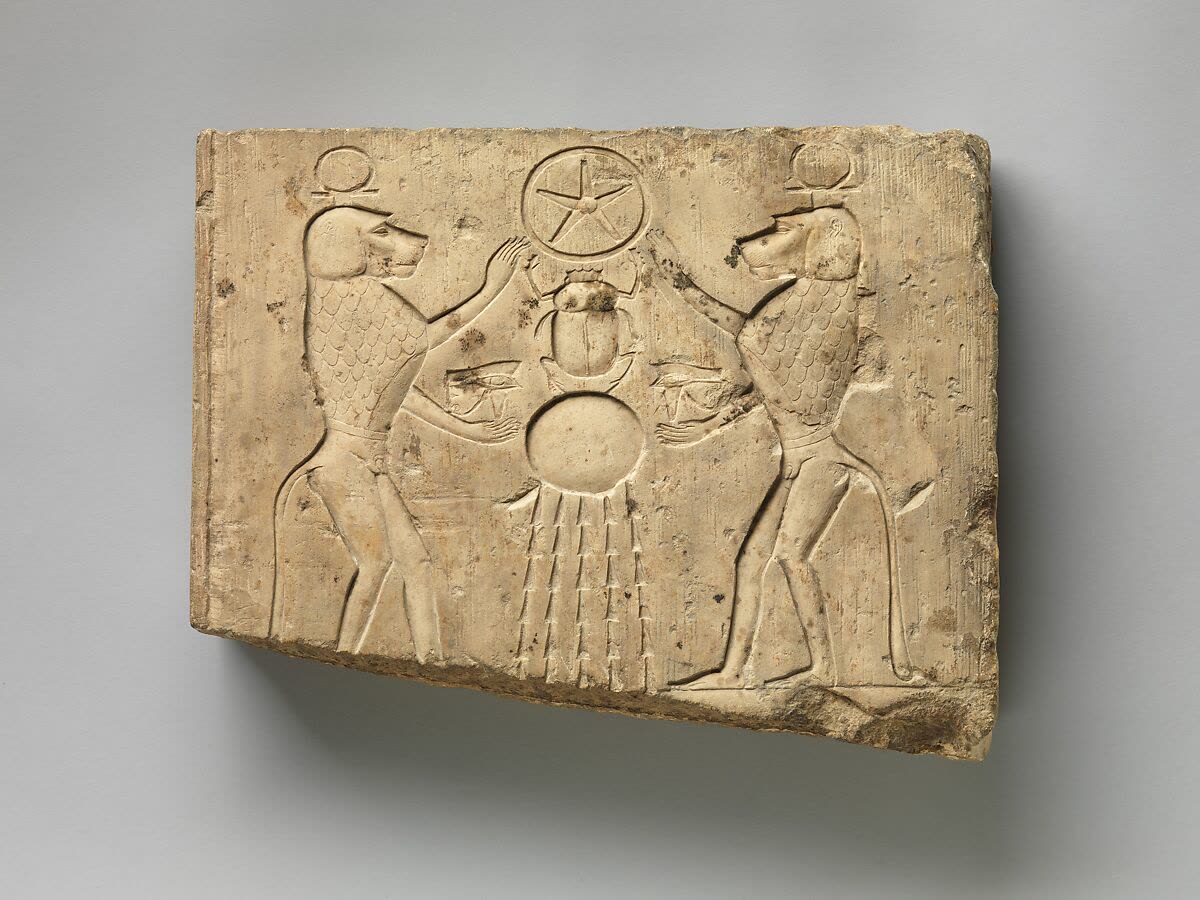
A limestone relief at the Metropolitan Museum of Art places a beetle between two baboons. The beetle holds a star inside a circle. Beneath him is a second disk, this one giving out rays. The museum identifies the beetle as Khepri, the newborn sun, and the circle with the star as the sign for the Duat. The arrangement places the region through which the sun passes and the light it brings forth in the same image. Other Egyptian sources express that emergence in words, on funerary equipment and in scenes of the god's boat. [1][2]
Coming into being
The name Khepri is related to the Egyptian verb conventionally written kheper, meaning to come into existence. The Louvre connects the scarab's movement of a dung ball with the image of the beetle moving the solar disk. The emergence of young beetles from a similar ball suggested renewed life. These observations help explain how a small animal could carry a large theological idea. In surviving representations the god may appear as a beetle or as a human figure with a scarab in place of the head. The relevant scene and the objects held by the figure help establish which role the image gives him. [1][2]
Atum and the first emergence
In a spell on the east wall of Pepi IIPepi IIPepi II was an Egyptian king of the Sixth Dynasty in the late third millennium BCEGlossary · Click to read the explanation's burial chamber, an invocation addresses AtumAtumAtum is an Egyptian creator god associated with HeliopolisGlossary · Click to read the explanation in a form James P. AllenJames P. AllenEgyptologist and Brown professor emeritus, studying ancient Egyptian language, literature and religion, including the Pyramid Texts.Glossary · Click to read the explanation translates as Atum Beetle. It recalls how the god became high like a hill and rose as the benben in its enclosure at HeliopolisHeliopolis, ancient IunuHeliopolis is the Greek name of Egyptian Iunu, at Matariya in northern present-day CairoGlossary · Click to read the explanation. He produced Shu and Tefnut and surrounded them with his arms. The spell then asks him to embrace Pepi Neferkare in the same way and extend his protection over the king and his pyramid. The original emergence gives the recitation a precedent for the protection that it seeks. [3]
This is one example of how the beetle and the solar god fit into royal funerary language. A damaged passage in Pepi I's pyramid also addresses Atum Beetle as it asks for the starry sky to open to the deceased king's spirit. The surroundings of the two passages differ. The one for Pepi II invokes the moment of creation and names the first pair of gods. The one for Pepi I places the address near other requests to open access to the sky. Both bring a form of the creator into a text concerned with the dead king's prospects. [3]
Khepri in the boat
Chapter 17 of the Book of the Dead addresses Khepri in his boat as a primeval being and asks for protection for the deceased. An explanatory gloss identifies the figure in the boat with Re-Horakhty himself. The same compilation contains several such questions and answers. In an earlier section they offer Atum in his disk and Re shining from the eastern horizon as explanations of a formula about the solar god. The relationship of these names is made explicit in a spell whose speaker can also assume forms and speak in the voices of gods. [4]
A fragment of the cartonnage of Padiuf in the Louvre shows Khepri as a scarab pushing a disk in a boat. Made from layers of prepared painted fabric, the fragment belonged to funerary equipment of the Twenty-second Dynasty. Gyula Priskin examines comparable sunrise imagery on hypocephali, circular funerary objects with registers of divine scenes. He reads a boat with a scarab, a goddess and a baboon as one way of showing sunrise. He also discusses scenes that put the scarab at the eastern end of the sun's journey through the Duat. The settings differ in medium and layout, but the images repeatedly place the animal at the transition into daylight. [2][5]
Reading the scarab in an object
The limestone relief in the cover adds a detail that the boat images lack. Its two baboons extend wedjat eyes toward the beetle. The Met suggests a possible association with Thoth on the evidence of the eyes and the forms on their heads. It also notes that the upper hand of the baboon on the right appears to have been restored before the relief entered the collection. The visible eyes, the sign for the Duat and the rays below the beetle together identify this as a scene about the newborn sun. [1]
A much smaller object in the Met, a New Kingdom faience scarab, puts the god's image on the base of the beetle-shaped seal. The carving sets a winged beetle holding a little disk below the crossed bows of Neit and the larger sun disk of Re. The museum's identification rests on the outspread wings and the small disk, details that matter because beetles also occur as hieroglyphs in names or other inscriptions. Here the motifs bring Neit into a group of images connected with creation. [6]
On a late New Kingdom pectoral in the Náprstek Museum, Isis and Nephthys raise their arms toward a scarab in a solar boat. A seated figure with a disk and an ankh takes the place occupied by a simple disk in other scarab scenes. The editors connect the two goddesses' presence with OsirisOsirisOsiris was an ancient Egyptian deity associated with the dead, life after death, renewal, and kingship. His roles appear in changing funerary texts, rituals, and judgment scenes, notably the weighing of the heart.Glossary · Click to read the explanation and with the hope of resurrection. Where the pectoral uses their gestures to make that connection, the limestone panel pairs its beetle with the sign of the Duat and the rays it brings into view. Their figures show how artists could give the same idea of solar emergence different settings. [1][7]
References and notes (7)
- The Metropolitan Museum of Art, Relief Panel Showing Two Baboons Offering the Wedjat Eye to the Sun God Khepri Read the iconographic analysis, the comments on the right baboon and the object record for 66.99.73. Return to the text ↑
- Musée du Louvre, Fragment of Padiuf’s Cartonnage Showing the Solar Barque with Khepri’s Scarab Read the description of N 3360, the scarab and verb connection, the object date and material, and the solar boats. Return to the text ↑
- James P. Allen, The Ancient Egyptian Pyramid Texts, 2005 Read Pepi II spell 359 on the east wall of the burial chamber and the damaged invocation in Pepi I spell 345 on the south wall of the antechamber. Return to the text ↑
- University College London, Digital Egypt for Universities, Book of the Dead Chapter 17 Read the title and glosses in Part a, sections 1–2, and Part b, section 5, including the identification of Khepri in the boat. Return to the text ↑
- Gyula Priskin, The Encounter Between the Sun and the Moon on Hypocephali Read the discussion of the sunrise boats in the upper register and the scarab at the eastern end of the underworld register, pp. 26–27. Return to the text ↑
- The Metropolitan Museum of Art, Scarab Inscribed with the Symbols of Neit, Khepri and Re Read the iconography, identification of the winged scarab, alternatives for the sign elsewhere and object details for 10.130.701. Return to the text ↑
- Annals of the Náprstek Museum, Study of Pectoral P 1672 Read the introduction, object description and analysis of the scarab, seated figure and goddesses on the recto. Return to the text ↑
Suggest a correction · Suggest a source for this record
Cite this record
IL Archive, «Khepri and the Newborn Sun», https://ilarchive.com/en/entities/khepri