Entity · Deity
Nabu, the Mesopotamian God of Writing
A reference page linking a name, group, or concept to the materials that discuss it.
- Names
- Nabu · Nabû
- Region
- Mesopotamia
Nabu was the god of writing and the patron of Borsippa. A dedication from his temple at Nimrud and a prayer about growing old show how kings, officials and worshippers addressed him.
Estimated reading time: 4 min Published Last reviewed:
Share article
Text
Introduction
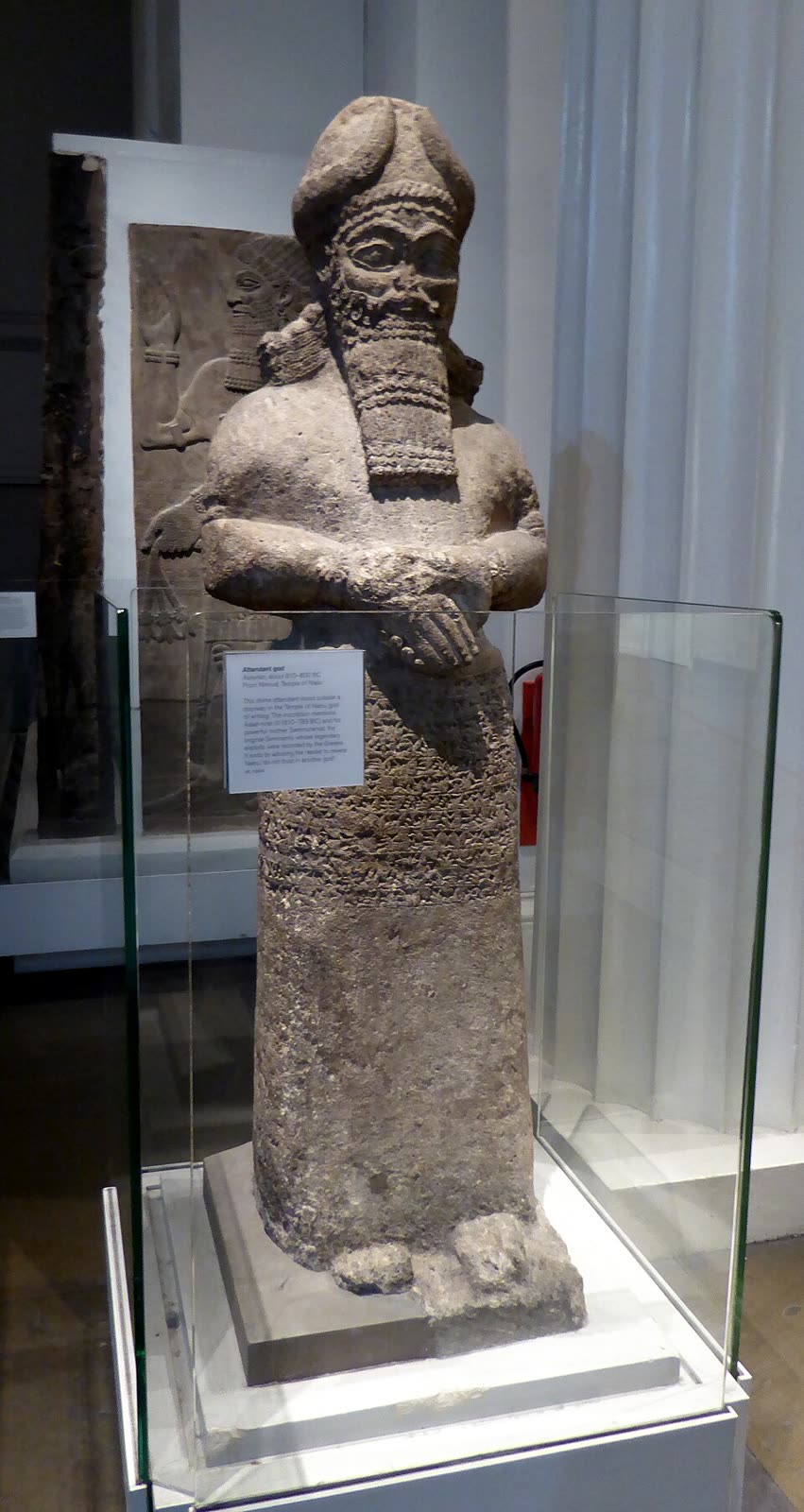
A limestone figure from an Assyrian temple at Nimrud stands with its hands held in front of its body. The British Museum identifies it as probably a divine attendant. It stood at a doorway to the temple of Nabu and was dedicated to the god of writing. What the dedication names and what the stone shows are two distinct kinds of evidence. Together they give a starting point for understanding how Nabu was worshipped. [1]
Nabu, also written Nabû, was the patron of Borsippa and was described as the son of MardukMardukBabylon’s leading god, worshipped at Esagil and elevated in the Akkadian Enūma eliš. His symbols include a spade and mušḫuššu dragon. His earliest origins remain obscure; Nibiru is no evidence of a planetary homeland.Glossary · Click to read the explanation. Alan Lenzi traces the god's rise in prominence from the later second millennium BCE and points to temples and shrines in major Assyrian and Babylonian cities in the first millennium BCE. Royal inscriptions and prayers show how Nabu's skill as a scribe could be applied to court affairs, scholarship and the concerns of a person growing old. [2][3]
A dedication at Nimrud
The British Museum dates the limestone figure to about 810–800 BCE. Its inscription names the Assyrian king Adad-nirari III and Sammuramat, the queen mother. The museum attributes the commission to the governor of Nimrud. It explains that the horns on the figure's headdress mark a divine being and that the position of the hands suggests an attendant. The figure is evidence of a dedication made to Nabu and of the place where it stood. Its appearance should be read in light of the museum's qualified identification. [1]
Borsippa and its temple
In an inscription of AshurbanipalAshurbanipalAshurbanipal was an Assyrian king of the seventh century BCE, reigning about 668–631 BCEGlossary · Click to read the explanation, the king addresses Nabu as the scribe of Esagil, the temple of Marduk, and calls him Marduk's firstborn son. The inscription also names Nabu's own temple, Ezida, at Borsippa. Part of the opening is broken, and the editors indicate where they have supplied words. The titles that survive put writing close to the work of divine government. They present Nabu as a bearer of the tablet of destinies and a god who gives counsel. [3]
The inscription records repairs to Borsippa's city wall and gates. Near the end it turns to a future ruler. In the editors' reading, that ruler is to ask skilled craftsmen about the work and, when rebuilding, honour the earlier inscription and place it with a new one. The text promises that Nabu will listen to the ruler's prayers. The god's place in the inscription extends from the opening titles to the instructions for whoever is responsible for the city next. [3]
The god and the people who wrote
Lenzi points to tablets found in several temples of Nabu. He discusses the large group of literary tablets from the Nimrud temple and the short closing statements on some tablets from other sites. A closing statement of this kind is called a colophon, like a note at the back of a book that identifies who wrote or copied it. Some of these statements express trust in Nabu. They offer a different setting for the god of writing from a monument recording a king's building work. [2]
One ancient prayer edited and discussed by Lenzi begins by praising Nabu and then turns to the person addressing him. The opening associates the god with a stylus, the tool a scribe used to write on a tablet. The speaker presents themself as Nabu's servant and describes the difficulties of old age before making a brief request. Lenzi notes a possible verbal echo between the god holding the stylus and the person taking up the prayer. One of the words needed for that reading has been restored where the text is damaged. The secure change of subject, from the god's qualities to the speaker's distress, already shows how a prayer could make the power of a divine scribe relevant to a human life. [2]
A temple, a name and an emblem
The governor in the Nimrud dedication gives his name as Bēl-tarsi-ilumma. In Eleanor Robson’s translation he dedicates the figure for the lives of the king and the king’s mother, as well as for his own health and the well-being of his people. He tells the person who later reads the words to place their trust in Nabu. Robson situates the statue among the stone figures protecting the approach to Nabu’s shrine. The temple’s inner court also gave access to a shrine for Nabu’s spouse Tašmetu. The monument belongs to the furnishing of that sanctuary and records an official’s personal appeal. [4]
A late Old Babylonian or early Kassite seal at the Metropolitan Museum of Art shows a goddess with raised hands next to four lines of writing. The museum identifies Nabu as the god invoked by the text. The carving and the lines can be seen together on a modern impression rolled from the cylinder. On another object at the Met, a fragment of a Babylonian clay prism, the museum identifies a stylus on an altar as Nabu’s emblem. Part of the object is broken, and the museum describes its identification as a particular kind of inscribed monument as tentative. The seal addresses Nabu by name. The prism shows how his writing tool could stand for him in an image. [5][6]
References and notes (6)
- British Museum, Stone figure of an attendant god, registration 1856,0909.65, collection record reproduced on Google Arts & Culture Read the museum description and object details, including the date, material, doorway setting and dedication, the names in the inscription and the qualified identification as an attendant. Return to the text ↑
- Alan Lenzi, A Shuilla: Nabu 1, in Reading Akkadian Prayers and Hymns: An Introduction (2011) Read pp. 325–326, on Nabu's prominence, Borsippa, the Nimrud tablets and colophons, and the prayer's structure, old age petition and possible verbal echo. Return to the text ↑
- Jamie Novotny, Joshua Jeffers and Grant Frame, The Royal Inscriptions of Ashurbanipal and Other Kings of Assyria, Part 3, RINAP 5/3 (2023) Read the editorial introductions and opening and closing sections of Ashurbanipal 253–254, pp. 70–74. Used the editors' translation of the titles, the Ezida and Borsippa references and the instructions to a future ruler. Return to the text ↑
- Eleanor Robson, Ancient Knowledge Networks: A Social Geography of Cuneiform Scholarship in First-Millennium Assyria Read pp. 58–61, including the rebuilding of the Nimrud temple, paired shrines, dedications of Bēl-tarsi-ilumma and the translation of the attendant inscription. Return to the text ↑
- Metropolitan Museum of Art, Corner fragment of inscribed prism (kudurru), 86.11.280 Read the catalogue’s identification of the broken prism, its three emblems, the altar with a stylus and the suggested object type. Return to the text ↑
- Metropolitan Museum of Art, Cylinder seal and modern impression: suppliant goddess, 47.115.2 Read the object details and description of the raised hands, horned headdress and Akkadian inscription invoking Nabu. Return to the text ↑
Suggest a correction · Suggest a source for this record
Cite this record
IL Archive, «Nabu, the Mesopotamian God of Writing», https://ilarchive.com/en/entities/nabu