Entity · Deity
Sobek
A reference page linking a name, group, or concept to the materials that discuss it.
- Names
- Sebek · Souchos
- Region
- Egypt
Sobek was an Egyptian crocodile god of inundation, fertility and royal power. The Pyramid Texts, Fayum papyri and Kom Ombo temple show how his roles varied across time and place.
Estimated reading time: 5 min Published Last reviewed:
Share article
Text
Introduction
Sobek is the Egyptian crocodile god who appears in Old Kingdom royal recitations and in temple and household imagery from later periods. In the words of a dead king, Sobek courses through the flood and makes vegetation green. At Kom Ombo, his sanctuary stands alongside that of Horus the Elder. In the Fayum, local communities worshipped several crocodile gods, and an illustrated papyrus shows Sobek joined with the sun god Re. [1] [2] [3] [4]
A king speaks as Sobek
In recitation 317 of the Pyramid Texts of Unis, the first-person speaker identifies himself as Sobek. The passage places him ahead of the flood and describes him with an alert face and a splashing movement. He advances toward his canals and the green fields of the Akhet, the region of the horizon in this translation. There he expects to receive a seat and to green the plants along the shores. The text names him as the son of Neith. In this ritualRitualAn organised or distinguished practice meaningful to a community; it may leave traces, but its form alone does not reveal an associated doctrine.Glossary · Click to read the explanation setting the identity with the crocodile god gives the dead king a voice and a way to move through a watery landscape. [1] [2]
A different recitation addresses Sobek by the title lord of Bakhu. The king asks that his ka ascend as the god travels through his own watery domain. The two spells thus use the figure in different grammatical roles. One addresses Sobek and asks him to act for the speaker. The other gives the speaker Sobek’s identity and describes his powers from within it. Marco Zecchi reads the latter as the transfer of the god’s strength and vitality to the deceased ruler. [1] [2]
Royal patrons in the Fayum
Shedet, known in Greek as Crocodilopolis, was a principal cult center. Zecchi follows the evidence for Sobek of Shedet across sites in the Fayum, including Hawara and Medinet Madi. At Medinet Madi, a temple named for the cobra goddess Renenutet contains scenes and inscriptions of Amenemhat III and Amenemhat IV. The two gods can be present in the same royal program, where the products of the region and the authority of its ruler are connected through ritual scenes. In one scene, Anubis and Sobek purify Amenemhat III with streams made up of life signs. [2] [4]
The geographical names attached to Sobek help distinguish local forms. The Roman-era papyrus BGU II 387, now in Berlin, concerns Soknopaios of Soknopaiou Nesos on the north side of Lake Qarun. The museum describes this god as a manifestation of Sobek with a crocodile’s body and a falcon’s head, consulted for oracles and healing. The fragmentary inventory lists sanctuary fittings such as plated wooden shrines, cult figures, incense burners and vessels, sometimes giving their material or weight. The list survives as a record of work in a particular sanctuary and complements images of the god from the region. [2] [5]
A crocodile and a figure with a crocodile head
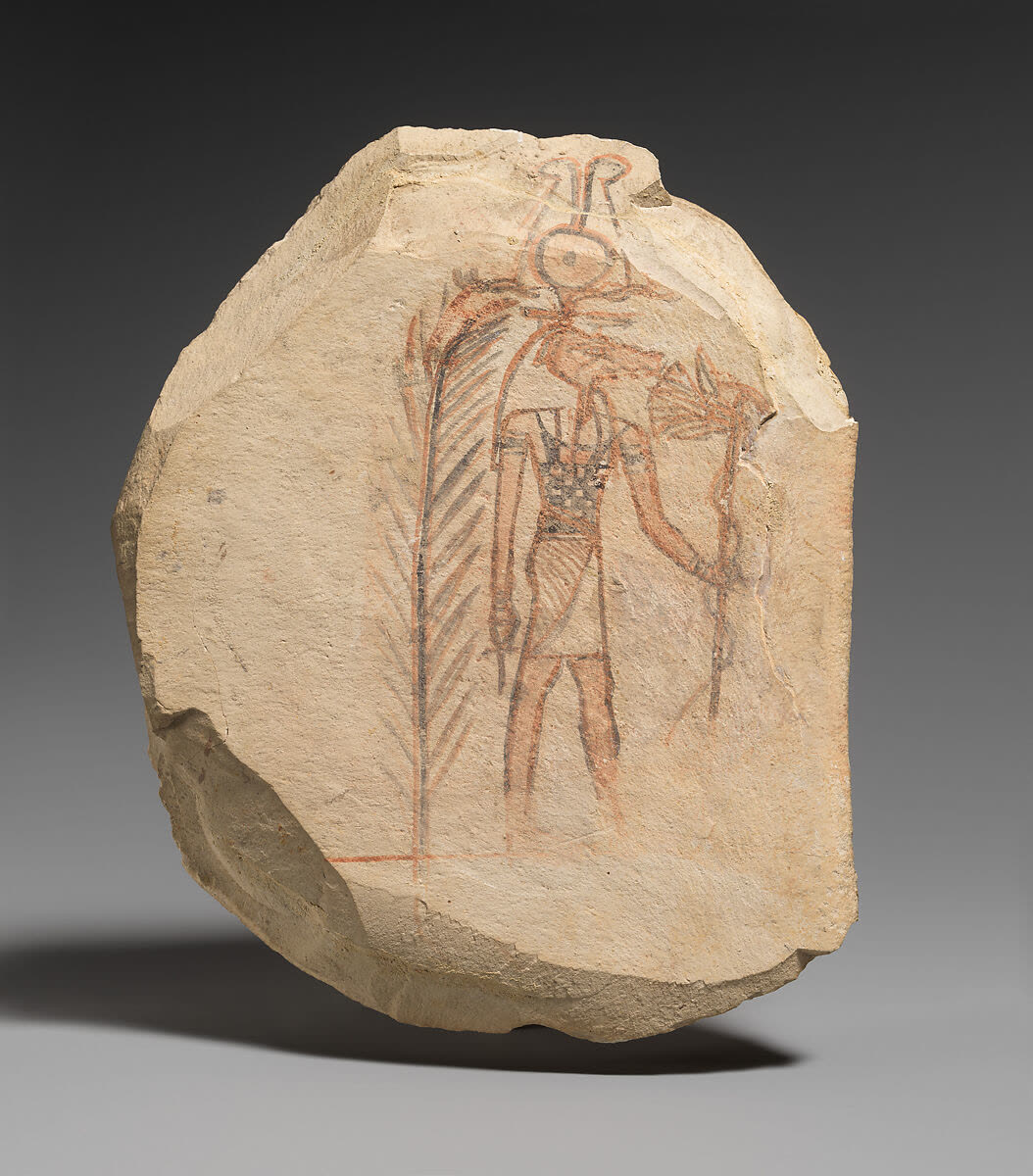
A Ramesside limestone ostracon in the Metropolitan Museum depicts a standing, crocodile-headed Sobek wearing a tall ornament with plumes, a sun disk and ram horns. A palm frond rises behind him. Water lilies surround his scepter, and he carries an ankh, the sign for life. Red and black ink are both still visible. The museum compares it with material from Deir el-Medina and the Valley of the Kings and records the ostracon as probably from Deir el-Medina. Local evidence includes the finds of crocodile drawings and, in the museum’s account of excavation reports, a flint crocodile figure. The precise importance of the god in the village remains open. [6]
A small copper-alloy image from the Ptolemaic period shows the animal itself on a shrine-shaped base. The object is just over five centimetres long, which gives it a very different scale from a temple relief. The Metropolitan Museum identifies the figure as Sobek and relates his association with the Nile flood and fertility to the royal and solar roles that developed around him. A viewer can compare the plain animal form on the base with the headdress, costume and ritual objects of the standing figure. [6] [7]
The double temple and the sacred lake
At Kom Ombo in Upper Egypt, two parallel routes through the columned halls lead to the sanctuaries. The southern axis is Sobek’s, where he appears with Hathor and Khonsu. The northern axis belongs to Harwer, Horus the Elder. The Egyptian Ministry of Tourism and Antiquities identifies Ptolemy VI as the earliest ruler named in the present structure and attributes much of the decoration to Ptolemy XII. Festival calendars on its walls record dates and associated rituals. The nearby Crocodile Museum displays mummified crocodiles. [3] [8]
The Book of the Faiyum gives a different view of the god’s domain. In the illustrated manuscript held in part by the Walters Art Museum, a long oval represents the lake. Sobek-Re, OsirisOsirisOsiris was an ancient Egyptian deity associated with the dead, life after death, renewal, and kingship. His roles appear in changing funerary texts, rituals, and judgment scenes, notably the weighing of the heart.Glossary · Click to read the explanation and the solar child appear within it, linking the lake with creation and the nightly renewal of the sun. Forty-two deities around the lake represent cult places. The Walters records versions of the text in hieroglyphs, hieratic and Demotic, including an unillustrated version on the walls of Sobek’s temple at Kom Ombo. That Upper Egyptian witness shows a composition centered on the Fayum circulating well beyond the lake it describes. [4]
References and notes (8)
- James P. Allen, The Ancient Egyptian Pyramid Texts, second edition Unis, pp. 59–60 and 64, recitations addressed to Sobek of Bakhu and spoken as Sobek Return to the text ↑
- Marco Zecchi, Sobek of Shedet Old Kingdom spells, Middle Kingdom program at Medinet Madi, and named local forms Return to the text ↑
- Egyptian Ministry of Tourism and Antiquities, Kom Ombo Temple Double axial layout, Ptolemaic building and cult calendars Return to the text ↑
- Walters Art Museum, The Book of the Faiyum W.738, manuscript text and image description, Sobek-Re and the Kom Ombo version Return to the text ↑
- Berlin Papyrus Database, Temple Inventory BGU II 387, Soknopaios, provenance and contents of the sanctuary inventory Return to the text ↑
- Metropolitan Museum of Art, Ostracon Depicting the God Sobek 29.2.23, date, likely findspot, ink and iconography Return to the text ↑
- Metropolitan Museum of Art, Crocodile on a shrine-shaped base 58.76.1, object and explanation of Sobek’s royal and solar associations Return to the text ↑
- Egyptian Ministry of Tourism and Antiquities, Crocodile Museum Museum brochure, offerings and Al-Shutb cemetery Return to the text ↑
Suggest a correction · Suggest a source for this record
Cite this record
IL Archive, «Sobek», https://ilarchive.com/en/entities/sobek