Person
Aristobulus, Jewish interpreter
Alexandrian Jewish author usually dated to the second century BCE, whose interpretation of the law survives in later quotations.
Last reviewed:
Text
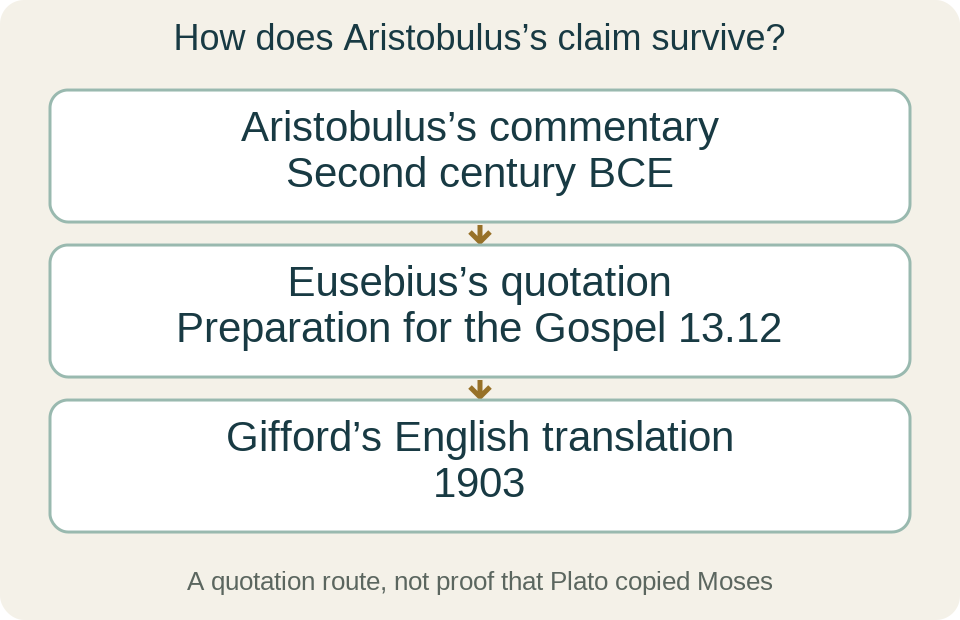
Aristobulus was a Jewish author from AlexandriaAlexandria (Egypt)Alexandria is a city on Egypt’s Mediterranean coast, founded by Alexander the Great in 331 BCE and an important center of trade and culture.Glossary · Click to read the explanation, usually dated to the second century BCE. His interpretation of the law survives in quotations by later authors, including Eusebius.[1]
One fragment attributes to him the claim that PlatoPlatoPlato (approximately 427–347 BCE) was a Greek philosopher who explored goodness, justice and cosmic order through philosophical dialogues.Glossary · Click to read the explanation followed the law and that an early Greek translation made it available. This attests his argument for the tradition’s priority; the historical connection itself requires other evidence.[2]
References and notes
- Aristobulus, Alexandrian Jewish author, Oxford Classical Dictionary; indexed extract. Identity, broad second-century BCE date and survival through quotations. Return to the text ↑
- Aristobulus fragment in Eusebius, Preparation for the Gospel 13.12, Gifford translation, 1903. Chapter opening: priority of the law, the proposed early translation and Plato’s alleged borrowing. Return to the text ↑
Suggest a correction · Suggest a source for this record
Cite this record
IL Archive, «Aristobulus, Jewish interpreter», https://ilarchive.com/en/people/aristobulus-jewish-philosopher
Continue reading