Person · Literary figure
Charaxus of Mytilene
- Names
- Charaxos · Charaxus · Kharaxos
Charaxus is named in a poem attributed to Sappho that prays for his return by sea. Ancient accounts connect him with the Egyptian port of Naucratis and differ about the woman he met there.
Estimated reading time: 5 min Published Last reviewed:
Share article
Text
Introduction
Charaxus of Mytilene appears in Greek poetry and in ancient accounts of travel between Lesbos and Egypt. A surviving lyric attributed to Sappho names him and gives voice to a prayer for his safe return by ship. Herodotus identifies him as Sappho’s brother and says he paid to free a woman called Rhodopis in Egypt. Athenaeus gives the woman in Charaxus’s story the name Doricha and treats Rhodopis as a different person. [1][2][3][4]
The notices make it possible to trace how his story changed as it passed from Greek lyric to histories, geographical writing and collections of quotations. The woman’s name and the interpretation of Sappho’s role vary with the witness. The works also give the voyage different stakes, from the safety of a ship to the cost of a payment and the reputation of its recipient. [1][2][3][4][5]
A prayer for a returning ship
The lyric often called the Brothers Poem begins, as preserved, with a speaker addressing someone who keeps talking about Charaxos and a laden ship. The beginning is incomplete, and the identity of the addressee is uncertain. The Dickinson commentary notes that translations differ over whether this person is talking about Charaxos having arrived or expressing a wish for him to come. Rachel Hadas’s translation reads the opening as talk of an arrival. The speaker goes on to ask to be sent to pray to Hera for a safe return. [1][2]
In that prayer, the speaker wants Charaxos to bring back his ship safely and find those at home well. An image of calm following a gale leads into a reflection on divine help. The closing lines turn to Larichos. If he lifts his head and becomes a man, the speaker hopes those at home will find relief from their troubles. The movement from the full ship to the people who await it gives the poem a domestic setting shaped by a voyage whose outcome is still a matter of concern to the speaker. [1][2]
Herodotus’s identification of Charaxus as Sappho’s brother helps explain the modern title of the poem. The lyric itself supplies neither the destination of the voyage nor the type of cargo. Its Charaxos is seen through what the speaker and the addressee say about him, including a wish that he return to find them in good health. [1][2][3]
Rhodopis in Herodotus
Herodotus introduces Rhodopis while rejecting a story that she built the pyramid of Mycerinus. He places her in the reign of Amasis, says that Xanthes of Samos brought her to Egypt and names Charaxus as the Mytilenean who paid a large sum to free her. He identifies Charaxus by his father, Scamandronymus, and through Sappho. In the same account, Rhodopis stays in Egypt after gaining her freedom, while Charaxus returns to Mytilene and is criticized by Sappho in a poem. [3]
Herodotus gives Rhodopis a material memorial of her own. He says she sent iron roasting spits to Delphi as a dedication paid for with a tenth of her property, and he uses the offering in his reasoning about how wealthy she could have been. In that larger argument, the payment by Charaxus is one event in Rhodopis’s life. Herodotus reports Sappho’s criticism without reproducing the poem in which he says it occurred. [3]
Doricha in Athenaeus and Strabo
Athenaeus says that Charaxus went to Naucratis on business and that Doricha became his lover there. In his account Sappho criticized Doricha for taking much of Charaxus’s property. He assigns the dedication at Delphi to Rhodopis and explicitly disputes the identification of her with Doricha. Athenaeus also quotes an epigram by Posidippus that recalls Doricha drinking wine with Charaxus in the morning and credits Sappho’s poetry with preserving her name. The epigram and the reported criticism give Doricha different places in the remembered story. [4]
Strabo describes Charaxus as a merchant carrying wine from Lesbos to Naucratis. He gives Doricha as Sappho’s name for the woman and says others called her Rhodopis. His description leads into a tale of an eagle carrying a sandal to a king, who seeks its owner and marries her. Strabo presents that episode as a fabulous story in his account of a tomb attributed to the courtesan. Herodotus, by comparison, uses his account of Rhodopis to argue against crediting her with a pyramid. [3][5]
What the port can tell us
Excavation at Naucratis gives this literary setting a material context. The British Museum’s 2016 fieldwork report identifies imported transport jars from the Aegean, Ionia, the LevantThe LevantThe Levant is a regional name for lands along the eastern MediterraneanGlossary · Click to read the explanation and Cyprus. Pitch survived on many of the jar fragments in one deposit, leading the excavators to suggest that wine was the dominant import there. The team also identified material from Lesbos in early deposits associated with Greek sanctuaries. This evidence describes a port with the trading connections assumed in the later account of Charaxus’s journey. Individual cargos and merchants remain the domain of the literary accounts. [5][6]
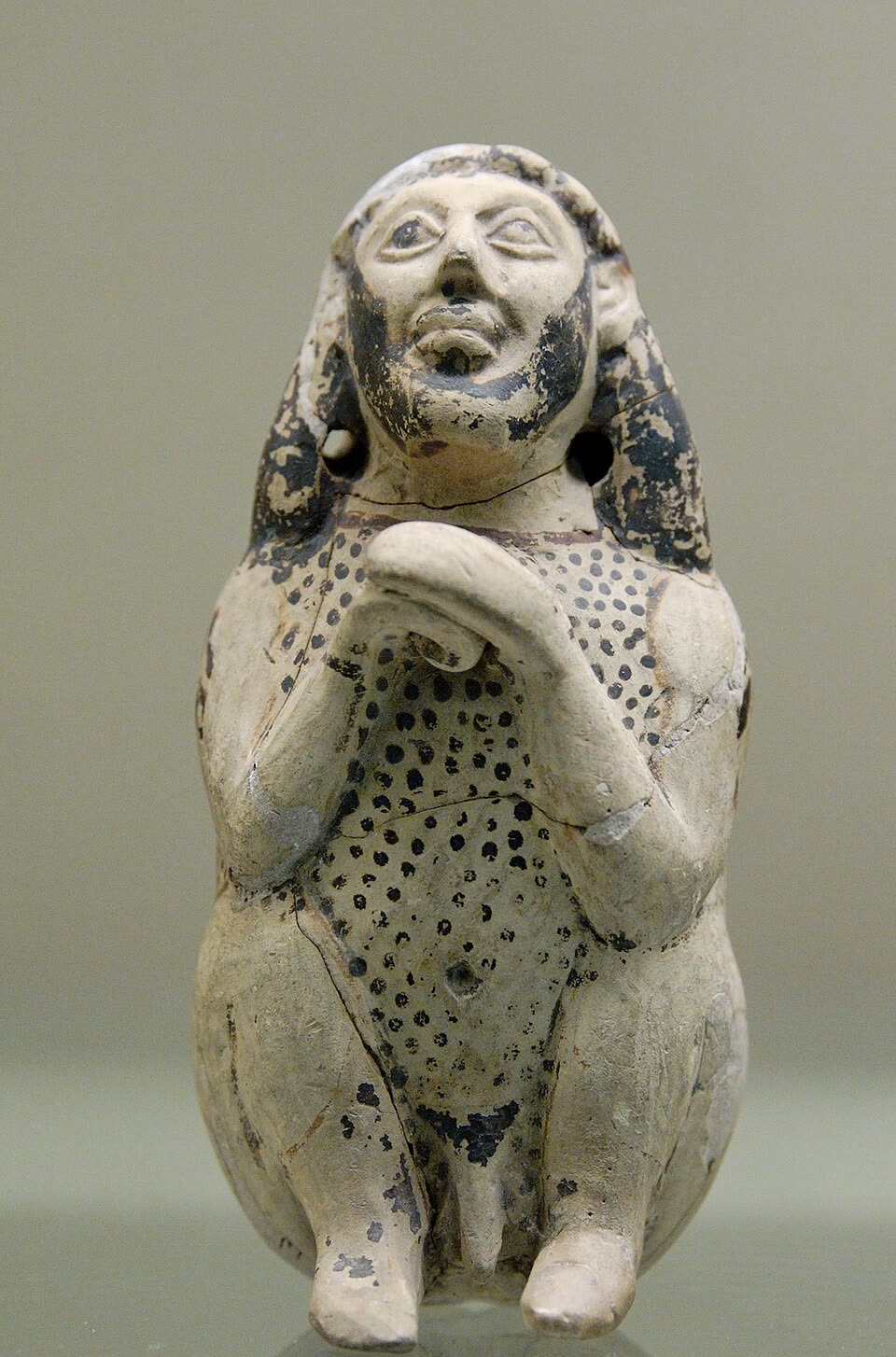
The pictured vessel is an East Greek aryballos in the form of a crouching man. Its recorded findspot is possibly the sanctuary of AphroditeAphroditeGreek goddess whose origin Hesiod relates to foam after the assault on Ouranos.Glossary · Click to read the explanation at Naucratis. The vessel belongs to the material setting of the port that Strabo and Athenaeus name, where the movement of people can be considered alongside imported objects and the places in which they were deposited. [4][5][6][7]
References and notes (7)
- Dickinson College Commentaries, Sappho, The Brothers Poem Read the Greek text, vocabulary and commentary on the missing opening, disputed interpretation in line 1, unidentified addressee, lines 5–12 on the prayer and lines 17–20 on Larichos. Return to the text ↑
- Sappho, The New Brothers Poem, translated by Rachel Hadas Read the translation in full, including the report of a laden ship, the request to pray to Hera, the weather image and the closing wish for Larichos. Return to the text ↑
- Herodotus, Histories 2.134–135, translated by A. D. Godley Read the pyramid argument, identification of Charaxus, payment for Rhodopis’s freedom, her dedication and the account of Sappho’s criticism. Return to the text ↑
- Athenaeus, Deipnosophists 13.596b–d, translated by C. D. Yonge Read the Naucratis story, distinction between the two women, the criticism attributed to Sappho and the epigram quoted from Posidippus. Return to the text ↑
- Strabo, Geography 17.1.33, translated by H. L. Jones Read the description of the tomb, Charaxus’s Lesbian wine trade, the variant names for the woman, and the story of the sandal. Return to the text ↑
- British Museum Naukratis Project, 2016 fieldwork report Read the report on imported transport amphorae, remnants of pitch, inferred wine imports and the provenances of material from archaic sanctuary deposits. Return to the text ↑
- Wikimedia Commons, Plastic aryballos BM GR1888.6-1.660 Read the object description, tentative sanctuary findspot, collection number and CC BY 2.5 license for Marie-Lan Nguyen’s photograph. Return to the text ↑
Suggest a correction · Suggest a source for this record
Cite this record
IL Archive, «Charaxus of Mytilene», https://ilarchive.com/en/people/charaxus