Person · Literary figure
Djedi in the Westcar Papyrus
- Names
- Dedi · Djed(i) · Djedi
- Region
- Egypt
Djedi performs wonders for Khufu and tells the king that three children of Re will come to the throne. The Westcar Papyrus places the prophecy between a performance at court and a story about the children’s birth.
Estimated reading time: 5 min Published Last reviewed:
Share article
Text
Introduction
Djedi is a magician in the Egyptian collection of stories preserved on the Westcar Papyrus. Prince Hardedef brings him to the court of Khufu, where he performs a series of wonders and answers the king’s questions about the sanctuary of Thoth. His answers lead to the news that a woman called Ruddedet is carrying three children fathered by Re and that the children will become kings. [1][2]
The scene changes the direction of the surviving collection. It begins with Khufu asking about what a magician can do and ends with the king learning about people who will rule after his descendants. The next surviving episode follows Ruddedet during childbirth. The turn from the court to her house follows from what Djedi has told the king. [1][2]
The prince’s visit
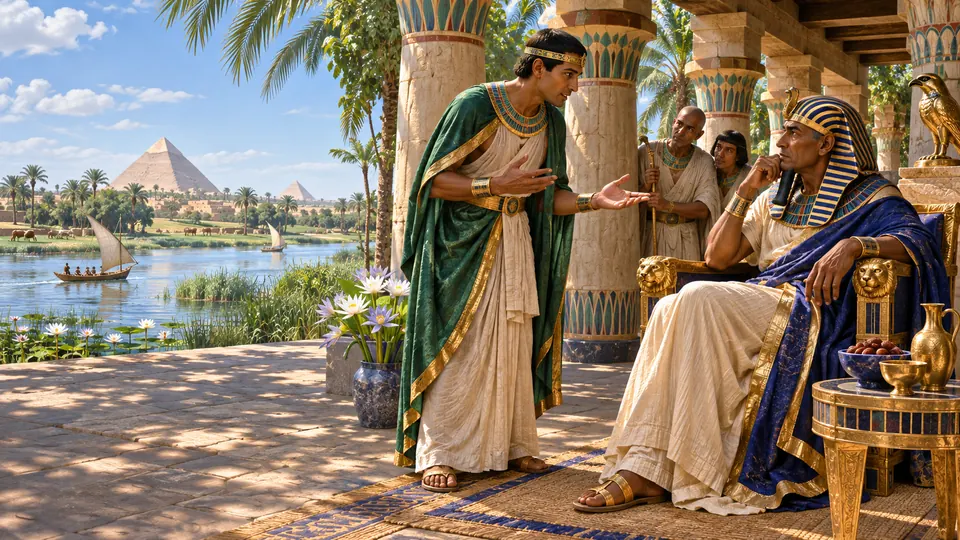
Hardedef introduces Djedi as someone alive in Khufu’s own time and living in Djed-Snefru. The tale gives the magician an age of 110 and credits him with an enormous appetite, measured in hundreds of loaves and jars of beer. The prince travels by water and then continues in a carrying chair. He finds Djedi reclining on a mat in the courtyard of his house, with one attendant anointing him and another working on his feet. [2][3]
Hardedef and Djedi exchange formal greetings before setting out. The magician asks for transport for his children and books, and the prince makes vessels and crews available. Djedi goes downstream on the prince’s own vessel. When they reach the royal residence, Hardedef reports his arrival before Djedi is taken into the hall. The passage gives space to the visit and its formalities before anyone at court sees a wonder. [2][3]
A limit on the demonstration
Khufu asks whether Djedi can rejoin a severed head and proposes trying the feat on a prisoner. Djedi objects to using a human being, and the story moves to demonstrations with animals. A goose is placed on one side of the hall and its head on the other. After Djedi speaks, the two move toward one another and the reunited goose makes a sound. A second bird and then an ox are brought. The text records the recovery of each animal in terms its audience can imagine seeing or hearing. [1][2][4]
The scene shows both the author’s interest in spoken magic and the relationship between the magician and the ruler. Khufu arranges the demonstration and asks the questions. Djedi can contradict a royal proposal before going on to perform. The court hears what he will permit as well as what he claims he can do. The Charles University glossed edition locates that exchange in column VIII, before the shift in column IX to the questions about Thoth. [2][4]
A box in Heliopolis
Khufu has also heard that Djedi knows information about the sanctuary of Thoth. Miriam Lichtheim renders the object of the inquiry as the number of its secret chambers. Djedi tells the king he does not know the number but knows a place where the information can be found. He points to a flint box kept in a building at On, the city also known as HeliopolisHeliopolis, ancient IunuHeliopolis is the Greek name of Egyptian Iunu, at Matariya in northern present-day CairoGlossary · Click to read the explanation. Jennifer McKeown discusses the reading of Khufu’s question as a request for the design of chambers he could copy in his own tomb. [2][4][5]
When the king asks for the box, Djedi says that the eldest of Ruddedet’s unborn children will bring it. The answer gives precedence to a person who has yet to be born and prompts Khufu to ask about the mother. Djedi identifies her as the wife of a priest of Re at Sakhbu. Her children, he says, have been fathered by the god. The question about a sanctuary and its hidden information now depends on an encounter at a later point in the story. [1][2][4]
The prophecy and the change of scene
The king’s reaction leads Djedi to give an order of succession. In Lichtheim’s translation, Khufu’s son and that son’s son are to come first, followed by one of Ruddedet’s children. The magician also predicts the date of their birth. Khufu says the sandbanks of the Two-Fish Channel will be dry when he would like to cross, and Djedi promises enough water for the passage. The king then assigns him to live with Hardedef and grants him provisions. Djedi’s portion of the court narrativeCourt TaleAn analytical category for stories in which a sage or outsider faces tests of skill, loyalty, or survival at a royal court, through contest, accusation, or reversal; it does not establish one textual origin.Glossary · Click to read the explanation ends with those orders. [2][4]
The surviving papyrus then follows Ruddedet as labor begins. The museum describes the children as triplets destined to take the throne, and the narrative brings deities to the birth to help their mother. A reader who has just heard Djedi speak about them can follow how the birth episode takes up his words. The sequence provides a literary account of succession with divine parentage and a domestic setting. [1][2]
The manuscript in Berlin
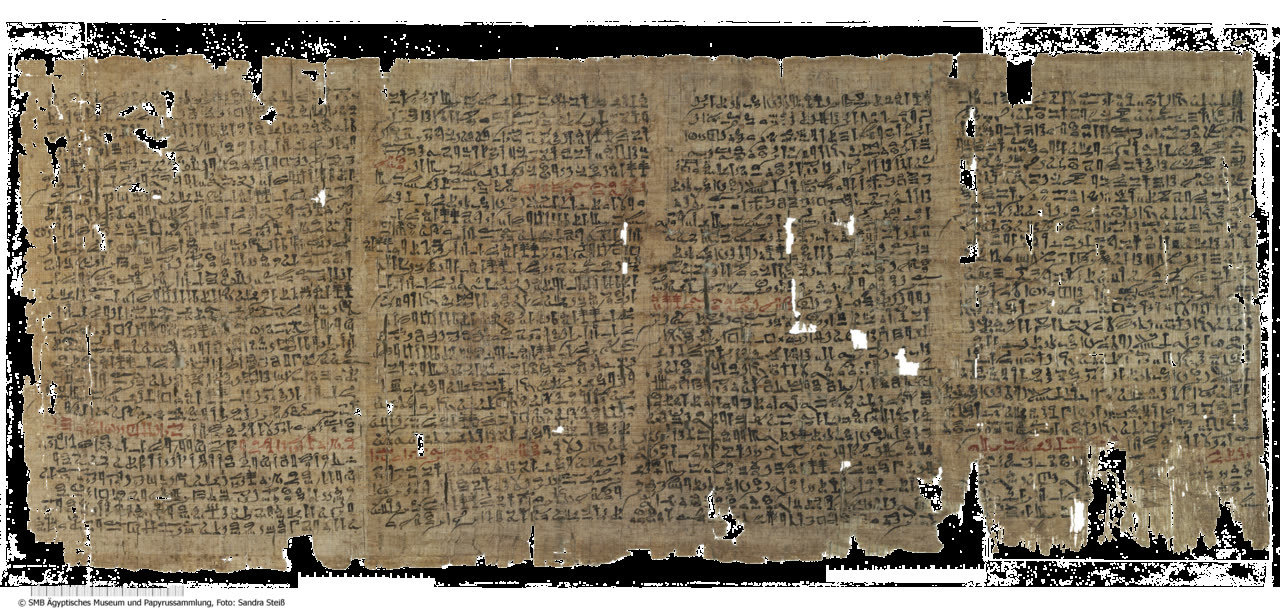
The story places Djedi in Khufu’s Old Kingdom court. Berlin P 3033 belongs to a later period, and it provides evidence for the way Egyptian writers retold events imagined around that court. The photograph shows the surviving recto sections of columns VI through IX, including the columns with the magician’s introduction, performance and prophecy. Both the joins across the papyrus and the damaged areas are visible in the manuscript. [1][2][4][6]
References and notes (6)
- Staatliche Museen zu Berlin, Hieratic Papyrus with the Story of Papyrus Westcar, Berlin P 3033 Read the collection identification and interpretation of Djedi’s demonstration, the triplets’ divine parentage and their future kingship. Return to the text ↑
- Miriam Lichtheim, Ancient Egyptian Literature, Volume I, King Cheops and the Magicians Read pages 215–222, including Hardedef’s visit, Djedi’s arrival, three performances, the exchange about Thoth, the prophecy and the next story. Return to the text ↑
- R. H. Barnhart, Papyrus Westcar Translation Read the line-by-line rendering from the introduction of Djedi and the visit in column VII to the journey and audience in column VIII. Return to the text ↑
- Charles University, Papyrus Westcar, glossed edition Read columns VIII–IX in the annotated text, including the prisoner proposal, spoken magic, flint box, Ruddedet and the royal orders. Return to the text ↑
- Jennifer McKeown, The Symbolism of the Djed-Pillar in The Tale of King Khufu and the Magicians Read the discussion of the fourth tale, especially the court demonstration, the reading of Khufu’s question about Thoth in note 39, and the treatment of royal succession. Return to the text ↑
- Wikimedia Commons, Papyrus Berlin 3033, columns VI–IX, recto Read the object identification, museum and photography credit, source dimensions and CC BY-SA 4.0 license. Return to the text ↑
Suggest a correction · Suggest a source for this record
Cite this record
IL Archive, «Djedi in the Westcar Papyrus», https://ilarchive.com/en/people/djedi-magician