Person
Regina of South Shields
- Names
- Catuvellaunian Regina · RGYNʾ · Regina · Regina of Arbeia
A Roman tombstone at South Shields honors Regina, a Catuvellaunian woman who died aged thirty. Its Latin account of her status and origins is followed by a lament in Palmyrene Aramaic.
Estimated reading time: 5 min Published Last reviewed:
Share article
Text
Introduction
Regina is known through a sandstone tombstone found near the Roman fort of Arbeia at South Shields. Its Latin inscription says that she was a Catuvellaunian, the freedwoman and wife of Barates of Palmyra, and thirty years old when she died. A short Palmyrene line below it names her again. The monument records something about the life of a formerly enslaved woman through the words and images chosen for her burial. [1] [2]
The Roman monument
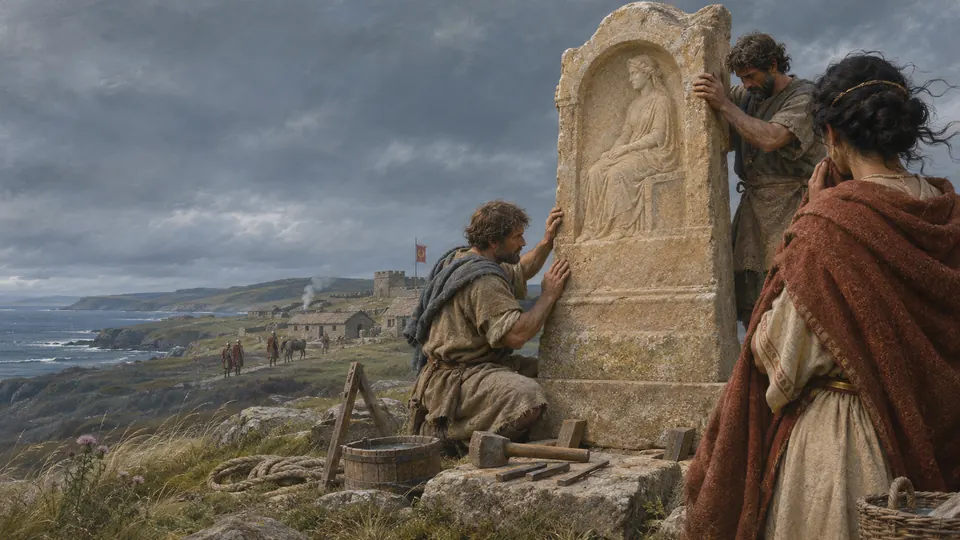
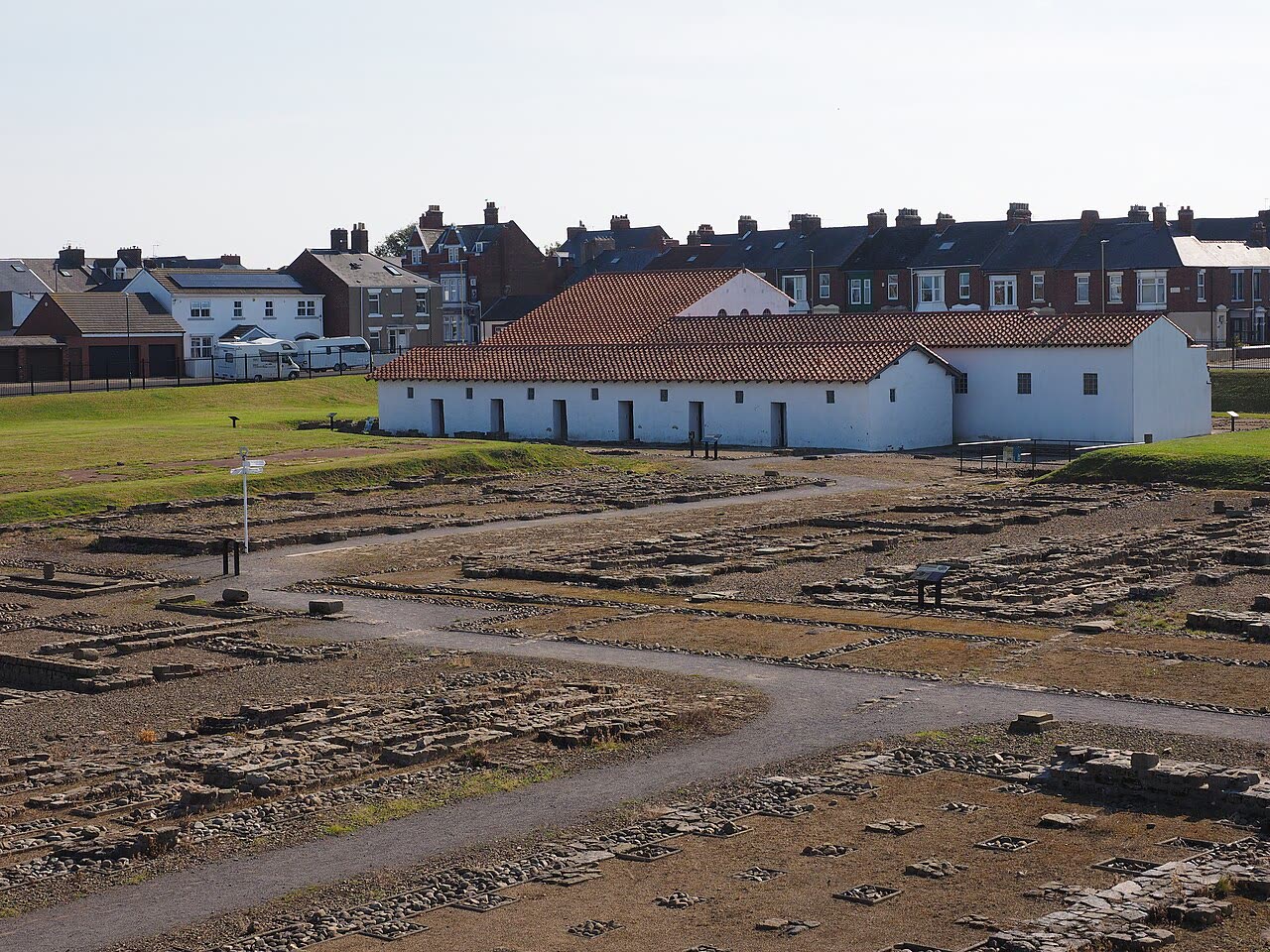
The stone was found in 1878 south of Bath Street, southwest of the fort. The Roman Inscriptions of Britain catalogue records it as RIB 1065 and dates it to the second century CE from its context. North East Museums uses the narrower range 175–200 CE. The stone stands a little over a meter high and survives in four pieces. It is held by the Arbeia museum under the accession number TWCMS: T765. [1] [2] [3]
The Latin text begins with the abbreviated dedication D M, for Dis Manibus, an address to the spirits of the dead. It then names Regina, her status, her husband, her people, and her age. The word liberta identifies a woman freed from enslavement, and coniuge is the word for a spouse in the inscription. The wording records her relation to the man who erected the stone. The precise events of her enslavement and release, and the date of her marriage, remain unknown. [1] [2]
The Catuvellauni were a people of southeastern Britain. Alex Mullen identifies Verulamium, at present-day St Albans, as an important center and points out that the wording describes Regina’s affiliation. Her exact birthplace is unknown. The interpretive possibilities extend to her name. Regina is the Latin word for queen, and Mullen proposes that the name might also have worked in a Celtic linguistic setting. The suggestion concerns the name as it appears in the epitaph and leaves open what people called her earlier in life. [1] [2] [4]
The shorter inscription
Below the framed three lines of Latin is one line in Palmyrene AramaicAramaicNorthwest Semitic language varieties documented since the early first millennium BCE, including Old and Imperial Aramaic, Syriac, Jewish dialects, and living Neo-Aramaic forms.Glossary · Click to read the explanation, the variety associated with Barates’s city. The edition reads it as a statement that Regina was his freedwoman, followed by an expression of grief. The expression at the end is rendered as alas. The Latin contains particulars about marriage, age, and people. The Palmyrene records her name and her tie to Barates and closes with a word of lament, so different elements of the commemoration survive in each language. [1] [4]
The different sizes and positions of the texts raise questions about who composed and carved them. The lettering of the Palmyrene is fluid, even though the curves of its script can be difficult to cut on stone. In the catalogue’s commentary, Eric Phillips interprets the skill evident in the two inscriptions as supporting a sculptor from Palmyra working with western influences. Mullen considers both the possibility of one multilingual carver and that of different hands. The catalogue also records two readings of the unusual endings in Latin, one treating them as the wrong grammatical case and another, proposed by James Adams, seeing a pattern comparable to Greek dedications. [1] [4]
Abigail Baker and Alison Cooley discuss how the stone is presented to modern visitors. They describe efforts to make its two written languages more accessible through recorded speech and other forms of interpretation. The surviving object gives us carved words commissioned in memory of Regina. Such museum presentations help convey the sound and setting of those words, while their voices are choices made by modern interpreters. The contrast in length between the carefully framed Latin and the single Palmyrene line remains a feature any reader can see in the original. [5]
A seated figure and her belongings
Regina appears full-length in a gabled niche, seated in a high-backed wicker chair. The figure’s face has been lost, and the rest of the carving preserves a necklace, bracelets, layered clothing, a wool basket, and a box held open by her right hand. Across her lap are a distaff, which held fiber ready for spinning, and a spindle for twisting it into thread. The museum reads these as signs of domestic skill. Maureen Carroll notes close parallels in the form and handling of the tools on funerary monuments from Palmyra, along with examples of spinning imagery elsewhere in the Roman Empire. The image presents virtues associated with the deceased and gives limited evidence for her daily work. [1] [2] [6]
Carroll identifies Regina’s clothing as British in form. She points out that surviving images offer little direct evidence for assigning this particular dress to the Catuvellauni. The upright monument follows a form at home in Roman Britain, while the handling of the figure and the detail of the spinning implements invite comparison with Palmyrene monuments. The visual evidence makes it possible to trace connections between workshops and traditions and to see how a single portrait drew on more than one. [2] [6]
A possible second Barates
A separate tombstone from Corbridge, RIB 1171, names a Palmyrene man who had reached sixty-eight. The beginning of his name is broken and can be restored as Barathes. The stone gives him a title usually understood as flag-bearer. The editors emphasize that the name is common at Palmyra and is known elsewhere in Syria, so the restoration leaves the proposed identification with Regina’s husband uncertain. Mullen also discusses the possibility that the title referred to a corporation. The South Shields epitaph records Barates’s origin and his relationship to Regina. His occupation and his reasons for coming to Britain remain open. [1] [4] [7]
References and notes (7)
- Roman Inscriptions of Britain, RIB 1065, Funerary Inscription for Regina Support, findspot, dating, accession, edition, translation, and commentary on grammar and workshop Return to the text ↑
- North East Museums, The Regina Tombstone Object date, portraits and details, clothing and spinning tools, and both inscriptions Return to the text ↑
- Tyne and Wear Historic Environment Record, South Shields Vicus, Roman Tombstone of Regina HER 898, findspot, 1878 discovery, dimensions, condition, and Latin epitaph Return to the text ↑
- Alex Mullen, Introduction, Multilingualism in the Graeco-Roman Worlds, Cambridge University Press pp. 1–3, Catuvellauni, the possible dual associations of the name, lettering, and the Corbridge identification Return to the text ↑
- Abigail Baker and Alison Cooley, Breaking Through the Language Barrier, Museum Management and Curatorship South Shields case study, museum interpretation and audio presentation, and fig. 1 Return to the text ↑
- Maureen Carroll, The Insignia of Women, Archaeological Journal, author’s full text pp. 281–286, 291–294, and 299–305, monument form, clothing, textile equipment, and parallels Return to the text ↑
- Roman Inscriptions of Britain, RIB 1171, Fragmentary Funerary Inscription of […]rathes Edition, apparatus, translation, and commentary on the name restoration and flag-bearer title Return to the text ↑
Suggest a correction · Suggest a source for this record
Cite this record
IL Archive, «Regina of South Shields», https://ilarchive.com/en/people/regina-of-south-shields
Continue reading