Person
Ruddjedet in the Westcar Papyrus
- Names
- Reddjedet · Redjedet · Ruddjedet · Rudj-Dedet
- Region
- Egypt
The Westcar Papyrus tells how Ruddjedet gives birth to three future kings with help from five deities. A prophecy in Khufu’s court leads to a story of childbirth and succession in a priest’s household.
Estimated reading time: 5 min Published Last reviewed:
Share article
Text
Introduction
Ruddjedet is the woman who gives birth to three future kings in the Egyptian stories collected in the Westcar Papyrus. The magician Djedi tells Khufu that she carries three children of the sun god ReRe, Egyptian sun godRe is the Egyptian sun god, associated with creation, life and renewal of cosmic orderGlossary · Click to read the explanation. The following episode moves from the palace to her household, where deities attend the births and emblems of kingship emerge from an ordinary exchange of grain. [1] [2]
A question at the king’s court
Ruddjedet first appears by name when Djedi speaks with Khufu. The king wants knowledge associated with the sanctuary of Thoth. Djedi tells him that the eldest of the three children Ruddjedet is carrying will obtain the object in question for him. Asked who she is, he describes her as the wife of a priest of Re, lord of Sakhebu, and says the god has declared that the children will exercise kingship in Egypt. The eldest will also hold the priestly office known as Greatest of the Seers at HeliopolisHeliopolis, ancient IunuHeliopolis is the Greek name of Egyptian Iunu, at Matariya in northern present-day CairoGlossary · Click to read the explanation. [1] [2]
Khufu is troubled. In Djedi’s account the succession will pass first through the king’s son and then through that son’s son before one of the children reigns. The prediction thus gives the present king an interval before the transfer of rule. The narrative links the coming dynasty to royal time measured by successive generations, while locating its beginning in a household that the palace has to ask about. The account then changes place and puts Ruddjedet’s labor at the center of the action. [1] [2] [3]
The visitors in disguise
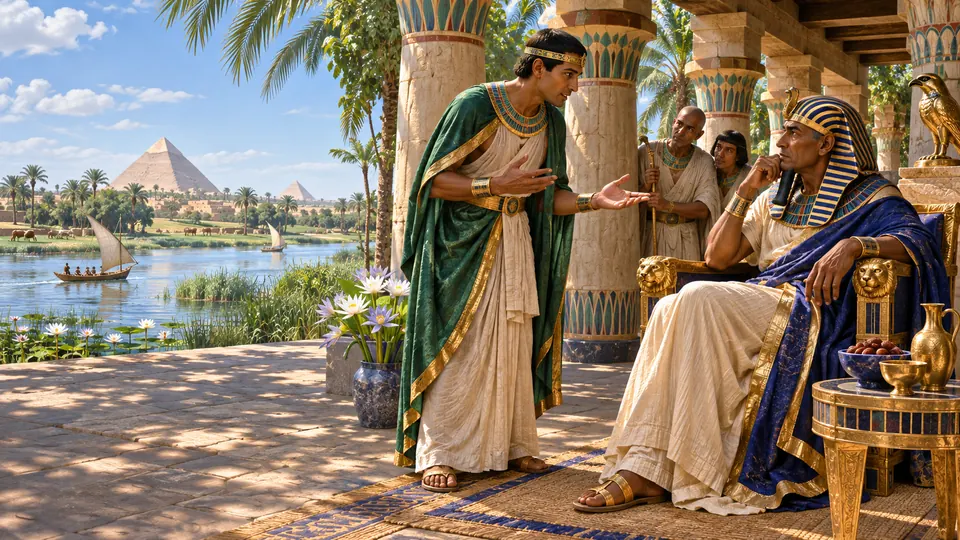
Re calls on Isis, Nephthys, Meskhenet, Heqet, and Khnum when Ruddjedet has difficulty giving birth. The four goddesses take the appearance of musicians, and Khnum accompanies them as a porter. At the house they show their instruments and tell Ruddjedet’s husband that they know how to help. The tale calls him Reusre in Mark-Jan Nederhof’s rendering and Userre in the Bibliotheca Alexandrina translation. The visitors are admitted and shut themselves inside the room with her. [1] [2]
The births follow a repeated pattern. Isis positions herself in front of Ruddjedet, Nephthys behind her, and Heqet hastens each delivery. Isis speaks words associated with the child’s name, and Meskhenet declares his destiny as king. Khnum gives strength or health to the newborn. The account describes golden appearance and lapis lazuli in the imagery of each child, while also giving room to practical details of birth and care. The three repeated scenes make the prophecy of three kings visible as three separate declarations over newborn children. Re gives his own reason for sending the deities. The sons will build temples, provide for altars, and increase offerings. In the story, those duties give the gods a direct interest in what happens inside the room. [1] [2]
Music in the grain room
Ruddjedet’s husband offers the visitors barley in exchange for their help. After leaving, the deities prepare three royal crowns, conceal them in the barley, and return during a storm to leave the grain in a sealed room. The episode later has Ruddjedet ask why the household has no beer ready. She directs a servant to fetch barley from the stored sack and undertakes to have the musicians repaid. The servant opens the room and hears music, dancing, and celebration, which the text identifies with what is done for a king. [1] [2]
Ruddjedet searches for the sound and recognizes its source when she puts her head against the sack. She puts the sack away under seal and tells her husband when he returns. The secret then becomes precarious. A quarrel with the servant leads to a threat to tell Khufu about the births. Before the servant can reach him, a crocodile seizes her, and her brother reports what happened to Ruddjedet. The surviving copy breaks off in this part of the domestic story, leaving the children’s later careers outside its preserved narration. [1] [2]
The tale places these events after a period of fourteen days associated with Ruddjedet’s cleansing. Joachim Friedrich Quack discusses the text as an important witness for purification after childbirth in ancient Egyptian literature. He stresses that the gods come to the house of Ruddjedet’s husband. He treats broader proposals for a dedicated childbirth structure with caution. Here the closed delivery room, the sealed grain room, and the return to household provisions provide the settings in which the text places the events. [1] [2] [4]
The papyrus and the kings’ chronology
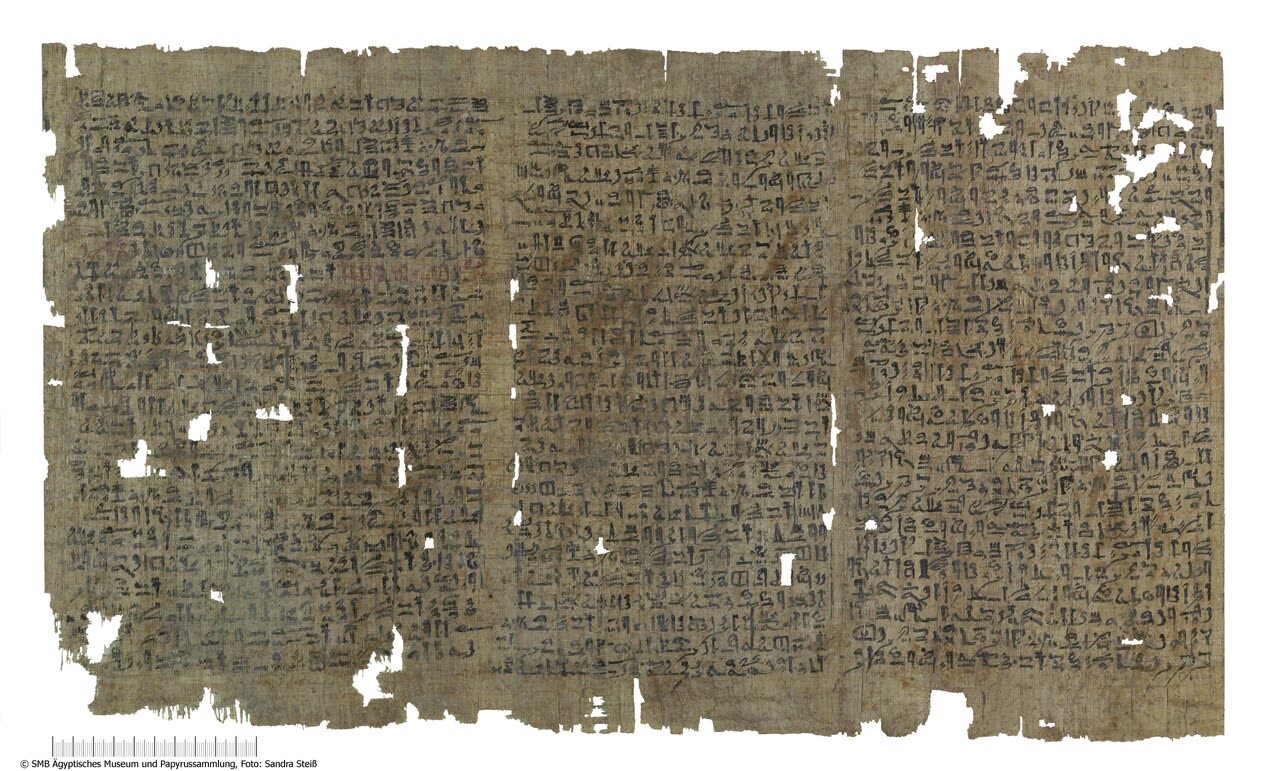
The Berlin papyrus is P 3033. The museum assigns it to the Seventeenth Dynasty and identifies columns X–XII on its reverse, the portion shown here. Josep Cervelló Autuori places the surviving witness at the end of the Second Intermediate Period or early Eighteenth Dynasty and discusses the possibility of an earlier composition. The witness was written centuries after the Old Kingdom reigns in which the tale is set. [3] [5]
The three literary names point to Userkaf, Sahure, and Neferirkare Kakai, the first three kings conventionally assigned to the Fifth Dynasty. Cervelló Autuori notes that four reigns intervene between Khufu and Userkaf in the historical sequence. Miroslav Verner discusses attempts to connect the tale of the royal mother with Khentkaus I and the evidence from Abusir that distinguishes her from another royal mother, Khentkaus II. The historical records establish kings and royal relationships in their own contexts. The surviving story gives Ruddjedet a place in Egyptian accounts of succession through the events it locates in her household. [3] [6]
References and notes (6)
- Mark-Jan Nederhof, Papyrus Westcar, after A. M. Blackman with Davies’ corrections Columns IX.8–XII.26, transliteration and translation of the prediction, births, concealment of the crowns, and fragmentary close Return to the text ↑
- Bibliotheca Alexandrina, The Westcar Papyrus, Digital Library of Inscriptions and Calligraphies English translation, conversation with Djedi and the account of Redjedet’s births and household Return to the text ↑
- Josep Cervelló Autuori, The Boundaries Between the First Three Dynasties pp. 154–155, Westcar manuscript dating, the quoted prophecy, and fiction compared with the Old Kingdom succession Return to the text ↑
- Joachim Friedrich Quack, Conceptions of Purity in Egyptian Religion pp. 143–144, Westcar XI.18–19, fourteen-day purification and the setting of the birth Return to the text ↑
- Staatliche Museen zu Berlin, Hieratic Papyrus with the Story of Papyrus Westcar, P 3033, columns X–XII Verso identification, museum dating, material and photographic credit Return to the text ↑
- Miroslav Verner, The Miraculous Rise of the Fifth Dynasty pp. 86–90, dynastic story, interpretations of Khentkaus I and II, and newly excavated Abusir evidence Return to the text ↑
Suggest a correction · Suggest a source for this record
Cite this record
IL Archive, «Ruddjedet in the Westcar Papyrus», https://ilarchive.com/en/people/ruddjedet