Site · Region
Allabria in Sargon II’s Eighth Campaign
- Names
- Allabria · Allapria
- Region
- The Near East
Allabria lay between Mannea and the Assyrian province of Parsua. An Assyrian report records tribute there in 714 BCE, two years after Sargon II removed its ruler Itti.
Estimated reading time: 5 min Published Last reviewed:
Share article
Text
Introduction
Allabria was a land named in Assyrian records of the Zagros. Ran Zadok places it between Mannea and the Assyrian province of Parsua. The report of Sargon IISargon IISargon II was an Assyrian king of the late eighth century BCE; ORACC dates his reign about 721–705 BCEGlossary · Click to read the explanation’s eighth campaign says that he approached a fortress in Allabria and received horses, cattle and sheep from the Allabrian Bel-aplu-iddina. The passage places the land on the route of the Assyrian expedition in 714 BCE. [1][2][3]
Sargon’s inscriptions also name Itti of Allabria, whom the king says he removed with his family in 716 BCE. Together, the episodes show how Sargon’s court presented changes in its relations with the land. They leave the location of many of the named places uncertain. A description of a route and an account of tribute can establish connections among places even when it is difficult to assign them modern coordinates. [1][2][3][4]
Between Mannea and Parsua
The campaign report mentions Allabria in a sequence of places reached after difficult travel across mountainous country. Sargon says that he came down to Surikash, where he places the border of Karalla and Allabria. Ullusunu, king of Mannea, came to meet him at Sinihini, a border fortress of his own land. The next named stop is Latashe, a fortress on a river in the Allabrian district of Laruete. After reporting the receipt of tribute, the king says he went down to Parsua. The text identifies the district of Laruete by the river and the fortress, as it had identified Mannea’s frontier by the place where Ullusunu met the king. [2][3]
Ran Zadok describes Allabria as a buffer state between the Assyrian province of Parsua and Mannea, one that belonged to Mannea only for a time. He also notes that Paddira, called the capital of Allabria, is described around 817 BCE as the easternmost point reached by the Assyrians. Krzysztof Hipp discusses these earlier Assyrian campaigns in the same region. Any more precise placement depends on where the surrounding lands lay. The route links several sites by their order and political affiliations, while the correspondences between their ancient names and present sites remain open to argument. [1][4]
The removal of Itti
An account in Sargon’s inscriptions attributes a revolt to the influence of Rusa of Urartu. It names Itti of Allabria and Ashur-le’i of Karalla and makes their actions part of the conflict that brought Sargon into Mannea. Sargon says that Itti was deported with his family. Grant Frame compares inscriptions that record resettlement in Hamath and includes Itti and his family among those placed there in the sixth campaign. The inscriptions preserve the sequence as an Assyrian claim about punishment and royal authority. [2][5]
The eighth campaign account names Bel-aplu-iddina as the person whose tribute Sargon received. The goods listed at this point are horses, cattle and sheep. Sargon’s annals for the following year, 713 BCE, name him again in a broader passage on tribute, together with Ullusunu of Mannea, Dalta of Ellipi and forty-five city lords of the Medes. The pairing of local names with the goods received is central to the way these campaigns are reported. The individual list for the Allabrian stop and the larger account of regional payments do different work in the narrative. [2][3]
A letter in the Assyrian state archives offers another perspective on the region. The editors of the Sargon correspondence cite a letter from a Bel-iddina to the king about the preparations of Rusa of Urartu, as an example of how local rulers were drawn into the war between Assyria and Urartu. The name matches that of Allabria’s ruler, but the identification of the sender is not certain. The correspondence shows how a local ruler could inform the Assyrian court about developments as the armies moved through neighbouring lands. [6]
The tablet from Assur
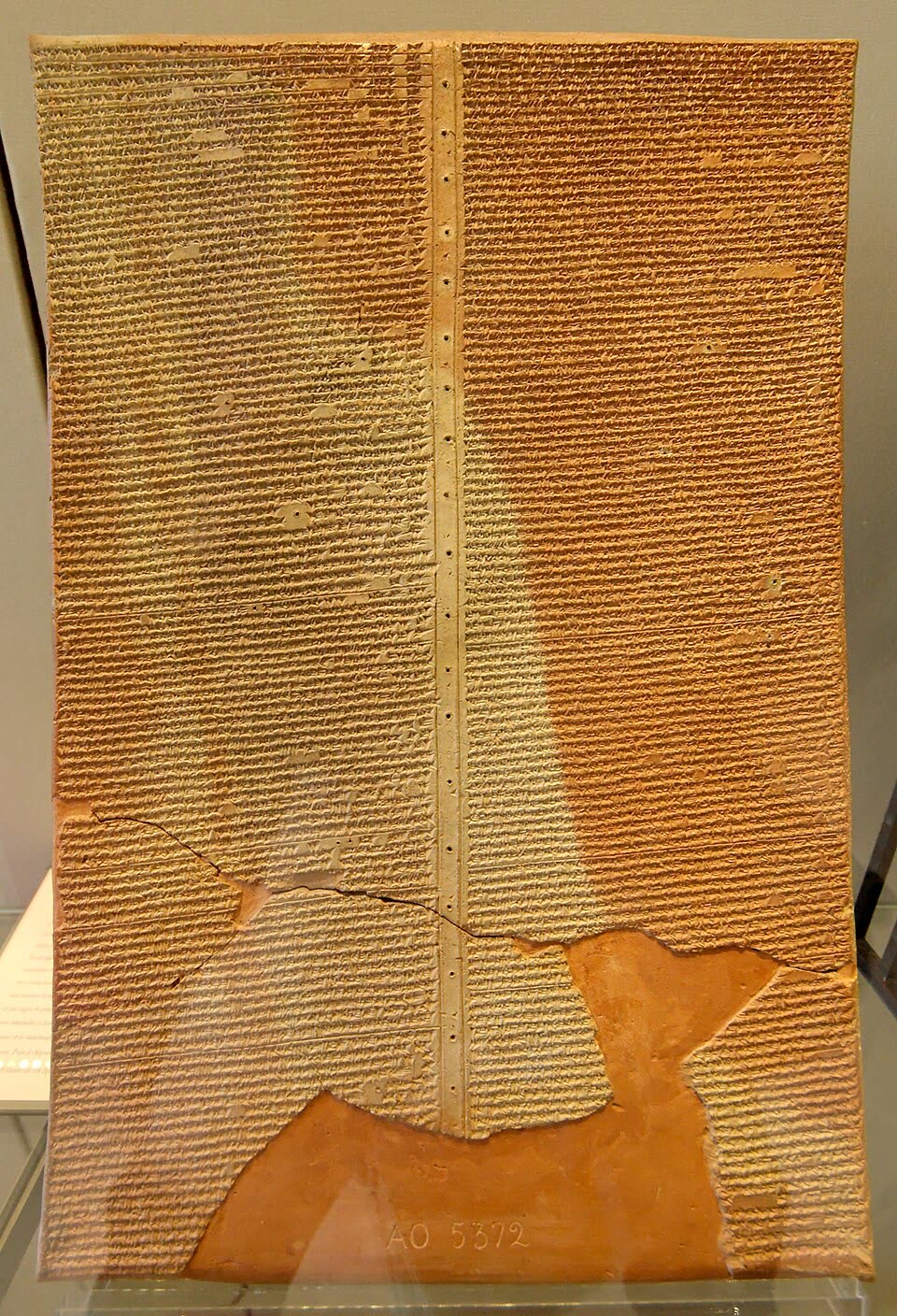
The Louvre keeps a clay tablet of the campaign report, AO 5372, found at Assur. It is about 37.5 centimetres high and preserves dense columns in AkkadianAkkadianAn ancient East Semitic language written in cuneiform from the third millennium BCE; its varieties include Babylonian and Assyrian, and it served in international diplomacy.Glossary · Click to read the explanation. The report is framed as a letter to the god Ashur. It describes a long expedition, including the expedition’s conflict with Urartu and the attack on Musasir. The smaller account of the stop in Allabria sits within that longer presentation of the king’s actions. [2][7][8]
The CuneiformCuneiformWriting with wedge-shaped signs, developed from Mesopotamian recording traditions and used for several languages from the third millennium BCE.Glossary · Click to read the explanation Digital Library Initiative records AO 5372 as a witness to the campaign text and presents the text by numbered lines. In line 31, Surikash appears in the same sentence as Mannea, Karalla and Allabria. The cluster shows the level of detail that survives for this part of the journey. The named places are useful for reconstructing relative position even when the modern referents of individual names are debated. [4][9]
The royal author speaks in the first person. He identifies himself through titles and makes attention to divine commands part of his account of government. This setting matters to the treatment of tribute. Sargon’s telling can turn the meeting of two rulers and the delivery of livestock into an example of the order he claims to impose. The archive letter has a different occasion. It passes on information needed during an unfolding conflict. [3][6][8]
Allabria comes into view through a named fortress, a district, two men associated with local rule, and several neighbouring lands. The accounts are unusually specific about tribute and the stages of travel. Their detail is strongest where Allabria intersects with the interests of Assyria. Much of the land’s local history and the exact position of its settlements remain difficult to recover from these records. [1][2][3][4][6]
References and notes (9)
- Ran Zadok, Mannea, Encyclopaedia Iranica Read the discussion of the limits of Mannea, the position of Allabria between it and Parsua, and the earlier Assyrian references to Paddira. Return to the text ↑
- Grant Frame, The Royal Inscriptions of Sargon II, King of Assyria, RINAP 2 Read the introduction on the campaigns, the inscriptions about the removal of Itti, and the translation of text 65 on the campaign and its receipt of tribute. Return to the text ↑
- Harvard course edition, The Eighth Campaign of Sargon II Read lines 28–55 of the English translation, including Surikash, Sinihini and the Allabrian fortress of Latashe before the passage on Parsua. Return to the text ↑
- Krzysztof Hipp, Šamšī-Adad V’s Campaigns into the Zagros Revisited Read pages 770–771 on Allabria’s neighbours, the proposed modern location and why the author rejects identifying Paddira with Rabat Tepe. Return to the text ↑
- Grant Frame, A ‘New’ Cylinder Inscription of Sargon II of Assyria from Melid Read the note on Hamath as a place of settlement for Itti of Allabria, his family and other deportees, and its references to Sargon’s inscriptions. Return to the text ↑
- Giovanni B. Lanfranchi and Simo Parpola, The Correspondence of Sargon II, Part II, Introduction Read the contextual discussion of letters 164 and 165, the probable identity of Bel-idina and the relationship to the eighth campaign. Return to the text ↑
- Musée du Louvre, Tablet of the Eighth Campaign of Sargon II, AO 5372 Read the curatorial account of the material, dimensions, Akkadian inscription, date and Assur findspot. Return to the text ↑
- Ministère de la Culture, Orient cunéiforme, What It Tells Us Read the account of the campaign, the example of Sargon’s first-person declaration and the discussion of the report’s framing and language. Return to the text ↑
- Cuneiform Digital Library Initiative, RINAP 2, Sargon II 065 ex. 001, P285665 Read the artifact entry and transliteration at lines 28–31, including the group of places in the description of the approach to Surikash. Return to the text ↑
Suggest a correction · Suggest a source for this record
Cite this record
IL Archive, «Allabria in Sargon II’s Eighth Campaign», https://ilarchive.com/en/sites/allabria