Person · philosopher
Avicenna (Ibn Sina)
Philosopher in the Arabic Islamic tradition, distinguishing possible from necessary existence in itself.
Metadata
These are descriptive fields, not conclusions.
- Edition
- 2
Text
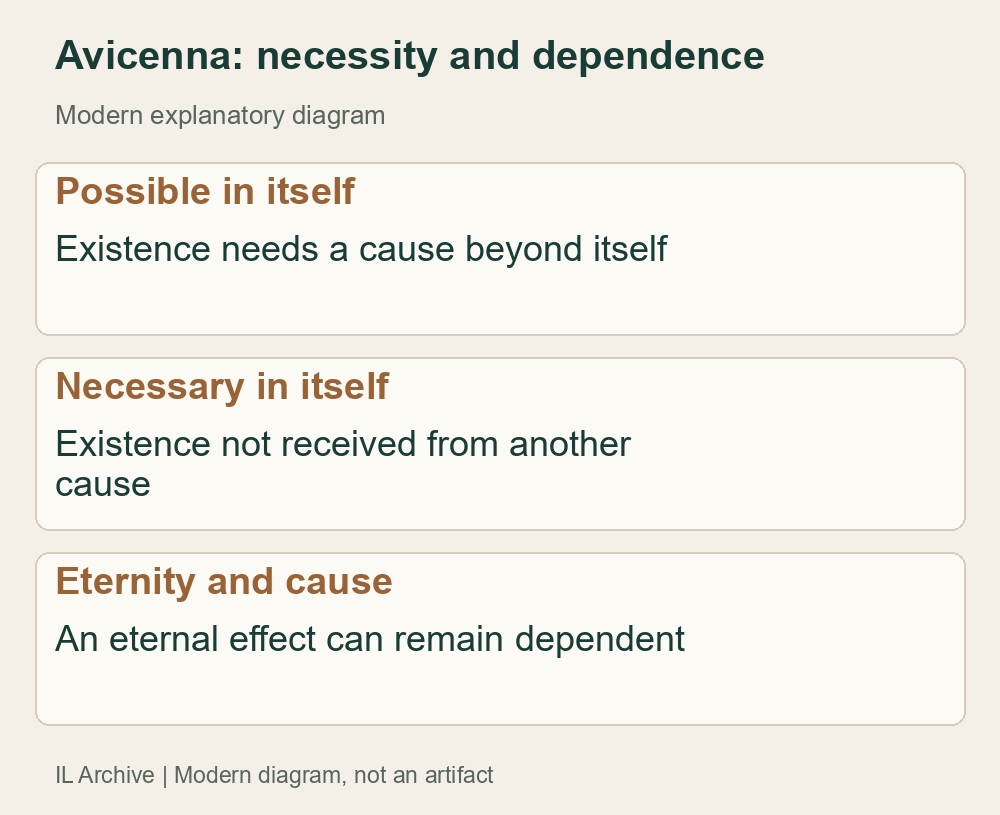
The distinction concerns ontological dependence: what is possible does not explain its own existence and needs a cause, while what is necessary in itself receives existence from no other source. Causal priority need not be temporal; an eternal effect can remain dependent in this model. [1]
This philosophical reconstruction has its own arguments, rather than literally transferring AristotleAristotleGreek philosopher whose concepts of actuality, soul and motion were reinterpreted in later religious traditions.Glossary · Click to read the explanation or prescribing a position for every Islamic school. Establishing a first principle should be separated from further theological accounts of attributes and providence. The diagram explains necessity and dependence without turning concepts into a timeline or depicting the person.
References and notes
- Ibn Sina’s Metaphysics, Stanford Encyclopedia of Philosophy Selected 4.1–4.2 and 5.2–5.4 passages; necessary/possible, creation and emanation. Return to the text ↑
Research history
Substantive changes are retained here. Minor copy edits remain in the internal operational log.
-
Substantive record update
Suggest a correction · Suggest a source for this record
Cite this record
IL Archive, «Avicenna (Ibn Sina)», Edition 2, https://ilarchive.com/en/people/ibn-sina