Artifact · Inscription
Mohenjo-daro Seal DK 5175/143: Image and the Limits of Naming Shiva
An object record bringing together its image, metadata, rights, and context.
- Names
- Mohenjo-daro Seal DK 5175/143 · Pashupati Seal (so-called)
- Timeline
- From 2500 BCE to 2400 BCE
- Region
- Mohenjo-daro, Sindh (present-day Pakistan)
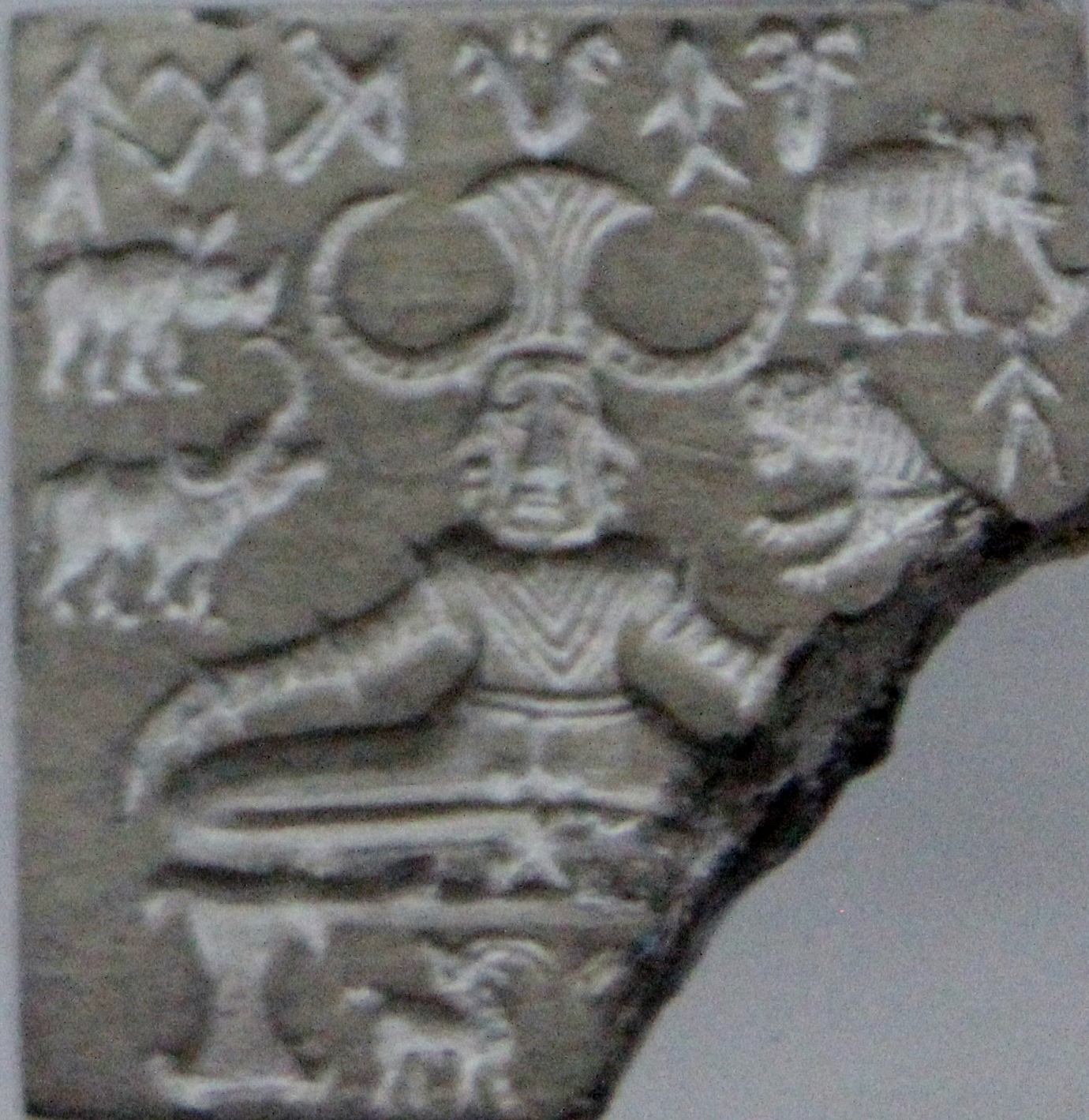
A steatite seal from Mohenjo-daro, approximately 2500–2400 BCE, with a horned figure, animals and undeciphered Indus signs; the entry explains its “Pashupati/proto-Shiva” naming and the objections to it.
Estimated reading time: 6 min Published Last reviewed:
Share article
Photograph
Photograph by Nomu420, 25 January 2014, via Wikimedia Commons; original file unmodified. · CC BY-SA
Mohenjo-daro seal DK 5175/143 as displayed at the National Museum, New Delhi. The horned figure, animals and lower-right break are visible, but soft focus prevents independent reading of the small Indus signs or fine facial details
License · Image sourceObject details
- Title
- Mohenjo-daro Seal DK 5175/143: Image and the Limits of Naming Shiva
- Timeline
- From 2500 BCE to 2400 BCE
- Region
- Mohenjo-daro, Sindh (present-day Pakistan)
- Rights
- CC BY-SA
Text
Introduction
What can we learn from a horned, seated figure surrounded by animals when the marks above it cannot yet be translated? This small object from Mohenjo-daro, often called the “Pashupati seal,” is a useful test of the distance between a surviving image and the name of a god supplied thousands of years later. This entry examines the particular seal DK 5175/143, the archaeological comparisons and the remaining uncertainties—not the entire history of Shiva worship or of yoga in South Asia. [1][3]
Which seal is this?
The National Museum in New Delhi catalogs the object as the Pasupati Seal, number DK 5175/143, made of steatite, from Mohenjo-daro in Sindh, and dates it approximately to 2500–2400 BCE. That is an archaeological estimate for the object's manufacture, not a date inscribed on it or evidence for the inception of a much later religion. The seal is now in the museum; neither its ancient maker nor its first owner is identifiable by a securely read inscription. [1]
The museum gives its dimensions as 1-6/16 × 1-6/16 × ¼ inches, retaining the fractional format of its catalog. Another Indian government museum portal lists the same number as 3.4 × 3.4 × 1.4 cm, but erroneously puts “Harappa” in both origin and findspot fields, in conflict with the Mohenjo-daro identification. The two records agree on the number, material and holding museum; discrepancies in thickness and location must be documented rather than erased through a guessed conversion. [1][2]
The number 420 appears in scholarly discussion of the same iconic seal, including Doris Srinivasan's analysis and a photographic plate in the Royal Asiatic Society archives; it is not a second National Museum accession number. Srinivasan reports an archaeological find context in the G section of the DK area, within the so-called lower city. This is a published contextual identification, not evidence for a particular find-house. The prehistoric manufacture, excavations of the 1920s and later scholarly illustrations have separate dates. [3][8]
What does the decorated face show?
Published images show a roughly square surface broken at the lower right. At the center sits a frontal figure with a tall headdress, large curved horns, arms stretching toward the knees, and patterned lines or ornaments across the chest and arms. Four larger creatures surround the figure, generally described by the museum and scholars as elephant, tiger, rhinoceros and buffalo; two smaller animals below the seat are commonly described as deer. A short sequence of Indus signs runs across the upper part. These are observations and conventional identifications of the image; precise species, supposed multiple faces and divine identity entail varying degrees of interpretation, not independent information supplied by a translated caption on the seal. [1][3]
The central arrangement and animal positions can be inspected, but the picture alone does not reveal whether the subject represents a historical person, a supernatural being or a scene with some other function. Nothing warrants imaginatively filling the broken corner. An incised original seal is also different from a modern impression that reverses its design: publications must distinguish original, impression and reconstruction before comparing the orientation of signs or figures. The National Museum separately describes tactile, actual-size and enlarged replicas; such teaching objects should never be substituted for photographs of DK 5175/143 without an explicit label. [1][7]
Signs without a deciphered name
The symbols above the headdress belong to the Indus writing system, for which no broadly accepted decipherment is available. The other government portal speaks of about seven signs, but counting them does not establish their language, the owner's name or their meaning. There is no agreed epigraphic reading here that yields “Shiva” or “Pashupati.” Seals can be communicative or administrative objects while also bearing meaningful imagery; the function of this individual seal cannot be reconstructed from its displayed face alone. IL Archive's stamp sealStamp sealA small engraved implement pressed into soft clay to leave an impression, unlike a rolled cylinder seal. Its uses are investigated through sealings, find contexts and wear; imagery alone establishes neither writing nor belief.Glossary · Click to read the explanation entry introduces the general technique of an impressed seal; the question here concerns this particular carving and its interpretation. [1][5]
How did “Pashupati” become its name?
In 1931, archaeologist John Marshall interpreted the figure as an early version of Shiva as Pashupati, “Lord of Animals.” His argument associated the horns and headdress, seating pose, surrounding creatures, perceived multiple faces and possible phallic feature with later Shiva iconography. This is a historical interpretive attribution, not an ancient name deciphered on the stone. A short excerpt from page 52 of Marshall's first volume, published by Harappa, documents this attribution. [4]
The difficulties extend beyond the gap in time between the Indus civilization and later Hindu iconography. The bent legs may resemble a meditative pose, but that resemblance cannot by itself establish the later Sanskrit name for a posture or the continued practice of yoga in precisely the same form. Marshall himself considered the possibility of an erect phallus while conceding that the feature might be the end of a waistband. Likewise, what he saw as profiles making three faces has been reinterpreted as features of a single face partly recalling an animal's. A small carved design does not settle these disputes by itself. [3][6]
Testing the interpretations against related objects
In a detailed iconographic study of 1975–1976, Doris Srinivasan compared the headdress and face with other Indus and pre-Indus representations, notably animal-like masks. She argued that a human–bull hybrid, or a being associated with bovine power, offered an alternative to a direct equation with later Shiva. This explains some features of the horns, face and possible waistband differently, but yields no deciphered ancient name. The published opening extract of a later article (1984) shows that she continued to question the direct Shiva identification, but does not reveal the full argument. [3][6]
Three expert responses on Harappa illustrate the real variety of scholarly positions. Richard Meadow insists that object type, motif, signs and find context be examined together, and notes that uninterrupted continuity into the historical period is unproven. Jane McIntosh finds possible connections with attributes later associated with Shiva persuasive enough for consideration, without treating them as a decipherment. Shereen Ratnagar discusses distribution using Mahadevan's sign and motif tables, but her statement that all comparable pieces came from Mohenjo-daro carries an editorial correction on that same webpage, noting finds at Harappa. The correction must be retained rather than silently repeating the earlier generalization. [5]
These interpretations are not equally established facts. The image was evidently significant enough to be carefully composed, yet a settled divine identity or ritualRitualAn organised or distinguished practice meaningful to a community; it may leave traces, but its form alone does not reveal an associated doctrine.Glossary · Click to read the explanation action has not been independently demonstrated. “Bull-man” is a modern hypothesis too, not a recovered proper nameProper nameA name that identifies a particular person, place, group, or entity in context, unlike a common noun denoting a class. Spelling alone may not settle the distinction.Glossary · Click to read the explanation. Readers seeking geographical context may use the Indus Valley historical-region entry, without borrowing the meaning of a different seal to explain this one. [3][5]
What does the seal establish, and what remains open?
DK 5175/143 establishes the existence of a horned seated figure, surrounding animals and Indus signs in an artifact of the Indus civilization. Its approximate manufacture date, modern holding institution and successive scholarly interpretations can be investigated. The claims that it names Shiva, depicts an unchanged form of later yoga, or records an unbroken religious tradition require other dated evidence: a deciphered text, demonstrable ritual contexts, and traceable iconographic sequences. Yet the absence of proof for a proto-Shiva identification does not establish that the image lacked religious significance or that later cultural contacts were impossible. Its value lies in beginning with the material witness and keeping an attractive identification distinct from a recovered ancient name. [3][5]
References and notes
- National Museum, New Delhi, “Pre-historic Archaeology Collection,” Pasupati Seal, DK 5175/143; material, date, provenance and display description. Collection entry, “Pasupati Seal” paragraph read in full; the museum’s interpretation is not treated as consensus. Return to the text ↑
- Museums of India, Pasupati Seal, DK5175/143; a separate government portal with conflicting measurement and findspot fields. Full repository record, especially Dimensions, Origin Place and Find Place; discrepancies are not silently reconciled. Return to the text ↑
- Doris Srinivasan, “The So-Called Proto-Śiva Seal from Mohenjo-Daro: An Iconological Assessment,” Archives of Asian Art 29 (1975–1976), 47–58. OCR/extracted text examined for printed pp. 47–58, particularly 47–50, 52–57 and note 13; no independent collation of photographed signs. Original excavation field notebooks were not re-examined for this update. Return to the text ↑
- John Marshall, Mohenjo-daro and the Indus Civilization, vol. I (1931), p. 52, in a short excerpt reproduced by Harappa. Short quoted extract attributed to p. 52 only; not a reading of Marshall’s full pp. 52–56. Return to the text ↑
- Richard Meadow, Shereen Ratnagar and Jane McIntosh, expert responses, “How common is the Yogi figure …?” on Harappa. All three replies and the editorial “[yes, they have]” correction read; Mahadevan and Parpola cited there were not independently consulted. Return to the text ↑
- Doris Srinivasan, “Unhinging Śiva from the Indus civilization,” Journal of the Royal Asiatic Society (1984), 77–89; publisher’s opening extract only. Cambridge Core extract only, not pages 78–89 or the original plates. Return to the text ↑
- National Museum, “Anubhav: A Tactile Experience,” Pashupati Seal section, describing two tactile replicas. Pashupati Seal section read; this is a teaching-replica description, not independent authentication of a photograph of the original. Return to the text ↑
- Royal Asiatic Society Archives, “Plate of Impression of seal no. 420 from Mohenjo-daro,” a 1984 archival plate record. Archival description only; its impression image was not downloaded or inspected locally. Return to the text ↑
Archive records may be reviewed and refined as better evidence or sources become available. Suggest a correction
Suggest a correction · Suggest a source for this record
Cite this record
IL Archive, «Mohenjo-daro Seal DK 5175/143: Image and the Limits of Naming Shiva», https://ilarchive.com/en/artifacts/mohenjo-daro-seal-dk5175-143