Artifact
Pazuzu Head Pendant Met 1993.181: A Carried Image and the Limits of Protection
An object record bringing together its image, metadata, rights, and context.
- Names
- 1993.181 · Pazuzu
- Timeline
- From 800 BCE to 601 BCE
- Region
- Mesopotamia (Met geographical classification; excavation site undocumented)
A Neo-Assyrian bronze pendant at The Met, dated approximately to the eighth–seventh centuries BCE; the article reads the head, the suspension loop and the direction of the gaze as clues to portable protection.
Estimated reading time: 6 min Published Last reviewed:
Share article
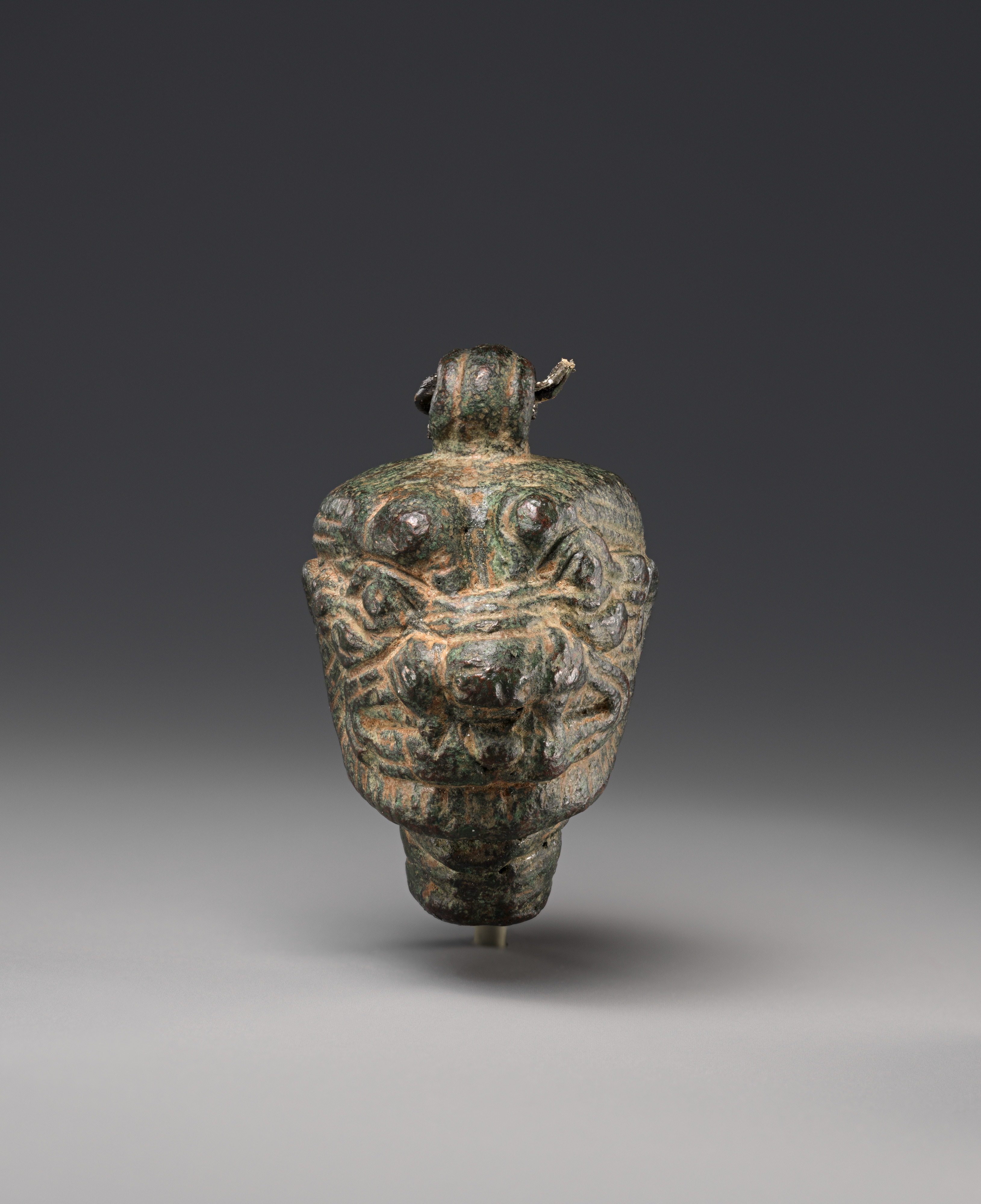
Photograph
The Metropolitan Museum of Art, New York; Purchase, Norbert Schimmel and Robert Haber Gifts, and funds from various donors, 1993. Photographer not named in the record. · CC0
Bronze pendant shaped as Pazuzu’s head, Neo-Assyrian, approximately eighth–seventh centuries BCE, The Met 1993.181. The frontal view shows the face and top suspension fitting; the support below is a modern display mount. The image does not document a reverse inscription or an ancient wearer
License · Image sourceObject details
- Title
- Pazuzu Head Pendant Met 1993.181: A Carried Image and the Limits of Protection
- Timeline
- From 800 BCE to 601 BCE
- Region
- Mesopotamia (Met geographical classification; excavation site undocumented)
- Rights
- CC0
Text
Introduction
How could a small, frightening head become an object of protection carried close to the body? The Metropolitan Museum of Art's bronze Pazuzu-head pendant offers a particular test case: a cast head and suspension attachment, but no complete ritualRitualAn organised or distinguished practice meaningful to a community; it may leave traces, but its form alone does not reveal an associated doctrine.Glossary · Click to read the explanation scene or text identifying an ancient owner. Its material form helps explain portable protection without telling us who wore this individual object, on what occasion, or what outcome the wearer believed it achieved.
A small Neo-Assyrian object
The Metropolitan Museum of Art in New YorkNew York CityNew York City is in the United States and houses the Metropolitan Museum of ArtGlossary · Click to read the explanation inventories the object as 1993.181. It identifies it as a bronze Assyrian pendant of the Neo-Assyrian period, dated approximately to the eighth–seventh centuries BCE. Its dimensions, in the museum's stated order, are 4.3 × 2.65 × 2.65 cm. The geographical label “MesopotamiaMesopotamiaHistorical region associated with the Tigris and Euphrates: Uruk, Ur, Eridu, cuneiform, Sumer, Akkad, Babylon and Assyria, their languages and cults, and the limits of archaeological evidence.Glossary · Click to read the explanation” is a broad classification, not a recorded excavation findspot for this particular pendant. [1]
The head and narrow neck are cast in three-dimensional bronze. This is not an inscribed sheet amulet or a figure with a complete body. In the frontal photograph, protruding eyes, swellings above the brow, an open snarling mouth and a short beard are discernible, as the museum describes them. Together they are the visual features by which the museum identifies Pazuzu; they are not the character's name literally written on the head. [2]
The attachment and the outward gaze
The suspension element rises above the head, whereas the modeled face points forward. The Met argues that a cord or chain passed through the loop would orient the demon's face away from the wearer. In this reading, the threatening face confronts dangers encountered in daily life instead of remaining an image seen only by its owner. This is a functional interpretation of the design, grounded in the attachment's position and the face's orientation—not a recorded experiment involving the ancient wearer of this object. [3]
The scale and suspension fitting make bodily portability plausible, yet they do not disclose the owner's identity, sex or actual manner of wearing it. A necklace is a strong possibility, but not a proven biography of the pendant. The small support visible beneath the neck in the modern photograph is a display mount, not evidence of an original body or of how the ancient object was carried. [2]
Why might a dangerous being protect?
The museum presents Pazuzu as king of harmful wind demons and associates him with cold winds from the Zagros region and with fears of illness. That is a museum account of Mesopotamian beliefs, not an explanation inscribed on this pendant. Sarah Graff's discussion of Assyrian supernatural beings cautions against automatically sorting them into modern, absolute categories of good and evil. A feared power could be turned against a different danger. [4]
Lamaštu figures prominently in traditions concerned with threats to pregnant women and infants. In some protective practices, Pazuzu's image served to repel her. The menacing expression was thus not necessarily incongruous for people who thought a dangerous force might be enlisted for defense. Still, this recurring association does not establish that this particular pendant belonged to a pregnant woman, was worn by a child, or served one exclusive purpose. [5]
Miriam Said explains that first-millennium BCE Mesopotamian practices did not map neatly onto modern divisions among medicine, religion and magic: objects, words, materials and rites could work together or in different combinations. She specifically includes 1993.181 among small protective items intended to be carried on a person, in contrast with monumental guardians or figurinesFigurineA small shaped object depicting a human, animal or abbreviated form, in clay, stone or another medium. Its form alone does not establish its use; manufacture, handling traces and find context matter.Glossary · Click to read the explanation placed near domestic thresholds. This describes beliefs about their efficacy, not a measurable demonstration of medical or supernatural success. [6]
A head without a body, and no recorded incantation
Other objects depict Pazuzu with wings, a scorpion's tail and other hybrid bodily features, or within complex scenes involving further figures. This pendant preserves a head, constricted neck and attachment. We cannot supply the rest of the body from another artefact or assume every version had an identical use. Its frontal photograph shows no inscription, and the Met's object entry does not record a readable text on this pendant. [7]
A useful counterexample is another object, accession reg.H.894, in the Bibliothèque nationale de France. It, too, is a bronze Pazuzu-head amulet with a means of suspension, but the French institutional catalogue describes a cuneiformCuneiformWriting with wedge-shaped signs, developed from Mesopotamian recording traditions and used for several languages from the third millennium BCE.Glossary · Click to read the explanation inscription on its reverse, associated with a documented incantation tradition. Its date, documentation and stated findspot differ from those of the Met pendant. Its letters, ritual wording and archaeological history must not be transferred to 1993.181. The contrast shows what an inscription may contribute when present—and what remains unavailable when it is not documented. [8]
Thomas Bender's study of Pazuzu and Lamaštu amulets discusses the French object as a comparative case and distinguishes easily suspended heads from other plaques that may have been carried or displayed differently. It also highlights how rarely ancient contexts of use are secure. Some suggestions concerning continuous wearing and birth-related use remain deductions from form and parallel evidence; they are not direct observations about this New York pendant. [9]
Not the same as a Lamaštu plaque
The Met also holds a separate obsidian amulet, 1984.348, showing Lamaštu within a more elaborate composition accompanied by cuneiform writing. It demonstrates that image and text could be combined in a protective object. But the bronze head 1993.181 is not a documented miniature copy of that plaque and cannot inherit its words or the particulars of its presumed ritual. Their different materials, images and textual evidence are precisely why the comparison needs limits. [10]
The documented chain of sale
The museum's modern provenance begins with a sale at Hôtel Drouot in Paris on 19–20 May 1987, lot 26, followed by the Met's acquisition at Sotheby's in New York on 12 June 1993, lot 230. Its references identify the two auction catalogues and the museum's annual report. Listing those publications does not establish an earlier excavation record. [11]
No specific excavation, stratigraphic layer or ancient owner is named. We therefore cannot place this very pendant in a particular house, tomb or sanctuary, or infer a documented daily routine or burial practice from its recent sales history. Nor does the museum's sales account alone amount to an independent legal assessment of all earlier transfers of ownership. [11]
What the evidence can sustain
We have an identified bronze casting, roughly dated to the Neo-Assyrian period, shaped as the recognizable head of Pazuzu with a suspension fitting. Comparative objects and museum interpretations make its placement among portable protective images persuasive. We lack the ancient owner's name, a documented findspot and an object-specific ritual text. Neither a frontal photograph nor a synthetic account of the tradition can replace that evidence. [1] [3] [9]
The pendant's significance lies in the relationship between a carried image and protection sought: within a particular Mesopotamian understanding, a fearsome image could be borne against feared dangers. Whether it worked, what words or gestures accompanied its use, and who wore this particular piece remain beyond what the artefact can establish. That boundary is an essential part of its history, not an invitation to borrow a story from a different amulet.
References and notes
- The Metropolitan Museum of Art, “Pendant with the head of Pazuzu”, 1993.181, object information, dating, bronze, dimensions and geographic classification. Object Information, identification and dimensions Return to the text ↑
- The Met, description and front-view photograph DP-16190-018.jpg; the photograph does not independently establish the reverse or any conservation history. Description and image, front view only Return to the text ↑
- The Met, interpretive paragraph on suspension-loop orientation and outward gaze; a proposed use rather than an attested wearer’s action. Description, suspension-loop paragraph Return to the text ↑
- Sarah Graff, “Pazuzu: Beyond Good and Evil,” The Met, 29 September 2014; discussion of ambivalent supernatural powers and protective practice. Essay: final paragraphs on protective powers Return to the text ↑
- Graff, same essay, Lamaštu and infant/pregnancy risks in the comparative tradition; not an object-specific owner identification. Paragraphs on Lamaštu and small body ornaments Return to the text ↑
- Miriam Said, “Mesopotamian Magic in the First Millennium B.C.,” The Met, December 2018, especially the portable-protection section naming 1993.181. Closing section, portable amulets; Met 1993.181 Return to the text ↑
- The Met, comparison between abbreviated heads and full-body images; no inscription presented for 1993.181 in this object record. Description and available object record Return to the text ↑
- Bibliothèque nationale de France, catalogue of amulet reg.H.894, a separate item with a cuneiform inscription on the reverse. Catalogue reg.H.894: date, findspot, reverse inscription Return to the text ↑
- Thomas Bender, “The Usage of Pazuzu and Lamashtu Amulets in Mesopotamian Birthing Practices” (2022), introduction, “The Lesser Evil: Pazuzu,” figure 3 and conclusion. PDF, introduction and “The Lesser Evil: Pazuzu,” fig. 3; conclusion Return to the text ↑
- The Met, distinct Lamaštu amulet 1984.348, with imagery and cuneiform; not the Pazuzu pendant. Museum description of 1984.348 Return to the text ↑
- The Met, Provenance and References tabs, Drouot 19–20 May 1987, lot 26, and Sotheby’s New York 12 June 1993, lot 230. Provenance and References tabs; archived supplied captures Return to the text ↑
Archive records may be reviewed and refined as better evidence or sources become available. Suggest a correction
Suggest a correction · Suggest a source for this record
Cite this record
IL Archive, «Pazuzu Head Pendant Met 1993.181: A Carried Image and the Limits of Protection», https://ilarchive.com/en/artifacts/pazuzu-head-pendant-met1993-181