Artifact · Inscription
The Taymāʾ Stele: Priesthood, Endowment, and Local Cult
An object record bringing together its image, metadata, rights, and context.
- Names
- Tayma Stone · Taymāʾ Stele · Teima Stele
- Timeline
- From 500 BCE to 350 BCE
- Region
- Tayma oasis, northwestern Arabia (present-day Saudi Arabia)
An Aramaic stone stele from Taymāʾ in the Louvre records an endowment linked to the priest Ṣalmšēzeb, his descendants and the sanctuary of ṢLM of HGM, with protection and a curse; the date of its inscription is debated.
Estimated reading time: 8 min Published Last reviewed:
Share article
Photograph
Photograph by Shonagon, via Wikimedia Commons. · CC0
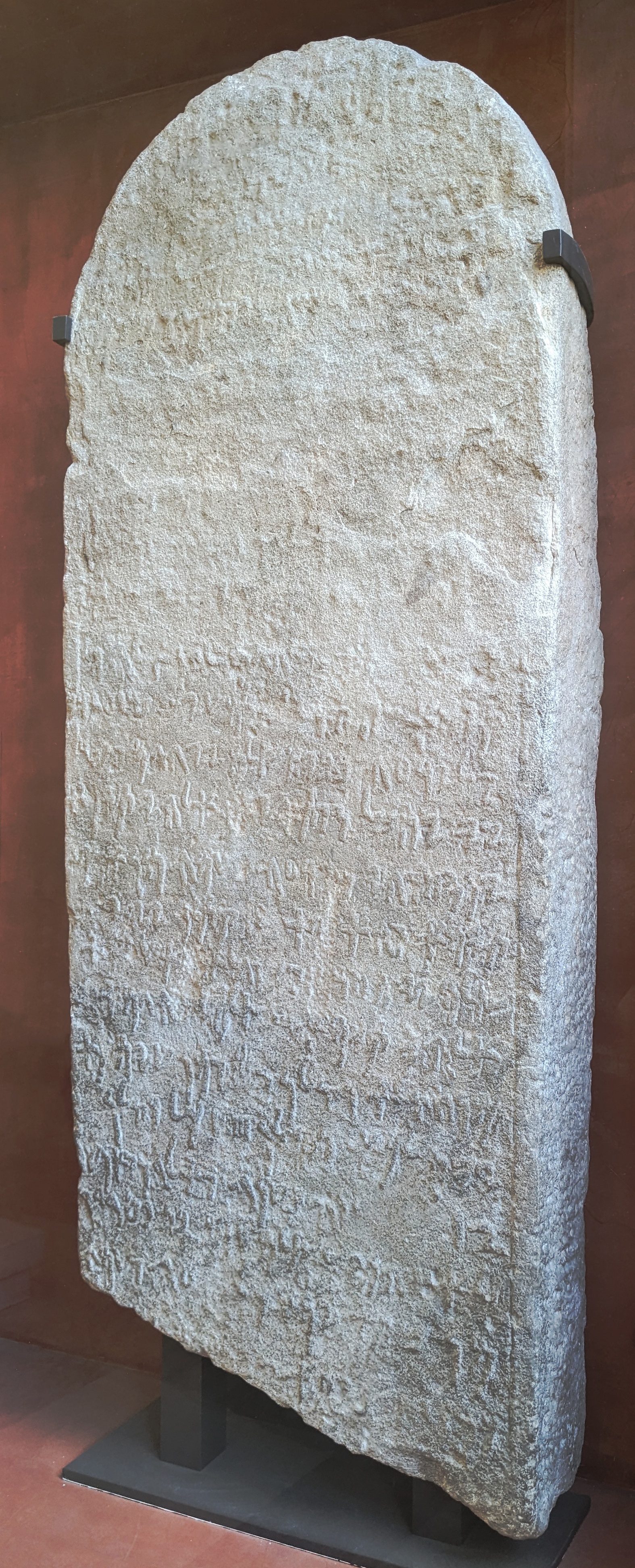
Front of the original Taymāʾ Stele, Louvre AO 1505; lower Aramaic lines are clearer than the worn upper portion. This view does not show the full side relief or permit independent sign collation
License · Image sourceObject details
- Title
- The Taymāʾ Stele: Priesthood, Endowment, and Local Cult
- Timeline
- From 500 BCE to 350 BCE
- Region
- Tayma oasis, northwestern Arabia (present-day Saudi Arabia)
- Rights
- CC0
Text
Introduction
This is not a general declaration about the “religion of Arabia.” The Taymāʾ Stele documents a much more specific local arrangement: how priestly service to a sanctuary, its resources, and the succession of a priest’s descendants could be asserted in writing. Its Aramaic inscription names gods of the oasis, a priest called ṢLMŠZB, a grant linked to land and date palms, and a curse against whoever damages the monument. Its historical value emerges when preserved wording, editorial restoration, and differences between editions are kept distinct. [1][5]
One sandstone object, not all the inscriptions of Taymāʾ
The object known as the Taymāʾ Stele belongs to the Louvre under inventory number AO 1505; the epigraphic catalogues identify it as CIS II 113 and KAI 228. It is an incomplete, round-topped sandstone monument with an Imperial Aramaic inscription on its front and relief work on a side. The Louvre gives its dimensions as 111 cm high, 43 cm wide, and 12 cm thick, while the DEAPS record gives the width as about 42 cm; the small difference does not imply two objects. Our photograph principally documents the inscribed front, rather than the whole side decoration. [1][3]
The damaged surface makes clear why a critical edition matters. Traces near the top are faint and lost sequences interrupt the writing; lower lines are easier to make out. The photograph shows the object's form and condition but is not sufficient for an independent letter-by-letter collation. The Louvre's description calls it an inscription of 23 lines, yet the displayed modern translation extends its numbering to 24, including a repeated number in the interface; DEAPS separately numbers its face A text and a brief text on face B. Line references therefore need an explicit edition. [1][3][12]
Dating the inscription, the reuse, and the discovery
The stone was found at Taymāʾ, an oasis in northwestern Arabia, now in Saudi Arabia, reused in a house according to the Louvre catalogue. Its original place of installation is consequently not established. The Louvre dates the discovery to 1884, identifies Julius Euting in connection with 17 February 1884, and records acquisition in 1885. The current DEAPS metadata instead says 1880, as does Peter Stein's 2013 overview. These are different documentary claims: the more detailed institutional provenance favors 1884 but the disagreement should remain visible. [2][3][4]
The inscription itself is commonly assigned to Persian-period Taymāʾ, with debate over a narrower fifth- or early fourth-century BCE date. A damaged opening is read as including “year 22,” although adjacent parts of the date and the king's name are incomplete; proposed restorations mention the month Tišrī and a Persian ruler. In 2013 Stein judged Artaxerxes II, perhaps around 380 BCE, plausible on palaeographic and formulaic grounds. That remains a conditional scholarly attribution, not a royal name visibly preserved on the stone. The written numeral may also be followed by damaged additional signs. This Aramaic stele is not the separate cuneiformCuneiformWriting with wedge-shaped signs, developed from Mesopotamian recording traditions and used for several languages from the third millennium BCE.Glossary · Click to read the explanation monument of Nabonidus from the oasis. [3][4]
Who grants what—and who benefits?
The surviving inscription is neither a complete private petition nor a first-person royal proclamation. Its edited translations attribute the grant to the gods of Taymāʾ and describe benefits for the priest Ṣalmšēzeb (ṢLMŠZB), son of Petosiris, and his descendants in the house or sanctuary of Ṣalm of HGM. A clause appears to concern erection of the stele by or for the priest, but part of the verb is restored in the scholarly text. The monument presents the priestly entitlement as publicly protected; its formula does not independently prove uninterrupted enforcement in later generations. [5][6]
Date palms, agricultural resources, and an allotment described in connection with the king appear in the grant. They point to material support for priestly service and sanctuary continuity, not a survey of the entire oasis economy or a general law for Arabia's priests. Stein noted that the documentary form, especially divine sanction and agricultural endowment, resembles Mesopotamian land-grant monuments often called kudurrus. Formal influence does not make this Aramaic object a Babylonian cuneiform tablet or a verbatim copy of a Mesopotamian legal text. [4][9][10]
The priest, divine names, and disputed identities
In the DEAPS presentation, ṢLMŠZB is preserved as a consonantal personal name with a patronymic naming Petosiris; a short inscription on the other face repeats the priest's name and title. The father's name has an Egyptian linguistic background, but names alone cannot establish the individual's nationality, birthplace, or the migration of his family. Similarly, the element ṢLM inside the priest's personal name must not automatically be treated as a separate deity wherever its letters recur. [5][6]
The Louvre's Stein 2025 rendering names divine figures including ṢLM of MḤRM, ŠNGLʾ, and ʾAšīmāʾ. The default Donner–Röllig version displayed by DEAPS instead presents a name resembling Ašērā in an overlapping passage. These are consequential editorial differences, not proof that Ašīmā and Asherah were demonstrably the same goddess. ṢLM of HGM is the local divine name or form associated with the sanctuary. Proposals about the wider origin or identity of ṢLM and the other divine figures require independent arguments; visual resemblance or a similar-sounding name cannot establish a specific lunar or Babylonian deity. [7][8]
Date palms and the limits of arithmetic
The grant contains a particularly instructive textual problem. Stein's 2025 translation on the Louvre page reads approximately 18(?) date palms associated with one category of land and 6 with land of the king, while its stated total is 21, explicitly flagged as anomalous. The Donner–Röllig translation on DEAPS instead gives 16 from a field and 5 from what it calls the king's treasury, yielding 21. The divergence concerns readings of numerals and a resource category, not simply different English words for the same settled quantities. [9][10]
We should not silently add 18 and 6 and “correct” the monument to 24, or blend “royal land” from one edition with “royal treasury” from the other. The recurring phrase translated as “year by year” signals an intended continuing benefit, but the precise administrative form of the endowment is not fully settled by an isolated number. What survives across the competing presentations is evidence of an asserted recurring allocation connected with date palms and priestly service; the specific tally must remain tied to a named edition. [9][10]
Curse and security for the priestly household
The document calls down the gods' action upon whoever destroys the stele, threatening his descendants and name, and contains a prohibition against removing the priest and his line from the sanctuary. Its legal-religious strategy combines a recorded endowment, hereditary entitlement, and divine deterrence against interference. A threat to erase a violator's name is a curse formula, not a report of an actual punishment visited on an identified person. Likewise, the text's aspiration to permanence does not attest continuous compliance through every later century. [5][6]
A short example: letters, restoration, and interpretation
In face A, line 9 of the DEAPS/Donner–Röllig presentation, the editorially transliterated sequence may be represented approximately as zy [hqy]m ṣlmšzb br pṭsry. The square brackets mark the restored portion of a verb meaning “erected”; the personal name and the words “son of Petosiris” are unbracketed in the displayed edition. A working translation identifies Ṣalmšēzeb, son of Petosiris, as the one erecting or responsible for the monument, but missing adjacent text limits the reconstruction of the whole sentence. This transliteration follows the published editor's segmentation, not an independent reading of the photograph. [6]
The protective clause offers another example. DEAPS, face A, lines 13–14, presents the consonantal sequence zy yḥbl swtʾ zʾ, forming a condition about whoever damages the stele, followed by an imprecation against that person's offspring and name. The edited letters, their translation as a violator of the monument, and a historian's inference that the curse protects a sanctuary resource are three different analytical steps. The line numbering of the Louvre's Stein presentation is not interchangeable with the DEAPS numbering without notice. [5][6]
The inscribed face and the side relief
The supplied original photograph shows the curved top, worn upper surface, clearer lower characters, and the museum supports. It does not show the complete side carving. The Louvre catalogue describes a standing figure with pointed headdress, draped dress, and staff on the right edge. Stein's 2013 study compares the relief's visual language with Mesopotamian traditions. These are descriptions and arguments from external sources, not details independently visible in this frontal photograph, nor proof that the depicted person must be a particular god or named priest. [1][4][11]
What this witness establishes
This is firm evidence of an Aramaic written local priestly endowment, invoking named divine authorities, a priest and his father, inheritance, and sanctions against damaging the stele. Uncertainties remain over the exact regnal date, some divine names, how many palms were assigned, and the original location in which the stone stood. The document alone cannot establish the religion of all North Arabian communities or a necessary trajectory toward later faiths. [3][5][8][9]
For further reading within IL Archive, see epigraphyEpigraphyThe study of writing preserved on physical objects and monuments: its documentation, reading, dating, translation, material context and historical interpretation.Glossary · Click to read the explanation for the method and AramaicAramaicNorthwest Semitic language varieties documented since the early first millennium BCE, including Old and Imperial Aramaic, Syriac, Jewish dialects, and living Neo-Aramaic forms.Glossary · Click to read the explanation for the written language. The OCIANAOCIANA: Ancient North Arabian InscriptionsOCIANA is an evolving academic database of ancient North Arabian inscriptions, with edited transliterations, translations, commentary, references, photographs and provenance; not a substitute for the stones.Glossary · Click to read the explanation project and Safaitic inscriptions belong to a different linguistic and documentary field and were not used as editions of this monument. [3]
References and notes
- Louvre Museum, “Stèle de Teima,” object AO 1505; physical description, inscription, side relief, dimensions, and concordance numbers. “Description,” “Inscriptions,” and “Physical characteristics” sections, actually read; the books listed as bibliography were not thereby read. Return to the text ↑
- Louvre, AO 1505 provenance entry; secondary reuse, named individuals and acquisition history. “Places and dates,” “History,” and “Location of object”; 1884 discovery, Euting on 17 February 1884, acquisition in 1885; page read. Return to the text ↑
- James D. Moore, “Louvre AO 1505,” DEAPS, Ohio State University; metadata and default Donner–Röllig editorial display. “Metadata” and “Text and Translation,” side A and opening of side B, read on the public page; printed KAI and Gibson volumes not consulted. Return to the text ↑
- Peter Stein, “Aramaic in Tayma: On the Linguistic Situation of the Oasis in the 2nd Half of the 1st Millennium B.C.,” Stuttgarter Theologische Themen VIII (2013). Extracted text of printed pp. 31–35, especially 33–34, read; PDF page-image capture failed; no claim to reading the entire volume. Return to the text ↑
- Peter Stein, 2025 reading and French translation of the stele embedded in the Louvre catalogue, on priest, descendants and curse. Louvre “Inscriptions,” face A as numbered 9–16 and 21–24; edited translation, not an independent photographic collation. Return to the text ↑
- Donner and Röllig as displayed in DEAPS; Aramaic transcription with restorations and German translation, including priest and protection clauses. Face A, lines 9–15 and 21–23 in DEAPS numbering; short examples rely on this edition, not an independent autopsy. Return to the text ↑
- Stein 2025 as presented by the Louvre, on local divine names including ṢLM and ʾAšīmāʾ; not definitive divine identifications. “Inscriptions,” face A, displayed lines 1–4 and 17–18; restorations and question marks retained. Return to the text ↑
- Donner and Röllig in DEAPS on divine names, including an Ašērā reading in contrast to Stein’s Ašīmā. “Text and Translation,” face A, lines 2–4 and 16–17; displayed edition read, printed KAI not read. Return to the text ↑
- Stein 2025 as published by the Louvre, palm endowment and problematic total. “Inscriptions,” displayed face A lines 19–21: 18(?), 6, total 21 (“sic”). Return to the text ↑
- Donner and Röllig’s default DEAPS translation, with numerals and the king’s treasury distinct from Stein’s Louvre rendering. “Text and Translation,” face A lines 18–20 in DEAPS numbering: 16, 5, total 21; default edition only. Return to the text ↑
- Louvre institutional description of the side relief, not a visual claim about the provided frontal photo. “Description/Features,” “Décor : sur tranche (droit)”; standing figure with pointed headdress, garment and staff. Return to the text ↑
- Wikimedia Commons specific photograph page, Shonagon, uploader-author CC0 1.0 dedication for this file. “Photograph,” “Licensing,” and “File history,” plus a check of the displayed image and an actual 340px/zoom review. Return to the text ↑
Archive records may be reviewed and refined as better evidence or sources become available. Suggest a correction
Suggest a correction · Suggest a source for this record
Cite this record
IL Archive, «The Taymāʾ Stele: Priesthood, Endowment, and Local Cult», https://ilarchive.com/en/artifacts/tayma-stele-ao1505