Artifact
The Tell Asmar Worshiper 40.156: Image-Presence and the Limits of Substitution
An object record bringing together its image, metadata, rights, and context.
- Names
- Standing male worshiper (Met 40.156) · Tell Asmar worshiper (40.156)
- Timeline
- From 2900 BCE to 2600 BCE
- Region
- Mesopotamia, Eshnunna/Tell Asmar (present-day Iraq)
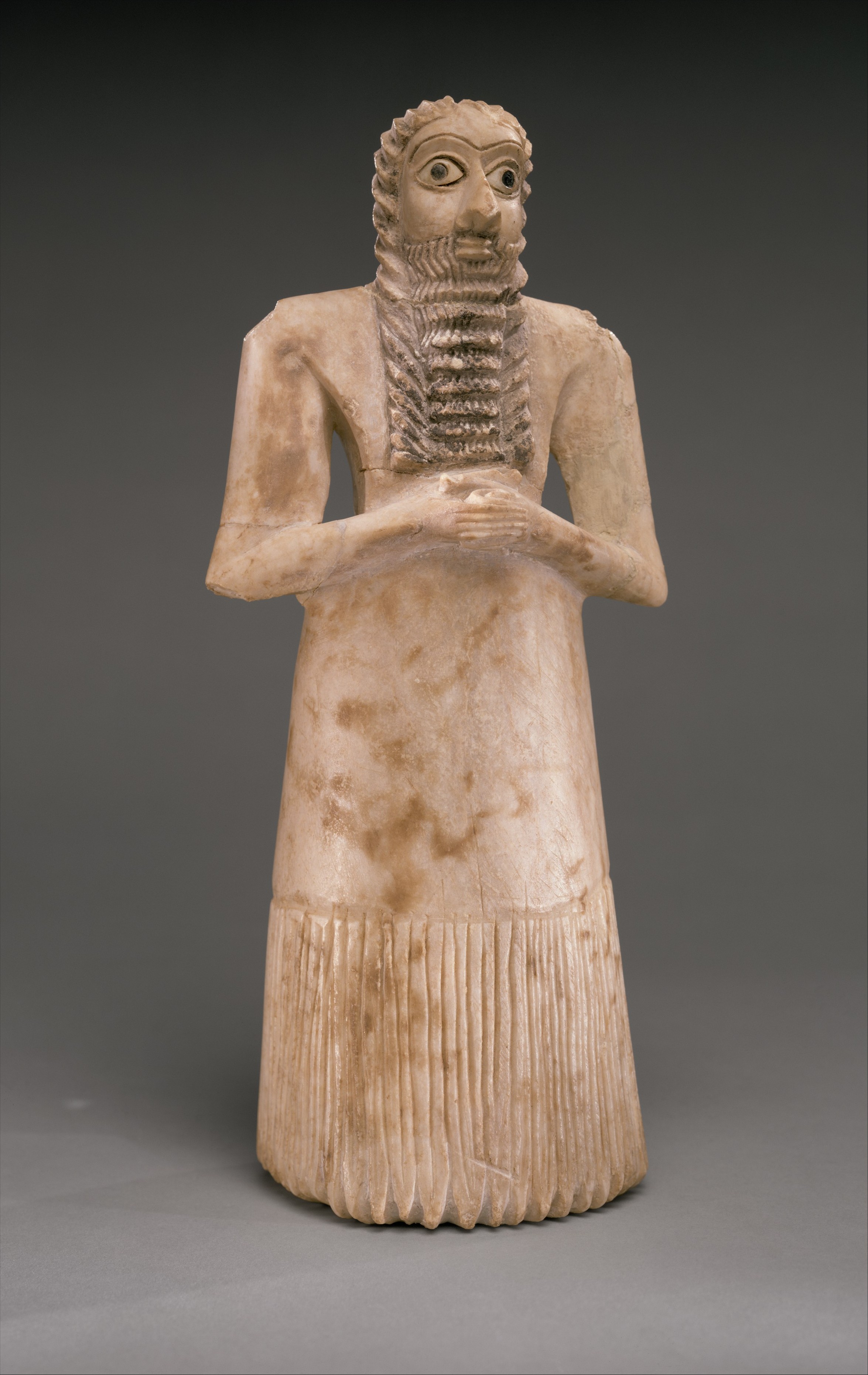
A standing worshiper statue from Tell Asmar, dated ca. 2900–2600 BCE, with clasped hands and inlaid eyes; the entry separates its form from the interpretation of devotional presence without settling which god was meant.
Estimated reading time: 6 min Published Last reviewed:
Share article
Photograph
Image source: The Metropolitan Museum of Art; MET_DT850 via Wikimedia Commons; this photograph CC0 1.0. No individual photographer identified.
Standing male worshiper from Tell Asmar/Eshnunna, ca. 2900–2600 BCE. The beard, clasped hands, inlaid eyes, and lower garment are visible. Frankfort records the legs and base as missing; this photograph shows the surviving object, not a reconstruction of its original temple setting. The Metropolitan Museum of Art, 40.156
License · Image sourceObject details
- Title
- The Tell Asmar Worshiper 40.156: Image-Presence and the Limits of Substitution
- Timeline
- From 2900 BCE to 2600 BCE
- Region
- Mesopotamia, Eshnunna/Tell Asmar (present-day Iraq)
- Rights
- CC0
Text
Introduction
At the Metropolitan Museum of Art stands a small stone figure from Tell Asmar. The name of the man represented is unknown, but the sculpture shows a deliberate arrangement: wide-open eyes and hands clasped before the chest. The object is accessioned as 40.156. It raises a question not about whether stone literally prays, but about how a human image could make a devotee present in a temple even when that person was physically absent.
One object, identifiable materials
The Met dates the Standing male worshiper to approximately 2900–2600 BCE, within Early Dynastic I–II in Mesopotamia, and locates it at Eshnunna, modern Tell Asmar in IraqIraqIraq is a modern country encompassing much of ancient MesopotamiaGlossary · Click to read the explanation. The figure measures 29.5 cm high, 12.9 cm wide, and 10 cm deep. Its recorded materials are gypsum alabaster, shell, black limestone, and bitumen. These are particulars of this one accessioned object, not specifications for every worshiper statue in the region. [1]
The male figure wears an articulated beard and a garment with a visible fringe; his hands meet in front of his torso. His eyes stand out through their white surfaces and dark pupils. A recent museum interpretation identifies shell for the whites and black limestone for the pupils. These are describable features of the published object image. The identity of the person represented, or what he might have said or wished for, cannot be read directly from the lines of the beard or the direction of his gaze. [2]
From gesture to interpretation
The Met identifies the figure as a worshiper and explains the clasped hands and wide-eyed stare as part of an image intended to pray perpetually for the person represented. Writing in 2026, Adam Eaker connects the prominent eyes with attention toward the divine and considers the role of looking in devotional practices across different cultures. The hand position and large eyes are matters of description; calling them perpetual prayer and interpreting the gaze as devotion are historical and curatorial readings that should be attributed to their authors. [1] [2]
In the accessible published object record, no inscribed text naming this particular person's owner or recording a specific prayer is presented. The museum notes that similar statues were sometimes inscribed with the names of rulers and members of their families. That observation cannot be converted into a hypothetical inscription on object 40.156. We consequently do not know whether the individual portrayed held a particular social rank, nor do we possess a name with which to give him an invented voice. [1]
Temple context: use and subsequent burial
The museum associates the figure with the Square Temple at Tell Asmar, which was perhaps dedicated to the god Abu; the qualification is part of the object record. Eaker states that the figure belonged to a group of twelve statues found buried beneath a temple floor, while neither the identity of those who buried them nor their motive is known. Their joint discovery establishes a deposit context, not a photographic record of how the statues were displayed before burial. [1] [2]
An essay by the Met's Department of Ancient Near Eastern Art observes that many votive sculptures were recovered from deposits, beneath floors or in structures altered through successive building phases, and that their original positions of display remain uncertain. It is therefore useful to distinguish three possible moments: the sculpture's making, its life within the temple, and its deposition or movement in the history of rebuilding. The findspot alone cannot show that this figure originally stood in the pit from which it was recovered. [3]
In what sense can an image stand in for someone?
In the museum's interpretation, the statue allowed a devotee who could not remain bodily in the sanctuary to remain represented before a deity. The image was a means of presence and attention, not a chronological record of how many prayers an unknown person performed. This is an account of a plausible religious role, based on object type, context, and comparison with other sculptures. It is not a test through which we can establish that stone literally spoke, saw, or enacted a physical deed on behalf of its owner. [1] [3]
A crucial distinction separates an image of a deity receiving worship from an image of a human worshiper. The Met's object account describes ancient views of divine presence in cult images after appropriate ritualsRitualAn organised or distinguished practice meaningful to a community; it may leave traces, but its form alone does not reveal an associated doctrine.Glossary · Click to read the explanation, yet it identifies 40.156 as a human worshiper, not a statue of a god. The possibility of human representation should not be used to argue that every image was worshiped or that divine and human images shared identical ritual functions or standing. [1]
A limited comparison is instructive: the Shabti of Sherinefer belongs to a funerary setting in which the image is associated with work in the afterlife, whereas the Tell Asmar statue raises the question of a worshiper's presence in a temple. Both show how an object may be assigned a function beyond resemblance, but the tasks, settings, and periods differ. “Working in place of the deceased” is not evidence for “devotional attention in place of a living person” without an independent argument.
Chronology, documentation, and the limits of knowledge
The range 2900–2600 BCE is the museum's approximate date of manufacture, not the year when the object was excavated. “Fletcher Fund, 1940” is the Met's acquisition credit, not a date for making, burying, or excavating the figure. The modern study of the group belongs to twentieth-century excavations and their reports, another timescale distinct from that of ancient devotional practice. [1] [2]
Even familiar archaeological period labels call for care. In the abstract of an academic article published in 2007 on the Square Temple, Jean M. Evans questions the use of sculptural style as a sufficient criterion for establishing Early Dynastic II and points to differing ceramic evidence. This statement is based only on the article's abstract; the full article was not read. The argument is neither a warrant to invent a new date for this object nor a reason silently to discard the museum's assigned range. [4]
The excavation reference can now be traced without conflating a field number with a museum accession. A publicly indexed excerpt from an official teaching resource of the University of Chicago's Institute for the Study of Ancient Cultures links Met 40.156 to its former ISAC Museum number A12329. Henri Frankfort's Sculpture of the Third Millennium B.C. from Tell Asmar and Khafajah (Oriental Institute Publications 44, 1939), p. 57, assigns A12329 to sculpture no. 9, field number As. 33:414, and records a height of 29 cm. The catalogue on p. 56 points to plates 18–20 and 24A, while his text on p. 24 states that the legs and base are missing. The bottom of the garment in the museum photograph must not therefore be described as a surviving original base. We read a digitally extracted text transcription of pp. 24 and 56–57 in a publicly accessible Scribd copy, not scans of the university PDF pages or the original plates. The official teaching resource was consulted as an indexed excerpt, not as a fully opened PDF. The Met now measures the piece at 29.5 cm, half a centimetre more than Frankfort's figure: the discrepancy is retained. The excavation number supplies no name for the owner, and Frankfort's conjecture about the two larger cult images is not transferred to this smaller human worshiper. [5] [6]
The statue is persuasive material evidence for making human presence visible in an early religious context. It cannot, however, disclose the owner's name, securely identify the intended deity, reconstruct the first display arrangement, or give access to the worshiper's inward experience. Its interpretive value lies partly in keeping description, informed comparison, and missing evidence distinct.
References and notes
- The Metropolitan Museum of Art, “Standing male worshiper,” accession 40.156, official object entry and description; inaccessible provenance tabs were not consulted. Collection entry 323735, accessible heading, date, media, dimensions, description, and credit line read in full. Return to the text ↑
- Adam Eaker, “On the Standing Male Worshipper,” The Metropolitan Museum of Art, October 6, 2026; recent interpretive essay on this object and its group. Entire published essay read, particularly object description, interpretation of looking, and the deposit of twelve statues; no lengthy passage reproduced. Return to the text ↑
- Department of Ancient Near Eastern Art, The Metropolitan Museum of Art, “Early Dynastic Sculpture, 2900–2350 B.C.,” October 2004; survey of votive images, deposits, and uncertainty over original display. Complete institutional essay, dated October 1, 2004, including discussion of deposits and unknown original display positions. Return to the text ↑
- Jean M. Evans, “The Square Temple at Tell Asmar and the Construction of Early Dynastic Mesopotamia, ca. 2900–2350 B.C.E.,” American Journal of Archaeology 111, no. 4 (2007): 599–632, DOI: 10.3764/aja.111.4.599. Publisher’s abstract only; the article’s pages 599–632 and figures were not read. Return to the text ↑
- Henri Frankfort, Sculpture of the Third Millennium B.C. from Tell Asmar and Khafajah, Oriental Institute Publications 44 (Chicago, 1939). Public digitized text transcription at https://www.scribd.com/document/429487820/tell-asmar . Digitally extracted text consulted: p. 24 (sculpture 9; missing legs/base) and pp. 56–57 (catalogue: no. 9, plates 18–20 and 24A, 29 cm, A12329, As. 33:414). Facsimile pages of the official university PDF and plates not viewed; OCR and tabular alignment can contain errors. Return to the text ↑
- Institute for the Study of Ancient Cultures, University of Chicago, “Tell Asmar Statue Hoard,” official teacher resource; its indexed excerpt explicitly identifies Met 40.156 as formerly ISAC Museum A12329. Search-indexed excerpt of the official teaching PDF concerning the distribution of the twelve figures, including 40.156 (formerly A12329); full PDF pages and images of excavation diaries were not opened. Return to the text ↑
Archive records may be reviewed and refined as better evidence or sources become available. Suggest a correction
Suggest a correction · Suggest a source for this record
Cite this record
IL Archive, «The Tell Asmar Worshiper 40.156: Image-Presence and the Limits of Substitution», https://ilarchive.com/en/artifacts/tell-asmar-worshiper-met40-156