Artifact
Shabti of Sherinefer: Answering the Call to Work in the Afterlife
An object record bringing together its image, metadata, rights, and context.
- Names
- Shabti Sherinefer · Shabti of Sherinefer
- Timeline
- From 1300 BCE to 1200 BCE
- Region
- Ancient Egypt
A Dynasty 19 shabti, ca. 1300–1200 BCE, combining Sherinefer’s festive clothing, agricultural implements and a Spell 6 inscription asking the figure to work in the owner’s place after death.
Estimated reading time: 6 min Published Last reviewed:
Share article
Photograph
The Metropolitan Museum of Art, New York; Open Access image 2057159 of object 2021.41.116. · Public domain
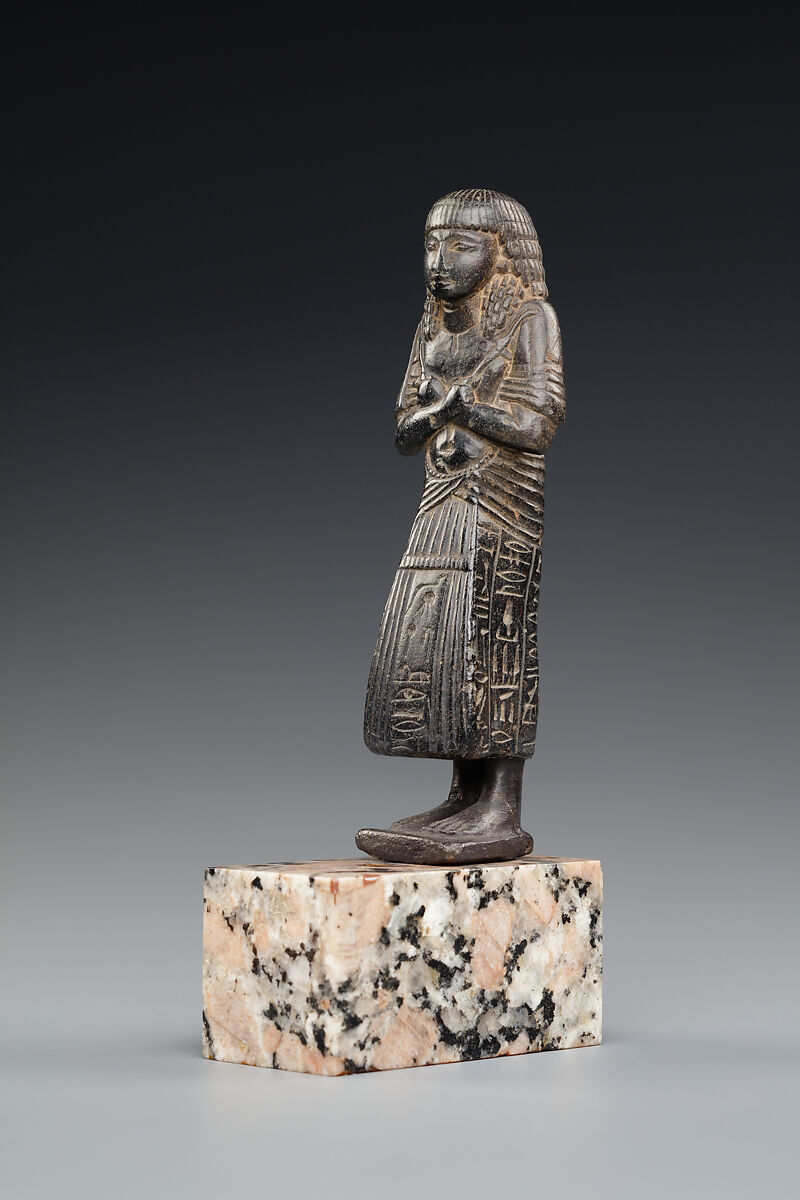
Angled front view of the Shabti of Sherinefer (The Met 2021.41.116), showing the wig, crossed wrists, pleated kilt and inscription on its front and side; the visible plinth is a modern display support
Object record · Image source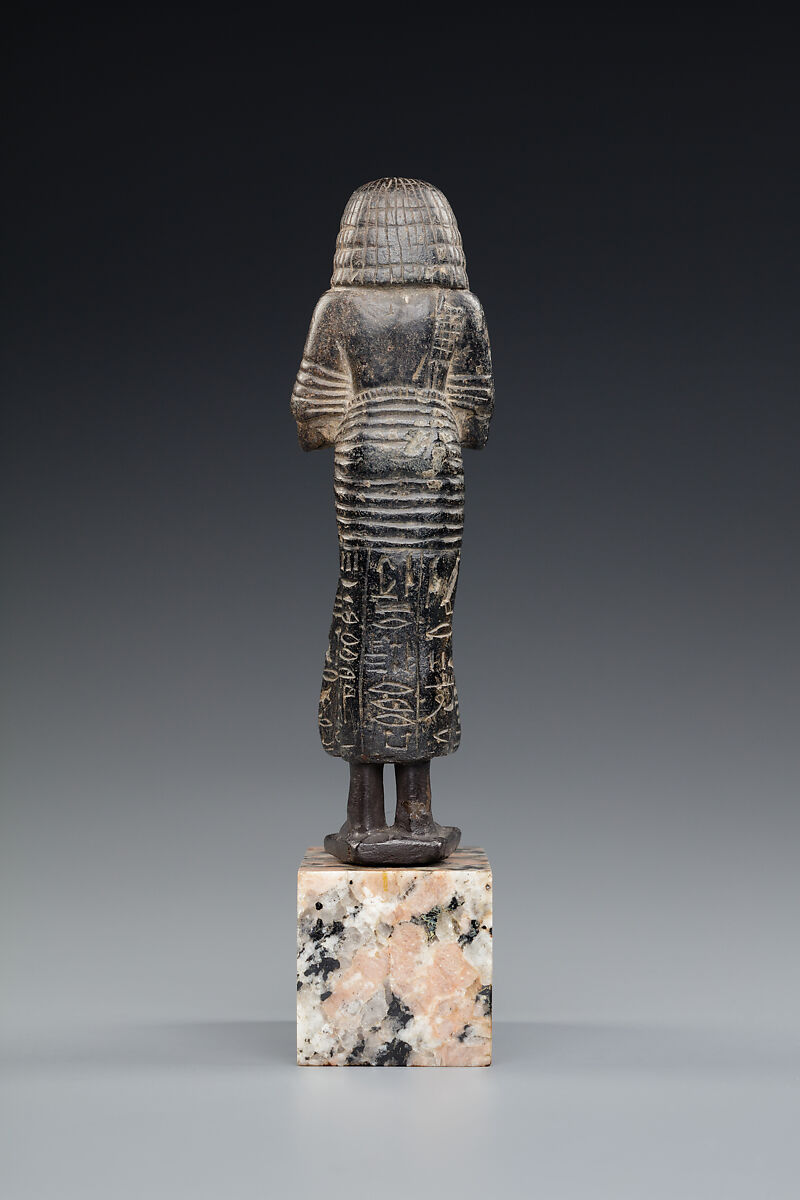
Photograph
The Metropolitan Museum of Art, New York; Open Access image 2057163 of object 2021.41.116. · Public domain
Back of the Shabti of Sherinefer (The Met 2021.41.116), showing the continuation of the carved signs on the garment and the shoulder-borne basket; the photograph does not independently establish the hieroglyphic reading. The plinth is a museum display support
Object record · Image sourceObject details
- Title
- Shabti of Sherinefer: Answering the Call to Work in the Afterlife
- Timeline
- From 1300 BCE to 1200 BCE
- Region
- Ancient Egypt
- Rights
- Public domain
Text
Introduction
A small figure dressed for ceremony yet equipped for farm work poses a deliberate question. What is a statue naming Sherinefer expected to do when its inscription commands a response to labour after death? This entry examines the Metropolitan Museum's specific object 2021.41.116, not shabtis in general. It combines the presentation of a dignified individual with implements and a text asking the figure to cultivate, irrigate, and carry sand on his behalf. Neither the implements nor the text prove that Sherinefer worked as a farmer in life, or that work was performed in an observable afterlife. They reveal the funerary purpose assigned to the object. [1][3]
One object, several different dates
The museum catalogues it as the Shabti of Sherinefer, dating it to the New Kingdom, Dynasty 19, ca. 1300–1200 BCE. It measures 11 cm high, 3.4 cm wide and 2.7 cm deep. Its medium is given as “steatite or serpentinite”: the catalogue does not decide between the two, and the colour of a photograph cannot settle the issue. Provenance is stated only as “From Egypt”, with no securely recorded tomb or excavation context. The inventory number 2021.41.116 is not an ancient date. “Bequest of Nanette B. Kelekian, 2020” describes its modern accession history rather than the period of manufacture. The museum's online record listed Gallery 122 as the display location when consulted; display arrangements can change. [1]
This object must also be distinguished from other figurinesFigurineA small shaped object depicting a human, animal or abbreviated form, in clay, stone or another medium. Its form alone does not establish its use; manufacture, handling traces and find context matter.Glossary · Click to read the explanation bearing versions of the sixth spell. The witness studied here is one carved body, with inscription distributed across its clothing and with a particular owner named by the museum, not the entire history of funerary figurines.
Festival clothing and equipment for fieldwork
In the museum's photographs and catalogue description, Sherinefer has a two-level curled and braided wig, round earrings, a fine sheer tunic with sleeves reaching the elbows, and a long pleated kilt with a stiff front panel and fringed waistband. His wrists are crossed at his chest and his hands hold agricultural implements; a grain basket sits over one shoulder. These observations rely on the photographs and curatorial description of the same object, not on a comparison figurine or independent decipherment of hieroglyphs. The series of views also shows why the inscription cannot be inspected from the front alone. [2]
This is not a depiction of someone dressed for ploughing a field. An image of the owner's desired status stands alongside the equipment for a duty that the text delegates. The attire is not proof of a recorded occupation, nor does the basket establish a particular crop. In a scholarly synthesis, Henk Milde emphasizes a double function of the shabti: representing the deceased and substituting for that person in food-producing labour. That distinction helps interpret this figure, without supplying an otherwise unknown burial biography for Sherinefer. [4]
A spell running around the figure
According to the museum, the inscription starts on the front of the kilt and continues around the sides and back. The museum identifies it as part of Spell 6 of the Egyptian Book of the DeadEgyptian Book of the DeadA modern name for a variable collection of Egyptian funerary spells and images intended for the afterlife, not a single book with a fixed sequence.Glossary · Click to read the explanation, with a funerary form of Sherinefer's name associated with OsirisOsirisOsiris was an ancient Egyptian deity associated with the dead, life after death, renewal, and kingship. His roles appear in changing funerary texts, rituals, and judgment scenes, notably the weighing of the heart.Glossary · Click to read the explanation. Its speech moves from the owner named in the invocation to an address to the shabti, should the owner be called upon to perform work in the realm of the dead. A text from another papyrus should not be transferred wholesale onto this object, nor can all its signs be claimed visible in one frontal photograph. [3]
The museum identifies three tasks: cultivating fields, irrigating canal banks, and transporting sand. Their purpose is to elicit an answer from the statue. The short expression “Here am I” follows the museum's published English translation; it is not an independent reading of Egyptian signs on the object. The conditional call, delegated duty, and prescribed answer together constitute a funerary wish and protective formula, not a report verifying that any summons or labour occurred. [3]
Why do elegant clothes accompany hoes and a basket?
This juxtaposition does not establish that Sherinefer was a farmer or overseer of labourers. The inscription addresses a small figure asked to serve in the named individual's place if a task should be imposed on him. Specialist research distinguishes its potential as an image of the deceased from its operation as a working substitute. Consequently, the statuette should not be reduced either to a modern legal category of “slave” or to a portrait entirely detached from labour. [4]
Shabti forms changed over time. UCL's survey of funerary figures notes that some New Kingdom examples wear the clothes of everyday life rather than mummy wrappings and that agricultural tools occur widely. This locates Sherinefer's appearance within a broader tradition; it does not establish that all Dynasty 19 examples looked the same or bore identical inscriptions. Terminology also requires care: Milde discusses the later reinterpretation of ushebti in association with “answering,” rather than deriving every earlier form securely from that meaning. [5][7]
A controlled comparison: Nu is not Sherinefer
UCL publishes a version of Spell 6 preserved in the Papyrus of Nu, dated to the middle of Dynasty 18, and traces earlier roots of the composition to Coffin Text 472. The Nu papyrus and the later Sherinefer figurine share the basic conditional structure: if someone is summoned to work, a substitute is to till, irrigate, move sand, and answer in that person's stead. Yet the UCL edition and translation concern Nu's papyrus, while the museum's English rendering concerns Sherinefer's figure. We should not assume verbal identity or silently import one edition's readings to reconstruct another witness that we have not collated. [6]
The comparison demonstrates how a related funerary formula could be written on different media. It does not prove that Sherinefer owned Nu's papyrus, that his artisan copied from it directly, or that every version of the spell had a fixed word order.
Modern collection history and evidentiary limits
The museum record establishes the named object, its possible stone medium, measurements, and present collection identity. It supplies neither an independent biography of Sherinefer nor the sculptor's name or a documented tomb excavation. A 2020 bequest is an acquisition event, not evidence that the object was excavated in that year. Likewise, a modern photographic display support must not automatically be treated as part of the ancient statuette, and a decorative feature cannot be given a textual meaning without evidence. [1][2]
The contribution of this witness lies in the conjunction of dignified appearance, labour implements, and a conditional instruction to respond. It complements the IL Archive introduction to the Book of the Dead by making one object's surface, inscriptions, size, and museum history the centre of inquiry. Neither the spell's supposed efficacy nor Sherinefer's actual occupation or posthumous experiences can be established from the figurine alone. [3][4][8]
References and notes
- The Metropolitan Museum of Art, “Shabti of Sherinefer,” object 2021.41.116; object record and museum metadata directly read. Overview and Artwork Details: Dynasty 19, ca. 1300–1200 BCE, alternative stone materials, measurements, provenance, 2020 bequest; unpaginated record. Return to the text ↑
- Metropolitan Museum of Art, curatorial description of the same object’s dress, tools and institutional photographs; the original oblique-front and back photographs were inspected locally. This was visual examination, not an independent reading of the inscription. Object 2021.41.116, dress-and-tools description and images 2057159 and 2057163; local 340-pixel and enlarged-view inspection, not an independent epigraphic collation. Return to the text ↑
- Metropolitan Museum, published translation of the Sherinefer shabti's abbreviated Book of the Dead Spell 6; only a very short phrase is quoted. Opening object description, inscription running around the kilt and its conditional work formula; no independent reading of Egyptian signs. Return to the text ↑
- Henk Milde, “Shabtis,” UCLA Encyclopedia of Egyptology (2012); printed pages 1–3 actually reviewed on funerary representation and substitution. Printed pp. 1–3, especially “Meaning” and changing terminology; no claim to reading books cited in its notes. Return to the text ↑
- UCL Digital Egypt, “Shabtis”; the complete short institutional overview was read for New Kingdom clothing, tools, and changing practice. The opening Shabtis paragraphs on form, tools and New Kingdom examples; unpaginated webpage. Return to the text ↑
- UCL Digital Egypt, “Book of the Dead chapter 6”; complete page read, expressly for the Papyrus of Nu, not the Sherinefer object. Introductory text and the eight displayed lines of Nu's transliteration and English translation; mid-Dynasty 18 and Coffin Text 472. Return to the text ↑
- Milde, “Shabtis” (2012), discussion of variant names and the later “answerer” interpretation. Printed pp. 2–3, linguistic section, without claiming every etymology settled. Return to the text ↑
- IL Archive, “Egyptian Book of the Dead” (record 310), live page read to delimit the existing overview and avoid duplication; not an original edition. Published article, general shabti and spell-six context, not an epigraphic witness. Return to the text ↑
Archive records may be reviewed and refined as better evidence or sources become available. Suggest a correction
Suggest a correction · Suggest a source for this record
Cite this record
IL Archive, «Shabti of Sherinefer: Answering the Call to Work in the Afterlife», https://ilarchive.com/en/artifacts/shabti-sherinefer-met2021-41-116
Continue reading