Artifact
The Trundholm Sun Chariot B7703: Movement and the Limits of Reconstructing Belief
An object record bringing together its image, metadata, rights, and context.
- Names
- Solvognen · Trundholm Sun Chariot
- Timeline
- From 1500 BCE to 1300 BCE
- Region
- Trundholm Mose, Odsherred, northwestern Zealand, Denmark
A gilded bronze model from the Nordic Early Bronze Age, found in 1902; the entry separates its size and making from readings of its two-sided disc and solar movement, without assuming a ritual or a named deity.
Estimated reading time: 8 min Published Last reviewed:
Share article
Photograph
Photograph: John Lee / National Museum of Denmark · CC BY-SA
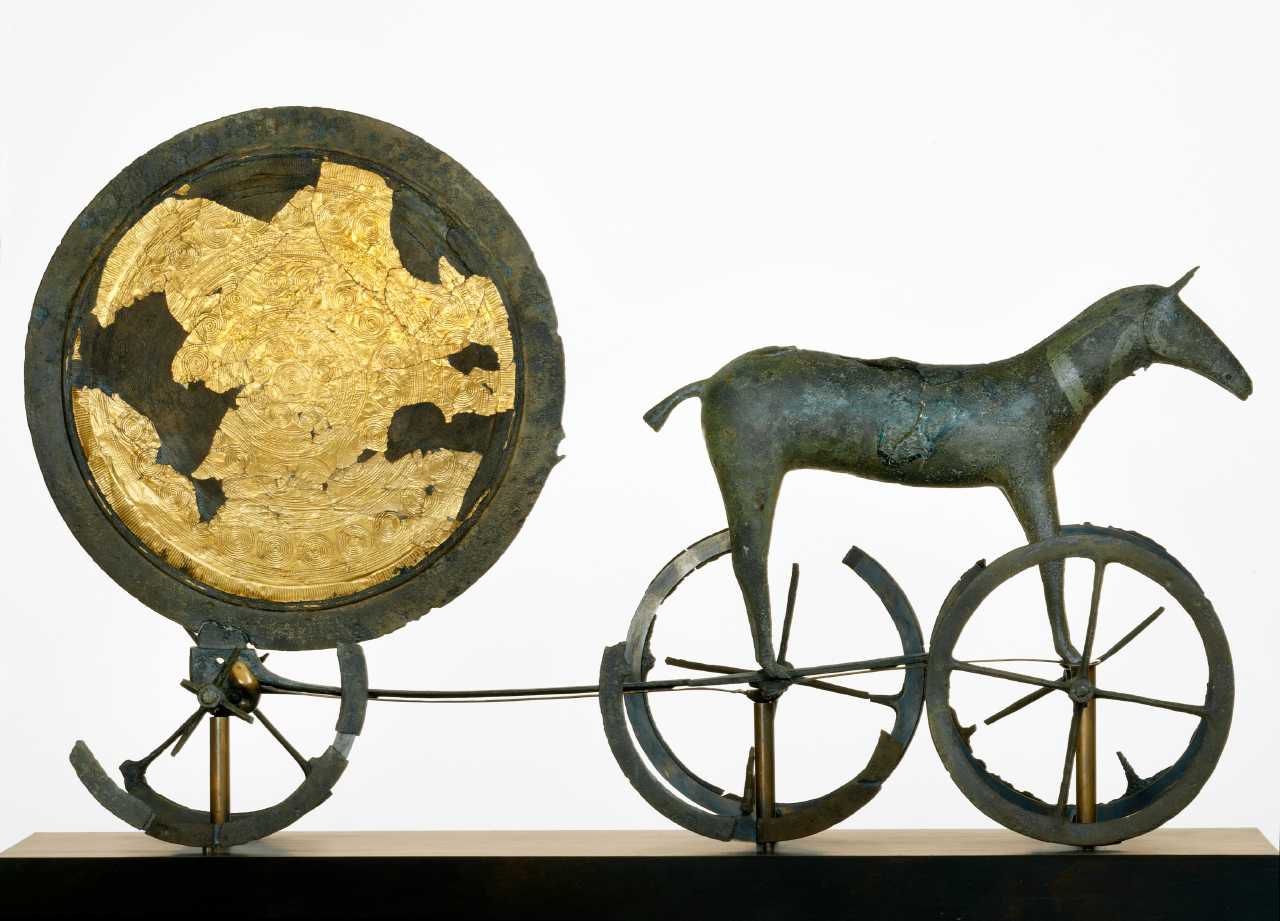
The Trundholm Sun Chariot, B7703, from its gilded-disc side. Losses in gold foil and interruptions in wheel rims are visible. The reassembled object is shown, not the reverse or the dates of individual restorations
Image source · LicenseObject details
- Title
- The Trundholm Sun Chariot B7703: Movement and the Limits of Reconstructing Belief
- Timeline
- From 1500 BCE to 1300 BCE
- Region
- Trundholm Mose, Odsherred, northwestern Zealand, Denmark
- Rights
- CC BY-SA
Text
Introduction
The Trundholm Sun Chariot is a small bronze model combining a horse, a circular disc and wheels. One face of the disc carries brilliant gold, while the other was left ungilded. What can this material arrangement tell us about representations of the sun and movement in northern Europe some 3,400 years ago? What remains a modern interpretation when there is no contemporary text explaining why the object was made or how it was used?
This entry examines the surviving artifact and the history of the fragments recovered from its findspot, then tests the proposed solar journey against other images and the limits of archaeological comparison. It concerns one specific object, not a reconstructed religion assembled from a single model.
The object and its measurements
The National Museum of Denmark in Copenhagen catalogs the original under number B7703, as an object of bronze and gold measuring 59 cm long, 24 cm wide, and 36 cm high. Such dimensions do not describe a carriage for a human passenger. They describe a model consisting of a horse, an upright disc and a supporting framework arranged with three pairs of wheels. Those are physical properties; the significance of motion requires further interpretation. [1]
The museum's image record assigns the object to Period II of the Nordic Early Bronze Age, approximately 1500–1300 BCE; archaeologists commonly place its manufacture around the fourteenth century BCE. This is an archaeological, stylistic date, not a year supplied by an inscription. The museum photograph of the gilded face belongs to B7703, rather than to the catalog entry for a modern replica. [2]
Discovery in 1902: an object already in pieces
The model emerged when Trundholm Bog, in northwestern Zealand, Denmark, was ploughed in September 1902. The horse appeared first, then the disc, with smaller parts scattered nearby. Archaeologist Jørgen Jensen recounts that the pieces reached the finder's home before the museum was notified; museum staff subsequently examined the spot and recovered further fragments. This is the history of the modern discovery, not a witness account of a Bronze Age ceremony. [3]
The object was not recovered as a complete vehicle. According to Jensen, only one of the six wheels was intact during the initial reconstruction. The others were fragmentary; part of the longitudinal rod, an axle, and small portions of the horse's ears, tail and back were missing. The museum reassembled the group following the discovery. Old fracture surfaces and detached gold foil indicated that not every break resulted from the plough or subsequent handling. Archaeological analysis supports deliberate fragmentation before deposition, without identifying the specific ritualRitualAn organised or distinguished practice meaningful to a community; it may leave traces, but its form alone does not reveal an associated doctrine.Glossary · Click to read the explanation, if any, performed at that moment. [4]
Returning to the findspot
Further pieces came to light much later. A bronze wheel fragment registered as B7703c was found with a detector in 1996. Another museum record, B7703d, comprises 16 fragments of wheel components recovered on 5–6 October 1998. These are associated find registrations, not new chariots. [5]
Museum and archaeological accounts of the 1998 investigations speak of 21 newly recovered pieces, including sections of wheels, spokes and axles, some of which helped complete the assemblage. The figures 16 and 21 need not contradict one another: one belongs to a particular sub-record, the other to a campaign-level account. Catalog differences should nevertheless remain visible. B7703d is labelled “Period III,” while the image record of B7703 says “Period II.” The difference alone neither establishes a separate artifact nor warrants silently redating the original. [6]
Bronze casting and the gold surface
Technical study shows that the horse was cast in bronze by the lost-wax method, around a clay core that can still be seen through damage on its back. The disc is not a solid gold plate. It consists of two convex bronze plates cast separately and joined around their edges by a surrounding ring. These details establish a sophisticated process of casting and assembly, but cannot by themselves identify a deity or reconstruct a story. [7]
Both sides bear concentric circles and spiral ornament, yet only one side was gilded, and some of that gold has been lost. Technical descriptions explain that thin gold foil was pressed over decoration in the bronze, some lines were subsequently retraced, and the edge was held by a hammered copper strip. The gilded side also has an outer, ray-like border lacking on the reverse. This asymmetry matters for interpretation, but it does not literally label the sides “day” and “night.” [8]
Movement: mechanism and proposed meaning
The horse and disc stand above a small frame with four-spoked wheels, axles and a longitudinal rod. Archaeologist Laura Ahlqvist describes two loops, one on the disc and another beneath the horse's neck, which probably held a connecting cord; the model may have been pulled to and fro. She also notes that the find was originally referred to as the “sun image from Trundholm,” before the term “Sun Chariot” became common in the twentieth century. The later name should not make us imagine a documented, full-sized horse-drawn ritual carriage. [9]
The wheels made physical movement possible, and the movement of a sacred image is a plausible function. But the object is not a record of its performance: we cannot identify its handlers, a particular route, or whether it was moved once or repeatedly before deposition. Arne Hedegaard Andersen accordingly distinguishes a sun drawn by a horse from the assumption that horse, disc and platform formed one historical “sun chariot.” The undercarriage may have served to display the action rather than represent a real vehicle. [10]
Two faces and a proposed journey
Viewed from the gilded face, the horse can be imagined pulling a bright sun in one direction; from the reverse, horse and ungilded disc appear to move in the opposite direction. This is the familiar interpretation of daylight and a nocturnal return. Ahlqvist also records other possibilities: the dark face might represent the moon, or an “extinguished” sun. What is observable is the deliberate difference in surface treatment, not a uniquely legible narrative of the sky. [11]
In 1955, Knud A. Larsen developed a stronger interpretation in which the gold and ray border indicated the sun's daily passage and its reverse journey at night. His published argument also connected the model to solar traditions in other regions. That is a historically situated scholarly thesis, not testimony from the Bronze Age maker. Proposed links to Greece, IranIranIran is the modern country containing Shush, ancient SusaGlossary · Click to read the explanation or India, or a common origin for solar worship, need independent evidence of dates and connections; a shared horse-and-disc motif is not sufficient. [12]
Testing the reconstruction against other media
In 2008, archaeologist Richard Bradley examined Flemming Kaul's scheme linking ships and solar emblems on Bronze Age razors, alongside Martin West's linguistic comparisons. Some carvings and metal images pair discs with horses, boats, fish or snakes, and the apparent direction of travel is taken as a clue to day and night. Bradley illustrated this model in his Figure 1 but raised a methodological question: can it be tested by independent evidence from archaeological settings, or is every image being fitted to a narrative already chosen? These motifs are not all pictures of the Trundholm object, and the objects and surfaces also differ in date and medium. [13]
Bradley examined the orientation of paired, shoe-shaped footprints cut into South Scandinavian rock surfaces. Some groupings could correspond to places from which people watched sunrise and sunset around the summer and winter solstices. He nevertheless stressed the restricted sample of published panels with usable orientations, regional variation, and the lack of horizon-profile surveys at the sites. Nor does a carved footprint date a ceremony or identify its participants. The comparison provides a possible test of solar concerns, not an established calendar or proof that the model travelled along a prescribed route. [14]
The original and a modern copy
The original B7703 must be distinguished from the museum's B19454: a replica made by the firm A. Michelsen, accessioned as a gift in 2019. Its catalogue describes complete wheels where the original has losses, fixing screws, and identifying stamps on internal surfaces. The photograph used here is linked to the original object's image record, not that replica. At the same time, a photograph alone cannot establish which parts of the reconstructed original are ancient and which were added during conservation. [15]
What remains of belief?
What the evidence establishes is an ancient model combining a horse, a disc with differently treated faces, and a wheeled frame; some components were broken before being deposited in a wetland, and the assemblage was reconstructed in modern times. A significant solar conception is a persuasive interpretation, but this object supplies no named god, verbal ritual instructions, or unified religious system for all of northern Europe. In that respect it differs from an artifact with inscribed divine names, such as the Piacenza Bronze Liver, or from Egyptian royal texts naming Aten. The comparison concerns kinds of evidence, not religious borrowing. The possible ritualRitualAn organised or distinguished practice meaningful to a community; it may leave traces, but its form alone does not reveal an associated doctrine.Glossary · Click to read the explanation behind the model remains a historical question rather than a scene recoverable from the wheels alone.
Quick answers
What is the Trundholm Sun Chariot?
It is a small bronze and gold model of a horse, an upright disc and a wheeled frame, about 59 cm long and 36 cm high. It is not a carriage for a person. [1]
How old is it and how do we know?
It is dated to about 1500–1300 BCE, with manufacture often placed around the fourteenth century BCE. This date comes from archaeological style, not from an inscription. [2]
Where and how was it found?
It turned up in September 1902 when Trundholm Bog in northwestern Zealand, Denmark, was ploughed. The horse appeared first, then the disc, and museum staff later recovered more fragments. [3]
Why is only one side of the disc gilded?
The reason is not certain. Some see a sun travelling by day and returning by night; others suggest the dark face is the moon or an extinguished sun. [11]
What can we not know about its purpose?
We cannot identify who handled it, a particular route, or whether it was moved once or often before it was deposited. The wheels made movement possible, but the object records no performance. [10]
References and notes
- National Museum of Denmark, original-object record B7703 (ObjektId 190857): bronze and gold, 59 × 24 × 36 cm; accession in 1902. No detailed conservation report is supplied. Identity, material, dimensions and accession fields; complete record read. Return to the text ↑
- National Museum of Denmark, still-image record DO-14902, “Solvognen (dagsiden)”: associates the image with B7703 and Period II (1500–1300 BCE). 9 March 2018 dates the image record, not the artifact. Image description, object number, chronology, photographer and rights; full page read. Return to the text ↑
- Jørgen Jensen, “Solvognen,” an online chapter from Danmarks Oldtid (book published 2004); reconstruction of the September 1902 discovery and initial recovery. The complete online chapter, not the entire book, was read. Discovery and first excavation paragraphs of the online chapter. Return to the text ↑
- Jørgen Jensen, same chapter, discussion of six wheels, missing pieces, old fracture surfaces, detached gold and initial reassembly; a specialist secondary account, not the original 1902 conservation dossier. Condition and assembly paragraphs preceding the 1998 re-examination. Return to the text ↑
- National Museum of Denmark, B7703c (ObjektId 4887), detector find of 19 September 1996; compare B7703d, 16 wheel fragments recorded on 5–6 October 1998. These are associated sub-records, not separate chariots. 1996 find description and date; comparison with https://samlinger.natmus.dk/do/object/273429 . Return to the text ↑
- National Museum B7703d: 16 wheel fragments, October 1998, catalogued “Period III.” Laura Ahlqvist and Jørgen Jensen give an overall 1998 total of 21 pieces, while still-image DO-14902 classifies B7703 as “Period II.” The catalogue dates the sub-find to October, Jensen’s broader account to November; no reason for the discrepancy is independently verified. Complete B7703d record; 1998 paragraphs in https://lex.dk/Solvognen and https://danmarksoldtid.lex.dk/Solvognen . Return to the text ↑
- Jørgen Jensen, same chapter, discussion of lost-wax casting, clay core, the two disc plates and component assembly. Based on a read specialist account, not a new laboratory examination. Fabrication, core, disc construction and component descriptions. Return to the text ↑
- Laura Ahlqvist, “Solvognen,” Lex, sections “Fremstilling af Solvognen” and “Solvognens motiv”: different faces, gold foil, copper retaining band and ray border. Full article read (updated 2 October 2024). Ornament and manufacture paragraphs in the named sections. Return to the text ↑
- Laura Ahlqvist, Lex, “Solvognens motiv”: loops interpreted as cord attachments, possible pulling action, and the later spread of the name Solvognen as opposed to the earlier “sun image.” No surviving cord is claimed. Final paragraph of “Solvognens motiv”; cord is a functional inference. Return to the text ↑
- Arne Hedegaard Andersen, “Solvognen,” Trap Danmark on Lex, complete short article; distinguishes the horse-drawn sun from the six-wheeled supporting vehicle, offering an interpretation rather than documentary evidence of a procession. Opening paragraphs on structure and interpretation. Return to the text ↑
- Laura Ahlqvist, Lex, ornament and religious-significance paragraphs: day/night is an interpretation; the ungilded side is alternatively discussed as moon or unlit sun. Sections “Solvognens motiv” and “Solens religiøse betydning.” Return to the text ↑
- Knud A. Larsen, “Solvogn og solkult,” Kuml 5 (1955), pp. 46–64. Only the published English abstract on the journal page was read, not the full paper or works it cites. The abstract presents his directional and common-origin hypotheses, treated here as attributed historical interpretations. Entire online English abstract; pp. 46–64 are bibliographic pagination, not pages read. Return to the text ↑
- Richard Bradley, “Midsummer and Midwinter in the Rock Carvings of South Scandinavia,” Temenos 44/2 (2008), pp. 223–232. The supplied ten-page PDF was read in full; pp. 223–226 and Figure 1 on p. 225 present the Kaul/West model and the question of independent testing. Kaul’s and West’s books were not read merely because cited. Printed pp. 223–226, Figure 1 on p. 225; supplied PDF SHA256 66c55962…048ef. Return to the text ↑
- Bradley, same paper, pp. 226–230 and Figures 2–4: rock settings, footprint motifs and orientations, publication-sample limitations, and missing horizon surveys. The solstice proposal is not a dated ritual record. Printed pp. 226–230; limitations and conclusion on p. 230. Return to the text ↑
- National Museum of Denmark, B19454 (ObjektId 519417), “Kopi af Solvognen”: A. Michelsen workshop copy, accessioned as a gift in 2019, with intact wheels, screws and identifying stamps. Accession date is not a verified manufacture date. Compared against original B7703 and its image record DO-14902. Copy identification, description and accession year; full record. Return to the text ↑
Archive records may be reviewed and refined as better evidence or sources become available. Suggest a correction
Suggest a correction · Suggest a source for this record
Cite this record
IL Archive, «The Trundholm Sun Chariot B7703: Movement and the Limits of Reconstructing Belief», https://ilarchive.com/en/artifacts/trundholm-sun-chariot-b7703