Entity · Deity
Enkimdu, the Farmer of Dykes and Canals
A reference page linking a name, group, or concept to the materials that discuss it.
- Names
- En-kim-du · Enkimdu
- Region
- Mesopotamia
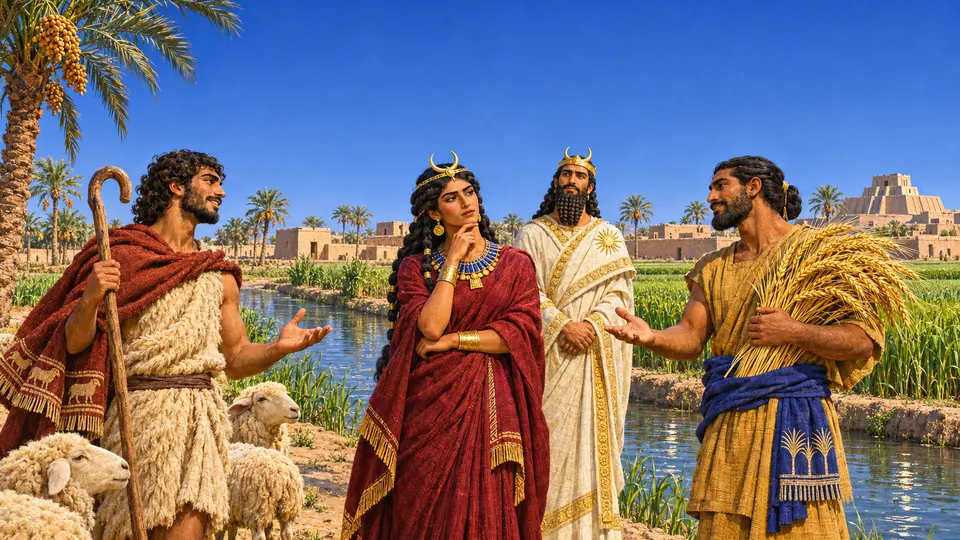
Enkimdu meets the shepherd Dumuzi in a Sumerian poem about Inana’s marriage. In Enki and the World Order, he receives responsibility for the ditches and dykes of cultivated land.
Estimated reading time: 5 min Published Last reviewed:
Share article
Text
Introduction
Enkimdu is a farmer and divine figure in Sumerian literature. In Dumuzid and Enkimdu, he is the suitor InanaInanna / IshtarA prominent Mesopotamian goddess whose Sumerian name Inanna became associated with Akkadian Ishtar across diverse traditions. She was associated with desire, war, royal authority and Venus, while local forms and genealogies varied among texts.Glossary · Click to read the explanation initially prefers to the shepherd Dumuzi. The encounter between the two men eventually takes place beside a river, where Enkimdu offers the sheep access to grazing and the young animals water from his canal. In EnkiEnkiMesopotamian deity also known as Ea, linked with Eridu and the Abzu (deep fresh waters), wisdom, incantations, and narratives of creation and cosmic order. Later written attestations do not identify the deity of Eridu’s earliest layers.Glossary · Click to read the explanation and the World Order, responsibility for ditches and dykes is assigned to him. [1][2]
Both poems make his association with cultivated land concrete. One puts him beside a pasture and a water source when he meets a rival. The other gives him a place in a sequence that describes the opening of furrows, the raising of grain and the distribution of tasks among the gods. [1][2]
The work of the two suitors
The sun-god Utu urges his sister Inana to marry Dumuzi. He commends the shepherd’s milk, butter and work. Inana replies that new wool will not persuade her and expresses a preference for the farmer, naming his flax and grain. The passage is damaged where she continues her answer. The surviving words give her reasons in terms of the goods and work of a household. [1][3]
Dumuzi answers with a series of proposed exchanges. A black garment is matched to a black ewe, a white garment to a white ewe. He offers milk against the farmer’s drinks and sets cheeses alongside beans. At the end he imagines leaving extra butter and milk after the farmer has eaten and drunk his fill. Each pairing adds to his case that the shepherd can equal the farmer’s contribution. In this speech he also calls Enkimdu the man of the dykes and canals, so the source of the farmer’s goods remains present in the argument. [1][3]
There is some variation in the goods between editions and manuscript copies. The Oxford translation distinguishes kinds of beer where Samuel NoahNoahNoah is the flood-story figure in Genesis and a prophet in the Qur’anGlossary · Click to read the explanation Kramer’s early translation gives kinds of date wine. A pair of lines about larger beans and cheeses appears as an addition in one of the Oxford edition’s witnesses. The translations agree on the structure of the exchange, even as the precise names of some of the drinks and foods have changed. [1][3]
Beside the riverbank
The setting of the dispute changes when the shepherd is grazing his sheep beside the river. Enkimdu approaches, and the herdsman provokes a quarrel. The farmer asks why he should compete and offers the sheep grass on the bank and access to the stubble. He also names fields of Unug and the Surungal canal as places where the animals can feed or drink. The offer turns the products listed earlier in the poem into an encounter about how the two men could share parts of the same landscape. [1][3]
In the Oxford rendering, Dumuzi answers by telling Enkimdu he will count him as a friend at his wedding. Enkimdu then names gifts he can bring, including wheat, beans and two-row barley from the threshing floor. His last promise turns back to Inana and offers her what she asks for. Kramer translated part of the wedding speech as an instruction for Enkimdu to stay away and marked uncertainties in the surrounding passage. The two renderings give different accounts of the invitation. The farmer makes an offer of goods near the close of both, and the closing praise is directed to Inana. [1][3]
Ditches and dykes in Enki’s order
In Enki and the World Order, Enki organizes ploughs, yokes and teams and opens furrows so barley can grow. He assigns responsibility for the ditches and dykes to Enkimdu, who is described as the farmer of EnlilEnlilEnlil/Ellil: a major Mesopotamian god associated with destinies, kingship, and Ekur at Nippur, already prominent in third-millennium god lists. His name’s origin and cult beginnings remain debated.Glossary · Click to read the explanation. In the preceding passage, rain falls under the care of the storm god Ishkur. In the following one, Enki heaps up barley and assigns the accumulated produce to the grain goddess Ashnan. Enkimdu’s task falls between those two portions of the sequence. The sequence treats the preparation and irrigation of land as work with a place among the other duties Enki distributes. [2]
The two works therefore put the same field infrastructure to different literary uses. The canal in the dispute is where a rival’s lambs and kids can drink. The ditches and dykes in Enki’s ordering of the world have a named overseer. Both descriptions make Enkimdu recognizable by his relationship to managed water, even though the poems give him different things to do. [1][2]
The clay copies
The CuneiformCuneiformWriting with wedge-shaped signs, developed from Mesopotamian recording traditions and used for several languages from the third millennium BCE.Glossary · Click to read the explanation Digital Library Initiative identifies a clay copy from Nippur, CBS 08320, as a witness to the dispute. Its reverse preserves part of Enkimdu’s name and the signs for the farmer’s association with dyke and canal. The Penn Museum catalogues another Nippur fragment as 29-16-435 and gives the same literary composition number. Small pieces of separate tablets can preserve different lines of an exchange that reads as a single conversation in a modern translation. [1][4][5]
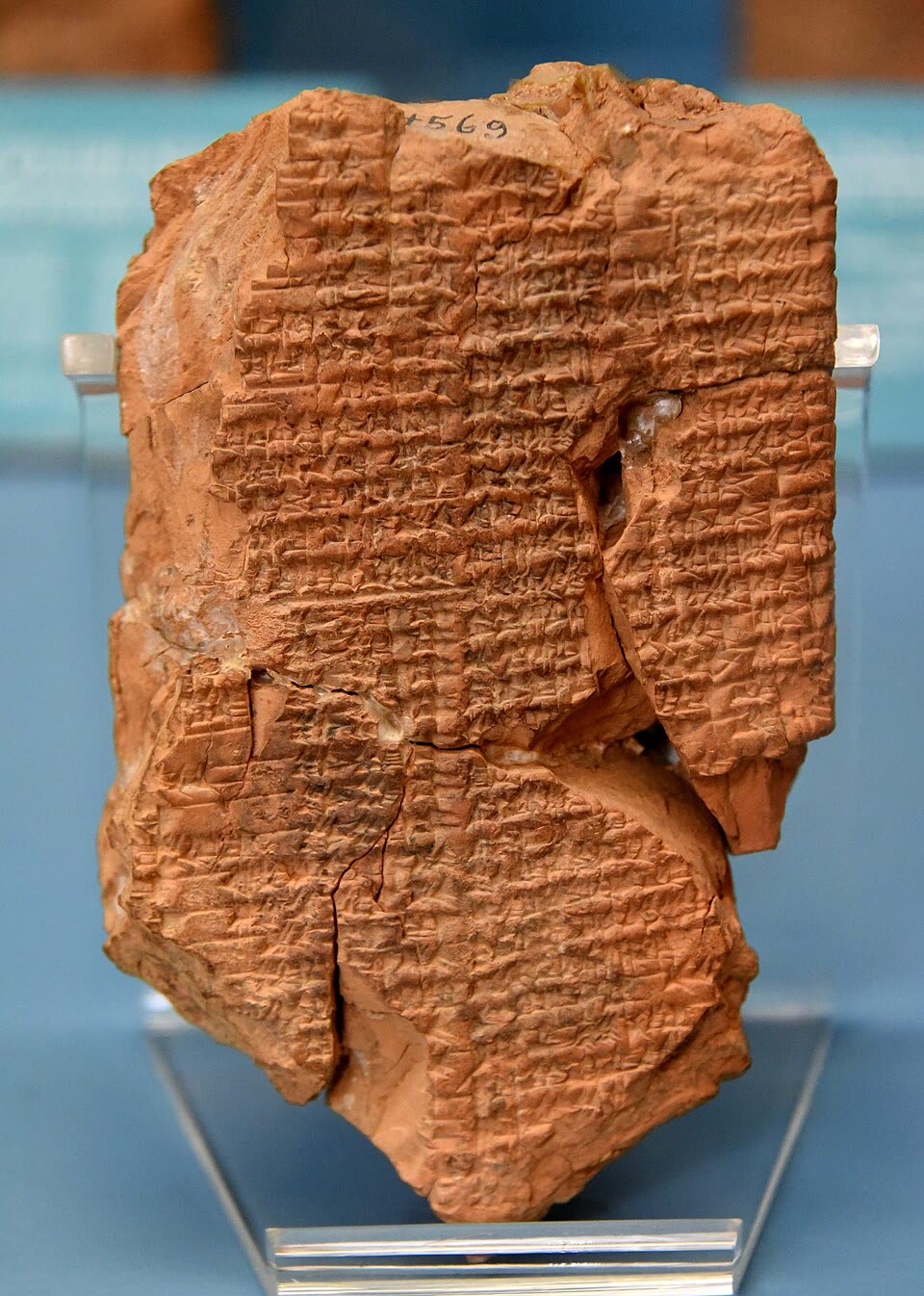
The pictured tablet is another witness from Nippur, photographed in Istanbul and identified as Inanna Prefers the Farmer, the title Kramer used for the poem. The writing on the surviving clay places the story in the manuscript record. Enkimdu’s two characteristic settings, the land beside a canal and the fields allotted by Enki, come from the separate works in which he is named. [1][2][3][6]
References and notes (6)
- Electronic Text Corpus of Sumerian Literature, Dumuzid and Enkimdu Read the complete translation, including Inana’s preference, Dumuzi’s proposed exchanges, the variant bean and cheese lines, the canal offer and the wedding speech. Return to the text ↑
- Electronic Text Corpus of Sumerian Literature, Enki and the World Order Read lines 318–340 on the ploughs and furrows, Enkimdu’s responsibility, neighboring assignments and the use of the hoe. Return to the text ↑
- Samuel Noah Kramer, Sumerian Mythology, Inanna Prefers the Farmer Read the account and translation of the courtship, list of goods, riverbank offer and disputed wedding speech. Return to the text ↑
- Cuneiform Digital Library Initiative, Literary 000663, witness P263161 Read the Nippur identification, Old Babylonian dating and reverse lines 10′–14′ preserving the name and the dyke-and-canal description. Return to the text ↑
- Penn Museum, Tablet 29-16-435 Read the Nippur provenience, fragment identification, published reference and composition number. Return to the text ↑
- Wikimedia Commons, Inanna Prefers the Farmer tablet Read the identification of the Nippur tablet in the Ancient Orient Museum in Istanbul, date ascribed to the manuscript, photo attribution and CC BY-SA 4.0 license. Return to the text ↑
Suggest a correction · Suggest a source for this record
Cite this record
IL Archive, «Enkimdu, the Farmer of Dykes and Canals», https://ilarchive.com/en/entities/enkimdu