Entity · Deity
Hebat, from the Court of Aleppo to Hittite Rock Sanctuaries
A reference page linking a name, group, or concept to the materials that discuss it.
- Names
- Heba · Hebat · Hepat · Ḫebat
- Region
- The Near East
Hebat appears beside storm gods in Syrian inscriptions, Hurrian myth and Hittite worship. A prayer by Queen Puduhepa and rock reliefs at Fıraktın and Yazılıkaya show how her position was expressed in Anatolia.
Estimated reading time: 5 min Published Last reviewed:
Share article
Text
Introduction
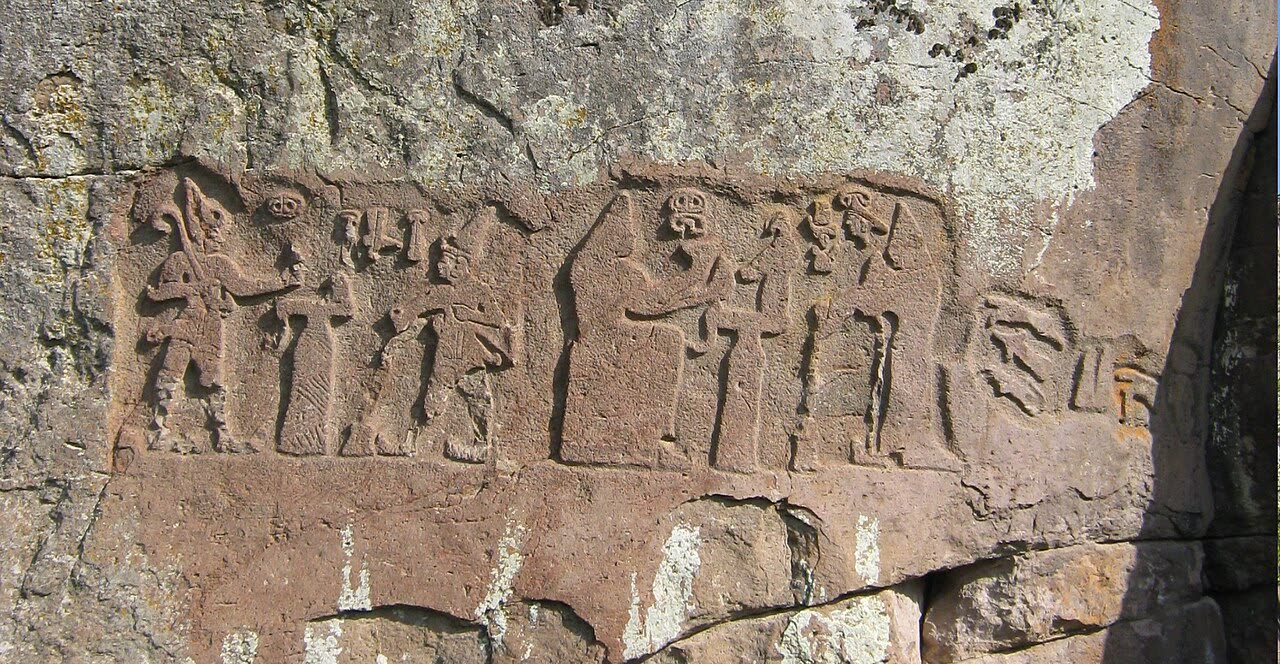
In a statue inscription from Alalakh, King Idrimi names Hebat alongside the Storm God and the lady of his city. At Fıraktın in AnatoliaAnatoliaAnatolia is the region occupying the Asian part of present-day TurkeyGlossary · Click to read the explanation, a rock relief shows a Hittite queen pouring a libation before Hebat, who receives it while seated. Both monuments place the goddess close to royal authority. They do so in different ways. Idrimi states a bond of service in the opening of his inscription, while the relief depicts an offering by a queen. Between those settings lie the ritualRitualAn organised or distinguished practice meaningful to a community; it may leave traces, but its form alone does not reveal an associated doctrine.Glossary · Click to read the explanation traditions in which Hebat accompanied the Storm God of Aleppo and the Hurrian storm god Teshub. [1][2][3]
Hebat in the Syrian royal record
Idrimi begins his inscription by naming his father and declaring himself a servant of the Storm God, Hebat and the goddess called the lady of Alalakh. Hebat is the middle name in the group. The city's lady is the third figure. That distinction matters for reading the inscription because the geographical title belongs to the last goddess. Jacob Lauinger's edition retains the spelling IŠTARInanna / IshtarA prominent Mesopotamian goddess whose Sumerian name Inanna became associated with Akkadian Ishtar across diverse traditions. She was associated with desire, war, royal authority and Venus, while local forms and genealogies varied among texts.Glossary · Click to read the explanation in the translation of that title. The opening places Hebat among the gods to whom Idrimi belongs before it describes the crisis in his father's house and the departure from Aleppo. [1][4]
Hebat appears alongside the Storm God in evidence for the older royal house of Yamhad as well. In an appendix to his study of Idrimi, Lauinger discusses a seal legend in which King Abba-El describes his relation to Addu, the Storm God, and ascribes his standing to Hebat's regard for him. The two inscriptions name different rulers and give their devotion different wording. Together they show that Hebat was already available to Syrian kings as a source of royal standing before her prominence in the Hittite monuments. [1][3]
A goddess with her own circle
Billie Jean Collins identifies Hebat as the consort of Hadda, the Storm God of Aleppo, in the Syrian tradition. Her place alongside Hurrian Teshub developed through the association of those storm gods. Ritual lists from Hattusa and Sapinuwa offer another way to trace that pairing. They preserve orders of offerings to a chief deity and the gods associated with that deity. The Hurrian term for this arrangement is kaluti. The lists transmitted under the names of Teshub and Hebat give each a circle with a distinct arrangement. [3]
One relationship helps explain how the lists work. Sharruma could receive offerings in the circle of his mother, Hebat. His presence there gives the order a family dimension alongside divisions between male and female deities. Collins also discusses rituals in which Hittite kings performed a kingship rite for Teshub and a queenship rite for Hebat. The headings preserve that distinction even where the text needs restoration. Royal practice gave the goddess a ceremonial position of her own. [3]
Puduhepa's prayer and offering
In a prayer for Hattusili III, Queen Puduhepa addresses the Sun Goddess of Arinna and explains that the goddess bears Hebat's name in the land of the cedars. The statement occurs inside a petition. Puduhepa identifies herself as a long-standing servant, recalls her husband's devotion to the Storm God of Nerik and asks for his health. Placing Hebat's name in this appeal allows the queen to address the goddess through names used in two settings. Another ritual that Collins cites invokes Hebat and the Sun Goddess of Arinna as separate recipients in paired procedures. The texts show why the occasion of each invocation matters. [3][5]
The rock monument at Fıraktın near Develi preserves two libation scenes. Hattusili stands before the Storm God in the scene on the left. On the right Puduhepa pours before seated Hebat. The accompanying hieroglyphic Luwian inscriptions identify the participants and call Puduhepa the Great Queen and daughter of Kizzuwatna. The inscription and the paired carving connect the queen's public title and origin to the offering visible on the rock. [2]
In the sanctuary and the song
At Yazılıkaya, near Hattusa, the facing groups of gods in Chamber A converge on Teshub and Hebat. Teshub stands on mountain gods. Hebat stands on a feline. Sharruma and the goddesses Allanzu and Kunzišalli follow her. Her position at the front and the figures immediately behind her make that composition different from the scene at Fıraktın. At Fıraktın a human queen delivers an offering to Hebat. At Yazılıkaya the goddess leads the figures who follow her and faces the Storm God at the meeting of two divine groups. [6]
The Song of Ullikummi gives Hebat an anxious part in a story about the Storm God's loss of power. As Ullikummi's advance cuts her off in her temple, Hebat asks Takiti for news of the Storm God and sends her out. The intervening passage is damaged. When TashmishuTashmishuDivine figure named in Kumarbi’s pregnancy with the storm god and the river Aranzah.Glossary · Click to read the explanation appears and announces the period of the Storm God's confinement, Hebat nearly falls from the roof. Her attendants catch her. The episode is told through the goddess's efforts to obtain news and through the danger that follows its arrival. [7]
These sources preserve several ways of placing Hebat beside a storm god. Idrimi invokes her through a service formula. Puduhepa speaks to her through a petition and appears before her in a relief. A myth makes the Storm God's fate something Hebat has to discover. Her place in each source depends on the kind of encounter it records. [1][2][5][7]
References and notes (7)
- Jacob Lauinger, The Labors of Idrimi Read inscription lines 1–6 and the appendix discussion of Abba-El's seal, including the Storm God and Hebat in the two royal declarations. Return to the text ↑
- Ömür Harmanşah, Rock Reliefs and Landscape Monuments Read the Fıraktın discussion, including the paired libation scenes, identification of the deities and hieroglyphic Luwian texts. Return to the text ↑
- Billie Jean Collins, Lost and Found in Translation: Religious Encounters in Hittite Anatolia Read the discussions of Aleppo and Teshub, the Hurrian kaluti lists, CTH 700 and the paired invocation in CTH 777. Return to the text ↑
- Cuneiform Digital Library Initiative, Statue of Idrimi, P500443 Read the transliteration of lines 1–6 and the object record for the inscribed statue. Return to the text ↑
- Itamar Singer, Hittite Prayers Read prayer 22, CTH 384, pp. 102–104, and its introduction, with Puduhepa's identification of the goddess and petition for Hattusili. Return to the text ↑
- Eberhard Zangger and Rita Gautschy, Celestial Aspects of Hittite Religion Read Chamber A's relief descriptions and figure identifications at the meeting of the two groups. Return to the text ↑
- Elisabeth Rieken and collaborators, Song of Ullikummi, CTH 345.I.3.1 Read the German translation of tablet III, especially the orders to Takiti, Tashmishu's announcement and the episode on the roof. Return to the text ↑
Suggest a correction · Suggest a source for this record
Cite this record
IL Archive, «Hebat, from the Court of Aleppo to Hittite Rock Sanctuaries», https://ilarchive.com/en/entities/hebat