Entity · Figure
Hedammu, the Sea Monster in a Hittite Song
A reference page linking a name, group, or concept to the materials that discuss it.
- Names
- Hedammu · Ḫedammu
- Region
- The Near East
Hedammu is a ravenous sea monster in a fragmentary Hittite song about kingship among the gods. Its surviving tablets describe a crisis over food and a goddess’s attempt to draw him out of the sea.
Estimated reading time: 5 min Published Last reviewed:
Share article
Text
Introduction
Hedammu, also written Ḫedammu, is a sea monster in a song preserved on cuneiformCuneiformWriting with wedge-shaped signs, developed from Mesopotamian recording traditions and used for several languages from the third millennium BCE.Glossary · Click to read the explanation tablets from Hittite AnatoliaAnatoliaAnatolia is the region occupying the Asian part of present-day TurkeyGlossary · Click to read the explanation. The surviving text places him in a struggle involving KumarbiKumarbiHurrian god in Hittite songs from Hattusha; he overthrows Anu and carries the storm god. A study of CTH 344, contested genealogy, and Greek parallels.Glossary · Click to read the explanation and the Storm-god. Hedammu’s appetite endangers the world that feeds both people and gods, and a goddess approaches him at the shore. The loss of much of the song makes it possible to follow several episodes closely while leaving the outcome uncertain. [1][2]
The song is usually studied alongside other compositions in which Kumarbi challenges the Storm-god. It has its own cast and setting within that group. The Sea appears as a figure who speaks and enters into agreements. The monster belongs to the water, and the surviving encounter moves between the shore and the waves. The texts give the Sea, Kumarbi and Hedammu different roles. [1][3]
A marriage and an appetite
In a surviving passage the Sea describes his daughter, Šertapšuruḫi, to Kumarbi, and the text goes on to arrangements involving the pair. Mary Bachvarova discusses the usual reconstruction in which Hedammu is the child of Kumarbi and the Sea’s daughter. Meindert Dijkstra questions whether the fragmentary evidence actually establishes that parentage. Even where the family relationship is unresolved, the marriage negotiations show the Sea and Kumarbi acting together. The offspring and feeding passages survive in several pieces whose positions in the complete song have had to be reconstructed. [1][3]
In one set of fragments, the monster’s food includes frogs and lizards. The remnants of a larger feeding scene make appetite one of his distinguishing features. The scale of that appetite matters because the song also asks how life and worship would continue without the human beings who produce food. The connection is made in a speech by EaEnkiMesopotamian deity also known as Ea, linked with Eridu and the Abzu (deep fresh waters), wisdom, incantations, and narratives of creation and cosmic order. Later written attestations do not identify the deity of Eridu’s earliest layers.Glossary · Click to read the explanation, who objects to what Kumarbi is doing. [1]
Ea’s objection
Ea asks what becomes of offerings if humanity disappears. In the relevant passage people are needed to grow grain and provide food for the gods. He addresses Kumarbi as someone who benefits from those offerings too. The speech gives the conflict consequences that extend beyond the Storm-god’s position. It puts the lives of cultivators and the gods’ dependence on their work into the same argument. [1]
Another preserved episode shows the practice of feeding at the level of divine hospitality. Kumarbi receives the Sea, food and sweet wine are served, and the vizier Mukišanu is told to close the doors. The meal and the closing of the doors accompany the gods’ discussion. Bachvarova and Noga Ayali-Darshan read such interactions in the context of the Sea’s recurring part in stories about Kumarbi. The Sea can be approached and persuaded as another participant in divine politics. [1][4]
At the shore
The goddess who approaches Hedammu is identified in the tablets by the sign for IshtarInanna / IshtarA prominent Mesopotamian goddess whose Sumerian name Inanna became associated with Akkadian Ishtar across diverse traditions. She was associated with desire, war, royal authority and Venus, while local forms and genealogies varied among texts.Glossary · Click to read the explanation. Dijkstra uses that name in his edition of one fragment. Bachvarova reads the divine name as Anzili in her presentation. The episode uses speech and attraction to bring Hedammu into contact with the goddess. A substance associated with the encounter enters the water in a surviving account. Hedammu responds, and the fragment preserves parts of their exchange. [1][3]
Dijkstra joins two previously separate fragments to bring more of the dialogue into view. The lines still have gaps, and some of the words in a translation have to be supplied in brackets. The surviving scene gives considerable space to the goddess’s actions and speech. Ayali-Darshan compares her part with the use of a goddess as an intermediary in other eastern Mediterranean stories of conflict involving the sea. The parallels concern the roles and actions preserved in the texts. They leave open how Hedammu’s encounter ended in the missing part of the song. [1][3][4]
The surviving tablets
The catalogue maintained by the Hethitologie Portal Mainz records the song as CTH 348. Its critical edition identifies witnesses that consist of fragments joined together, including KBo 26.71 and KUB 12.65. The catalogue also preserves details of where fragments were recovered or stored. One piece was found among earlier excavation debris at Temple I at Hattusa, and its association with a second piece is recorded as a join. The catalogue entry distinguishes those two kinds of information. [2][5]
Bachvarova discusses a join between KUB 33.94 and KUB 8.67, a witness with a colophon that identifies it as a second tablet. Its surviving beginning presupposes earlier action. She also compares two forms of the story in the fragments and considers that more than one telling may have been in circulation. The proposal gives particular weight to differences in the preserved episodes, alongside the gaps created by damage to the clay. [1]
A later Anatolian comparison
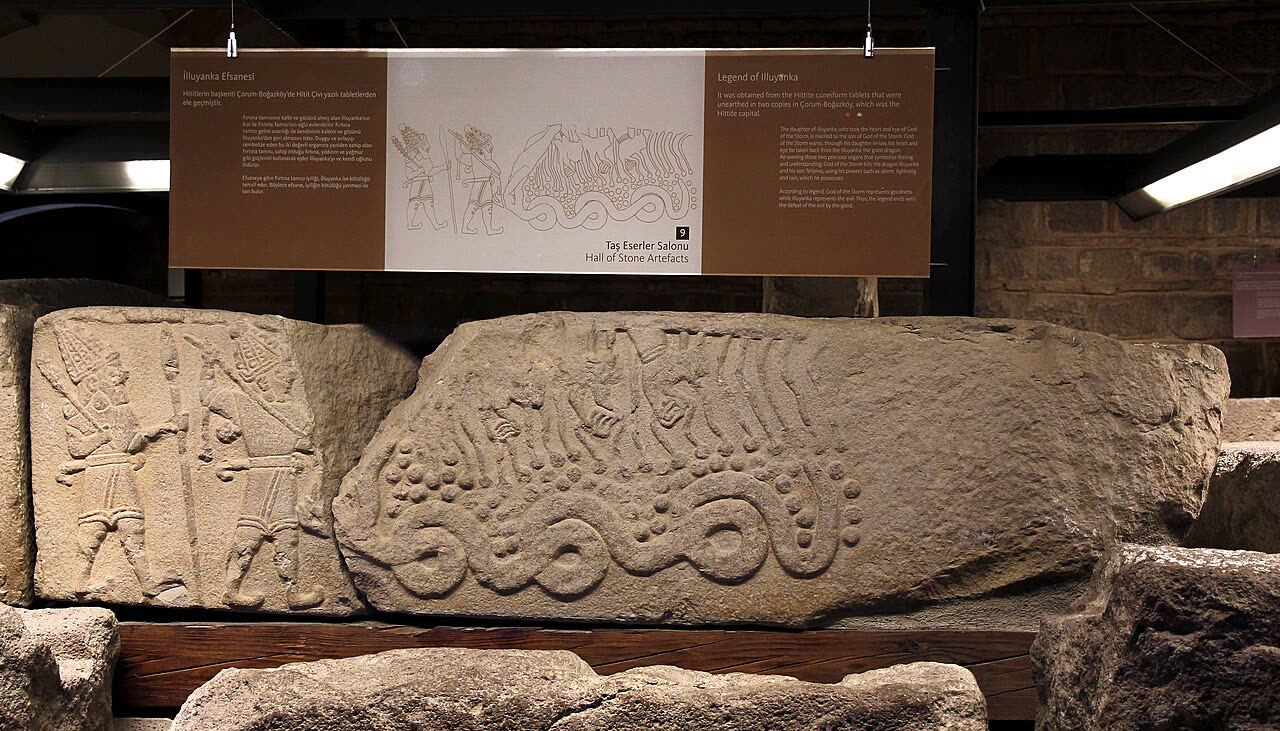
A relief from Arslantepe shows an attacking figure opposite a coiled serpent. Vladimir Shelestin, Alexandre Nemirovsky and Anastasia Iasenovskaia examine the relief in a study of Anatolian serpent combat and consider connections with both the Hedammu story and the story of IlluyankaIlluyankaIlluyanka, Hittite for “serpent,” opposes the Storm-god in two CTH 321 accounts. In one, Inara and Hupasiya help trap it; in the other, the god’s son retrieves his stolen heart and eyes.Glossary · Click to read the explanation. The shape of the relief and the visible actions support comparison with those narratives. The identities of the figures are matters of interpretation. [6]
In the song, Hedammu’s appetite leads Ea to speak for the people whose work sustains divine offerings. The goddess’s surviving encounter makes speech and attraction part of the response to the danger. Those episodes are among the clearest ways to see what the writers made of the monster, even though the tablets that would settle the end of his story have yet to be identified. [1][3]
References and notes (6)
- Mary R. Bachvarova, Multiformity in the Song of Ḫedammu: Evidence and Implications Read the discussion of the tablet sequence and spelling, the reconstructed marriage and offspring, the account of different versions, and the translated speeches, meal and shore scene. Return to the text ↑
- E. Rieken and colleagues, Critical Edition of the Song of Ḫedammu, CTH 348.I.1, Hethitologie Portal Mainz Read the critical edition’s witness list, including witness G and the recording of its joined fragments. Return to the text ↑
- Meindert Dijkstra, Ishtar Seduces the Sea-Serpent, Ugarit-Forschungen 43 Read the joined shore scene and discussion of the use of divine names, the strengths and limits of the parentage reconstruction and the missing parts of the story. Return to the text ↑
- Noga Ayali-Darshan, The Other Version of the Story of the Storm-god’s Combat with the Sea, JANER 15 Read pages 24–26 and 33–36 on Kumarbi, the Sea’s role and the comparative evidence for the encounter with a goddess. Return to the text ↑
- Hethitologie Portal Mainz, Konkordanz der hethitischen Keilschrifttafeln, CTH 348 Read the fragment records and excavation note on 553/u, recovered in Temple I debris, and the recorded join with Bo 2612. Return to the text ↑
- Vladimir Shelestin, Alexandre Nemirovsky and Anastasia Iasenovskaia, The Serpent-Fighting Imagery of Anatolia Read the description and comparative interpretation of the Arslantepe relief and examined the photographs showing the attacking figure and serpent. Return to the text ↑
Suggest a correction · Suggest a source for this record
Cite this record
IL Archive, «Hedammu, the Sea Monster in a Hittite Song», https://ilarchive.com/en/entities/hedammu