Entity · Deity
Nemty, the ferryman in the contest for Osiris's throne
A reference page linking a name, group, or concept to the materials that discuss it.
- Names
- Anti · Anty · Nemti · Nemty
- Region
- Egypt
Nemty ferries Isis to the island where the gods judge the claims of Horus and Seth. His name and images also appear in Upper Egyptian cult and in traditions of crossing to the east.
Estimated reading time: 5 min Published Last reviewed:
Share article
Text
Introduction
Nemty is the Egyptian god who ferries Isis to the island where the gods are weighing the rival claims of Horus and Seth. His part in the tale turns on a rule about who may cross, a payment in gold and the consequences of accepting it. Other sources describe a falcon god honoured at Atefet, a deity associated with the east and a figure named in funerary texts about crossing water. Older Egyptological works often call him Anty or Anti. [1] [2] [3]
An order at the water's edge
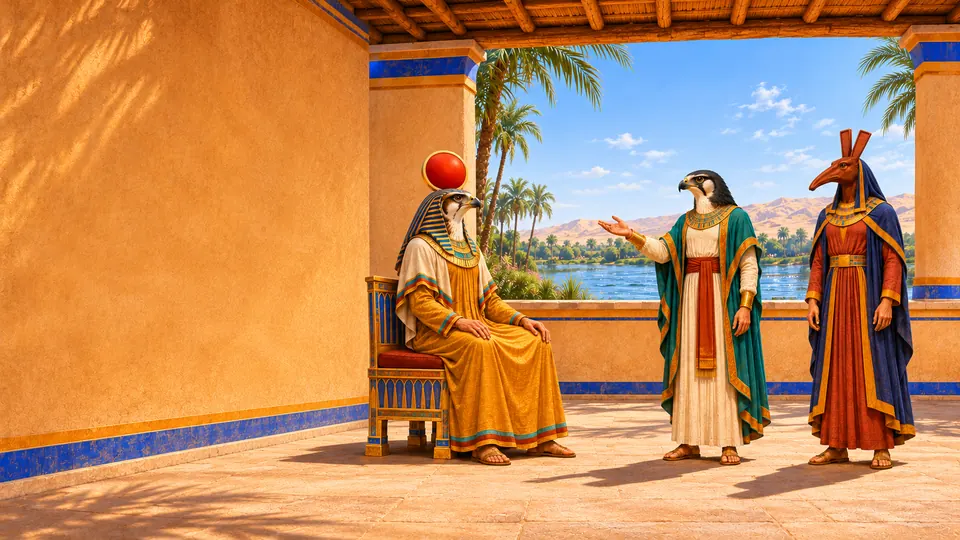
In the Contendings of Horus and Seth, Seth insists that he will not argue his case with Isis present. The sun god tells the council to cross to the Island in the Midst and orders the ferryman to keep away any woman resembling Isis. The council goes to the island and shares a meal there. When Isis arrives at the boat, she is disguised as an elderly woman. She tells the ferryman she has brought flour for a hungry boy who has been tending cattle on the island for five days. [1]
Nemty answers that he has been told to ferry no woman. Isis asks whether the order was given because of Isis, then offers him a loaf. He refuses it after pointing back to the order. A gold ring changes his mind. He asks for it, takes it and ferries her across. The scene makes separation by water a practical matter of who controls a boat. Disguise gets Isis as far as a conversation with the ferryman. The ring brings the crossing itself, with the risk of disobeying the council falling on him. [1] [3]
On the island, Isis takes a younger appearance and tells Seth a story about a dead herdsman. In it, a stranger tries to take cattle from the man's son. Seth says the stranger has no claim while the son lives. Isis reveals the implication for the case that brought the gods to the island, and the sun god tells Seth that he has judged himself. Gardiner points out a play on the Egyptian words rendered as cattle and office in this episode. Nemty's crossing lets Isis get close enough to have Seth argue for a son's inheritance in his own words. [1] [3]
Punishment and gold
Seth calls for the ferryman to be brought before the assembly, and Nemty is punished. Alan Gardiner translates the words as the removal of the soles of his feet, and in a note interprets the expression as flogging. Other discussions read the bodily injury more literally. The clearest sequel is Nemty's declaration that gold is henceforth an abomination for his city. That declaration brings the price of the passage back into the story and connects it with a local prohibition in the world of the tale. [1] [4]
The Cairo Calendar preserves a different story involving a crossing and an offer of gold. In Gábor W. Nemes's discussion of the damaged passage, Seth takes an elderly disguise and attempts to bribe the ferryman on a journey connected with OsirisOsirisOsiris was an ancient Egyptian deity associated with the dead, life after death, renewal, and kingship. His roles appear in changing funerary texts, rituals, and judgment scenes, notably the weighing of the heart.Glossary · Click to read the explanation's bark and Abydos. The calendar also seems to refer to punishment of the ferryman. Its damaged wording leaves details of the injury open. The different roles of Seth and Isis in the two texts are evidence for how a recognisable episode could recur with changed participants and a changed purpose. [4]
What the name and images record
The hieroglyph used in some spellings has a falcon over a curved object. Gardiner describes the curved form as a boat, pointing to examples with a rudder, and connects the passage in the Contendings with traces of a ferrying role in the Pyramid Texts. Michal Čermák examines a Coffin Text spell in which the deceased, travelling on the Winding Waterway, describes shining like Nemty. He also discusses the SinaiSinai: peninsula and biblical mountainSinai is a peninsula in eastern Egypt; in the Torah the name also denotes the mountain of revelation to MosesGlossary · Click to read the explanation inscription that gives Nemty the title Lord of the East. That monument depicts the god with a Seth-animal head, even though the spelling and other evidence also associate him with the falcon. [1] [3] [5]
A title of Nestanebetisheru preserved in the Greenfield Papyrus calls her priestess of Nemty, Lord of Atefet. Giuseppina Lenzo identifies Atefet as the principal cult centre of the falcon god and the capital of the twelfth Upper Egyptian nome. Stephen Quirke compares evidence of Nemty as a local deity along the east bank with the Sinai stela and the story about the ferry. Donald Bailey stresses a distinction between the god of the twelfth nome and Nemtiwy, the dual deity of the tenth nome associated with Antaios. Related spellings and overlaps with Seth make it important to identify the location and the exact text before equating figures. [2] [5] [6]
A passage with consequences
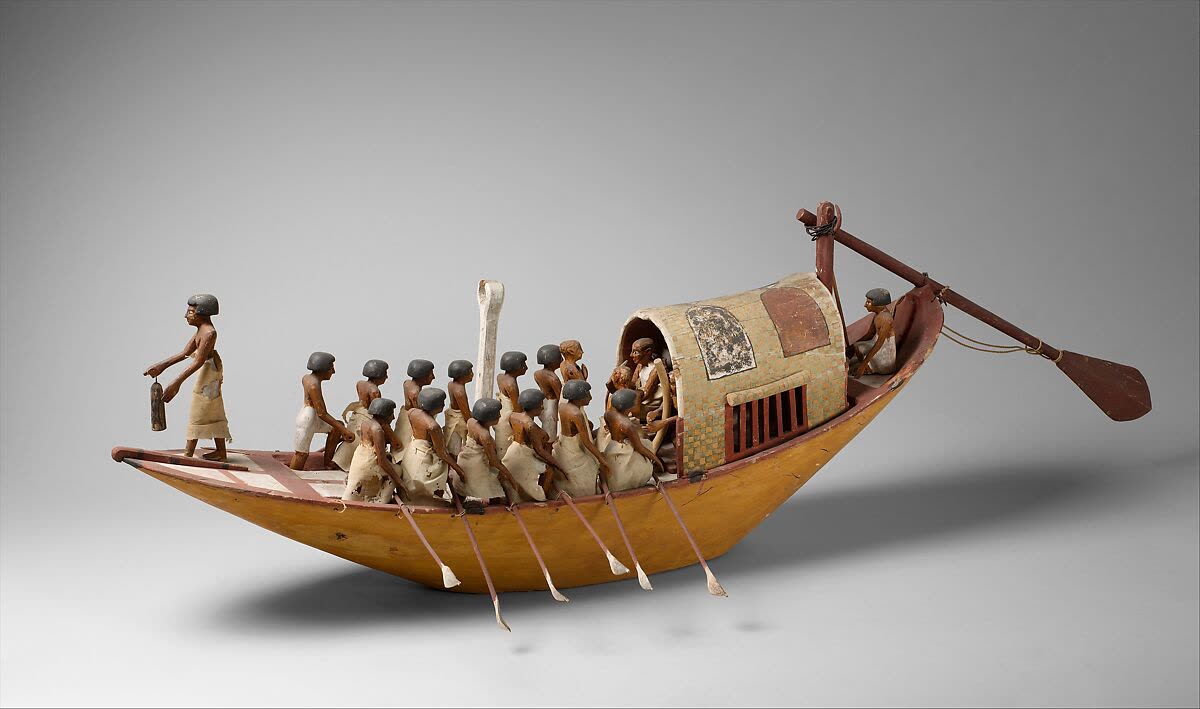
The riverboat from Meketre's tomb illustrates how ancient Egyptian artisans represented a passage by water. The model has oarsmen, a lookout in the bow and a helmsman at the stern. The Metropolitan Museum also sees details that connect this particular voyage with the afterlife. The Contendings gives its own crossing a different purpose. The ferryman must decide whether to obey an instruction that restricts access to a royal deliberation. The decision he makes puts Isis within reach of Seth, and the assembly holds him responsible when the result becomes clear. [1] [3] [7]
References and notes (7)
- Alan H. Gardiner, The Library of A. Chester Beatty: Description of a Hieratic Papyrus 1931, section 8, pp. 17–19 and notes. Text of the ferry episode, the punishment and early discussion of the name sign. Return to the text ↑
- Giuseppina Lenzo, The Greenfield Papyrus 2023, pp. 20–21. Read the priestly title of Nestanebetisheru, cult setting and history of the name reading. Return to the text ↑
- Michal Čermák, The Way of Horus: Kingship and Transition in the Contendings of Horus and Seth Charles University dissertation, 2023, discussion of the ferryman, Coffin Text spells and the Sinai stela. Return to the text ↑
- Gábor W. Nemes, The mythological importance of the constellation Msḫtjw in mortuary representations until the end of the New Kingdom ENiM 13 (2020), pp. 40–41, discussion of the Cairo Calendar and its uncertain readings. Return to the text ↑
- Stephen Quirke, Exploring Religion in Ancient Egypt 2015, discussion of eastern Egyptian cult places and Nemty's Seth-like appearance on the Sinai stela. Return to the text ↑
- Donald Bailey, Antaios, an Egyptian God in Roman Egypt: Extracting an Iconography Read the Antaios section and note 14 distinguishing the tenth and twelfth nomes and the related gods. Return to the text ↑
- The Metropolitan Museum of Art, Travelling Boat being Rowed, 20.3.1 Object interpretation, tomb context, period and public-domain image designation. Return to the text ↑
Suggest a correction · Suggest a source for this record
Cite this record
IL Archive, «Nemty, the ferryman in the contest for Osiris's throne», https://ilarchive.com/en/entities/nemty