Entity · Deity
Nephthys, mourner and guardian of the dead
A reference page linking a name, group, or concept to the materials that discuss it.
- Names
- Nebet-Het · Nebthet · Nephthys
- Region
- Egypt
Nephthys mourns and protects Osiris beside Isis in Egyptian funerary literature and art. Temple songs, inscribed burial vessels and Plutarch's account place her in different ritual and narrative settings.
Estimated reading time: 5 min Published Last reviewed:
Share article
Text
Introduction
Nephthys is an Egyptian goddess known for mourning OsirisOsirisOsiris was an ancient Egyptian deity associated with the dead, life after death, renewal, and kingship. His roles appear in changing funerary texts, rituals, and judgment scenes, notably the weighing of the heart.Glossary · Click to read the explanation and protecting the dead. Her Egyptian name, conventionally rendered Nebet-Het, means Lady of the Mansion. It can be written in hieroglyphs on her head in sculptures of the goddess. Egyptian funeral texts often pair her with Isis. Spoken laments call Osiris or the deceased back into the presence of the living, while burial objects invoke her protection of particular people and parts of the body. [1] [2] [3]
Two voices in the Pyramid Texts
The paired mourners occur in the Pyramid Texts. In spell 422, the deceased is to hear Isis speak and Nephthys call. Spell 482 describes a company coming to Osiris at the sound of the two goddesses' wailing. Spell 670 brings the king directly into the scene by addressing the recipient as Osiris Neferkare, the royal name of Pepi IIPepi IIPepi II was an Egyptian king of the Sixth Dynasty in the late third millennium BCEGlossary · Click to read the explanation. The verse marks the voice of each goddess, with weeping from Isis and wailing from Nephthys. In these passages a listener knows who grieves by hearing the voices named in the recitation. [2]
The association with Osiris gives the words a purpose in a royal burial. The dead king can be treated in the role of the god whom the sisters mourn. Harold M. Hays notes that spell 670 also differentiates between Osiris and Neferkare elsewhere, even though it can name the two together. The movement between divine story and individual beneficiary is part of the way the texts work. The sisters' presence brings to the burial the relationship to Osiris that makes their acts of calling, mourning and care intelligible. [2]
The festival of the two kites
The Songs of Isis and Nephthys in the Bremner-Rhind Papyrus specify a performance at the temple of Osiris at Abydos, from days 22 to 26 of the fourth month of inundation. The opening calls it the festival of the two kites. It directs the temple to be purified and two women to be prepared with wigs and instruments. The names of Isis and Nephthys are written on their arms, according to the translation. The chief lector has his own recitation in the opening exchange. The written instructions thus identify who takes the parts of the sisters and whose presence their singing addresses. [4] [5]
In the songs, the sisters ask Osiris to come home after an untimely departure and wish to see him in his former shape. They speak of their tears and of embracing or protecting his body. A protective recitation also asks the divine assembly to ward off Seth. Other papyri preserve a related composition conventionally called the Lamentations of Isis and Nephthys. Foy Scalf notes that the Berlin copy of that text prescribes performance on day 25 of Khoiak and connects the recitation with sustaining the dead body and placing Horus on his father's throne. The two compositions have related aims and preserve distinct instructions. They describe specific dates and settings for the work of mourning as a temple rite. [4] [5]
Mourning made visible
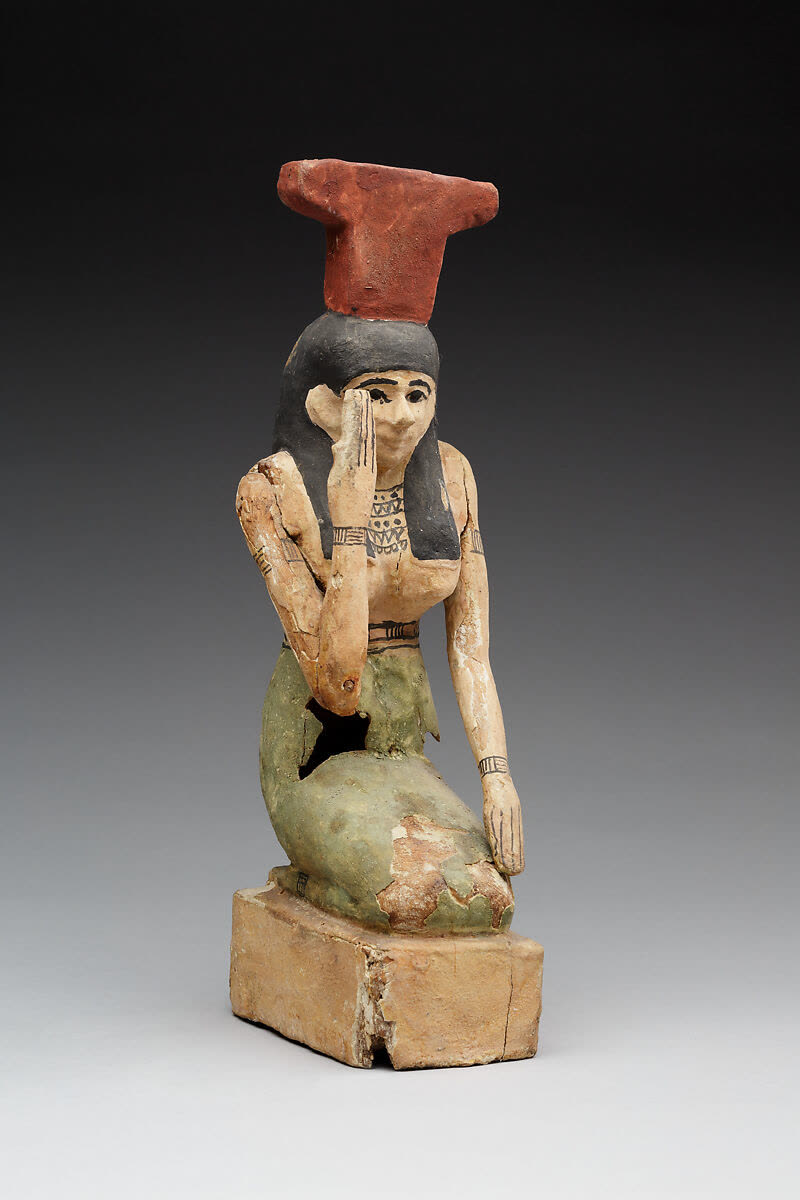
The Metropolitan Museum's painted wooden figure of Nephthys kneels with one hand raised to her face. Its head ornament identifies the goddess. The catalogue pairs it with a corresponding Isis figure and suggests that such figures could be set at either end of a sarcophagus, as the goddesses flank Osiris in images. The precise positions are an interpretation. The pairing and the gesture already make the sculpture recognisable as a participant in lament, even without a larger scene around it. The Walters Art Museum preserves another kneeling figure that uses the same kind of gesture. [1] [6]
Nephthys could also be addressed in inscriptions that asked for the physical protection of the dead. The Eighteenth Dynasty canopic jar of Ruiu is dedicated to Nephthys and Hapy, the Son of Horus associated in this burial with the lungs. Its text has the goddess put her arms around the contents, protecting Hapy and Ruiu. The canopic jar of the troop captain Minmose invokes Nephthys with Imseti. The Met notes that Imseti was customarily paired with Isis and identifies this combination as a variant attested in the New Kingdom. The protective act could be invoked for a named person in more than one arrangement of the gods. [3] [7]
Nephthys in Plutarch's story
Plutarch's Greek On Isis and Osiris introduces Nephthys on the fifth of the days added to the Egyptian year. In one tradition he reports, she and TyphonTyphon / TyphoeusTyphon (Typhoeus), a serpentine adversary of Zeus in Greek myth; his defeat and punishment vary across Hesiod, Pindar, and the later Library.Glossary · Click to read the explanation, his name for Seth, are children of CronusKronosGreek divine figure and Zeus’s father; Hesiod connects his reign with struggles between divine generations.Glossary · Click to read the explanation, and he also calls her Typhon's wife. Later in the narrative Isis learns that Osiris mistook Nephthys for her. A garland left behind provides the clue. Nephthys exposes the child she bears out of fear of Typhon. Isis finds him with the help of dogs, raises him and gains a guardian and attendant named Anubis. [8]
The childbirth episode gives Nephthys an individual story within Plutarch's account of a divine household. Egyptian rites can address her through a role she shares with Isis, and the inscribed jars sometimes give her a duty performed in her own name. The two raised voices recorded in the Pyramid Texts, the names written on performers in the temple songs and the arms wrapped around Ruiu's jar all give that shared concern for the dead a specific form. [2] [3] [4] [8]
References and notes (8)
- Walters Art Museum, Statue of Nephthys, 22.255 Read the explanation of her name, identification by the head emblem and mourning posture. Return to the text ↑
- Harold M. Hays, The Organization of the Pyramid Texts 2012, section on personal services and listings of the mourning and summoning motifs. Read PT 422, 482 and 670 and the distinction between Osiris and the king in PT 670. Return to the text ↑
- The Metropolitan Museum of Art, Canopic Jar of Ruiu, 35.3.34a, b Object record, excavation context and the inscription invoking Nephthys and Hapy. Return to the text ↑
- R. O. Faulkner, The Songs of Isis and Nephthys Translation of BM EA 10188 from Journal of Egyptian Archaeology 22 (1936), hosted with minor language updates. Read the opening and columns 1–5. Return to the text ↑
- Foy Scalf, Passports to Eternity University of Chicago dissertation. Read pp. 35–37 on the Songs and Lamentations, their performance dates and the directions for the performers. Return to the text ↑
- The Metropolitan Museum of Art, Mourning Nephthys, 12.182.23a Object record and interpretation of the Isis and Nephthys pair, and public-domain image designation. Return to the text ↑
- The Metropolitan Museum of Art, Canopic Jar Inscribed for Minmose, 2005.106a, b Inscription of Nephthys and Imseti and description of the New Kingdom variant. Return to the text ↑
- Plutarch, On Isis and Osiris, translated by Frank Cole Babbitt Sections 12–14, the days of birth, family relations and the account of Nephthys and Anubis. Return to the text ↑
Suggest a correction · Suggest a source for this record
Cite this record
IL Archive, «Nephthys, mourner and guardian of the dead», https://ilarchive.com/en/entities/nephthys