Entity
Typhon / Typhoeus
A reference page linking a name, group, or concept to the materials that discuss it.
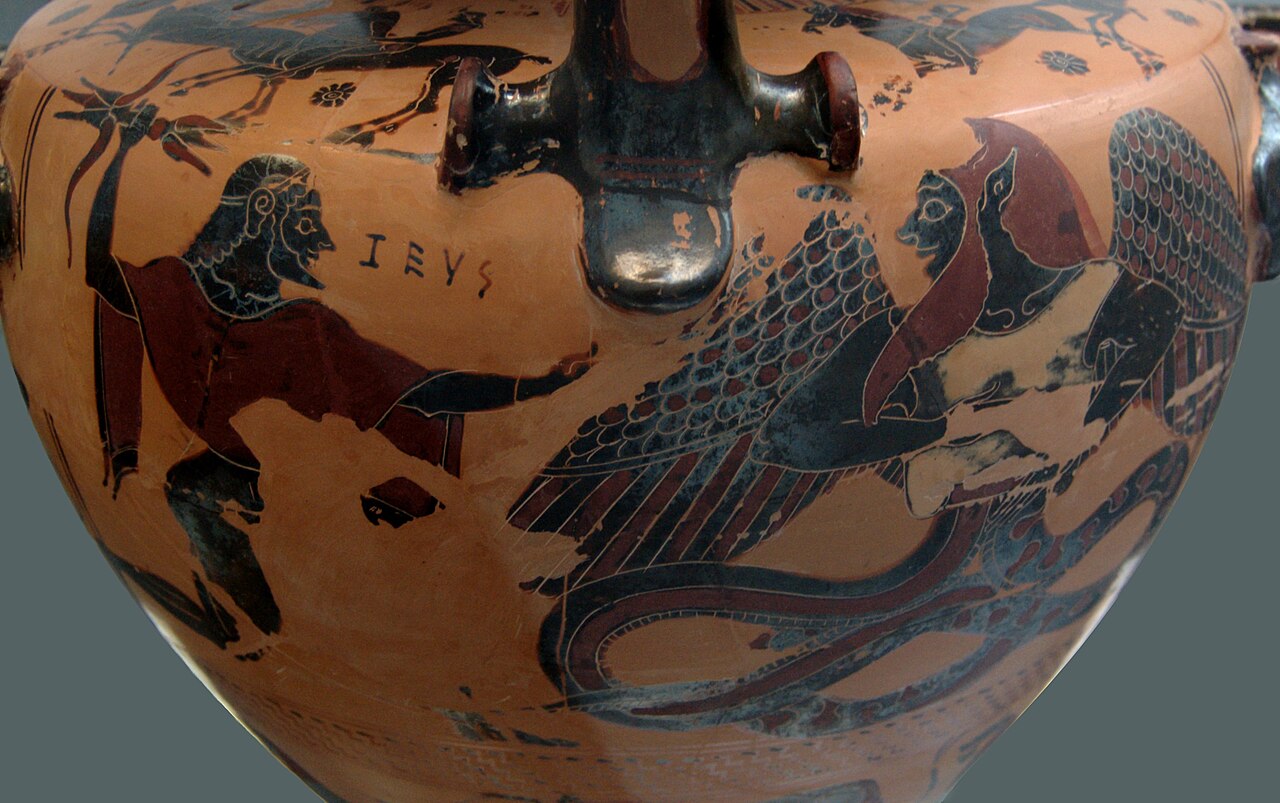
Typhon (Typhoeus), the serpentine foe of Zeus: Hesiod describes the thunderbolt battle, Pindar places him under Etna, and the later Library recounts Zeus’ stolen sinews.
Estimated reading time: 4 min Published Last reviewed:
Share article
Text
Introduction
Who is Typhon, or Typhoeus, the terrifying opponent who challenges ZeusZeusZeus is the sky god and leading deity in many Greek traditions. In the Iliad he presides over divine gatherings while others can still speak and object.Glossary · Click to read the explanation in Greek myth? How does the battle change between an early surviving poem and accounts transmitted centuries later? This entry compares HesiodHesiodGreek poet whose major work is generally dated to the late eighth or early seventh century BCE, including the Theogony.Glossary · Click to read the explanation's TheogonyHesiod’s TheogonyGreek poem on divine generations and Zeus’s kingship; its surviving form does not identify all of Hesiod’s sources.Glossary · Click to read the explanation, an ode by Pindar, and the Library traditionally attributed to Apollodorus.
The distinction also matters when Typhon is compared with the Hittite serpent IlluyankaIlluyankaIlluyanka, Hittite for “serpent,” opposes the Storm-god in two CTH 321 accounts. In one, Inara and Hupasiya help trap it; in the other, the god’s son retrieves his stolen heart and eyes.Glossary · Click to read the explanation. A storm god's recovery of what an enemy has taken occurs in a particular, later Greek telling. It should not be read back into Hesiod's earlier verses.
Names and identity in Greek poetry
Typhon and Typhoeus are different forms of the name of a formidable mythological figure, not necessarily two distinct beings. In the TheogonyHesiod’s TheogonyGreek poem on divine generations and Zeus’s kingship; its surviving form does not identify all of Hesiod’s sources.Glossary · Click to read the explanation, HesiodHesiodGreek poet whose major work is generally dated to the late eighth or early seventh century BCE, including the Theogony.Glossary · Click to read the explanation, whose poem is generally placed in the late eighth or early seventh century BCE, presents Typhoeus as the youngest child of GaiaGaiaEarth as a divine figure, active in the gods’ origins and conflicts in Hesiod.Glossary · Click to read the explanation, Earth personified, and TartarusTartarusDeep abyss in Greek poetic imagination, named by Zeus as a place of punishment in the Iliad.Glossary · Click to read the explanation, the abyss of Greek mythical geography. [2][10]
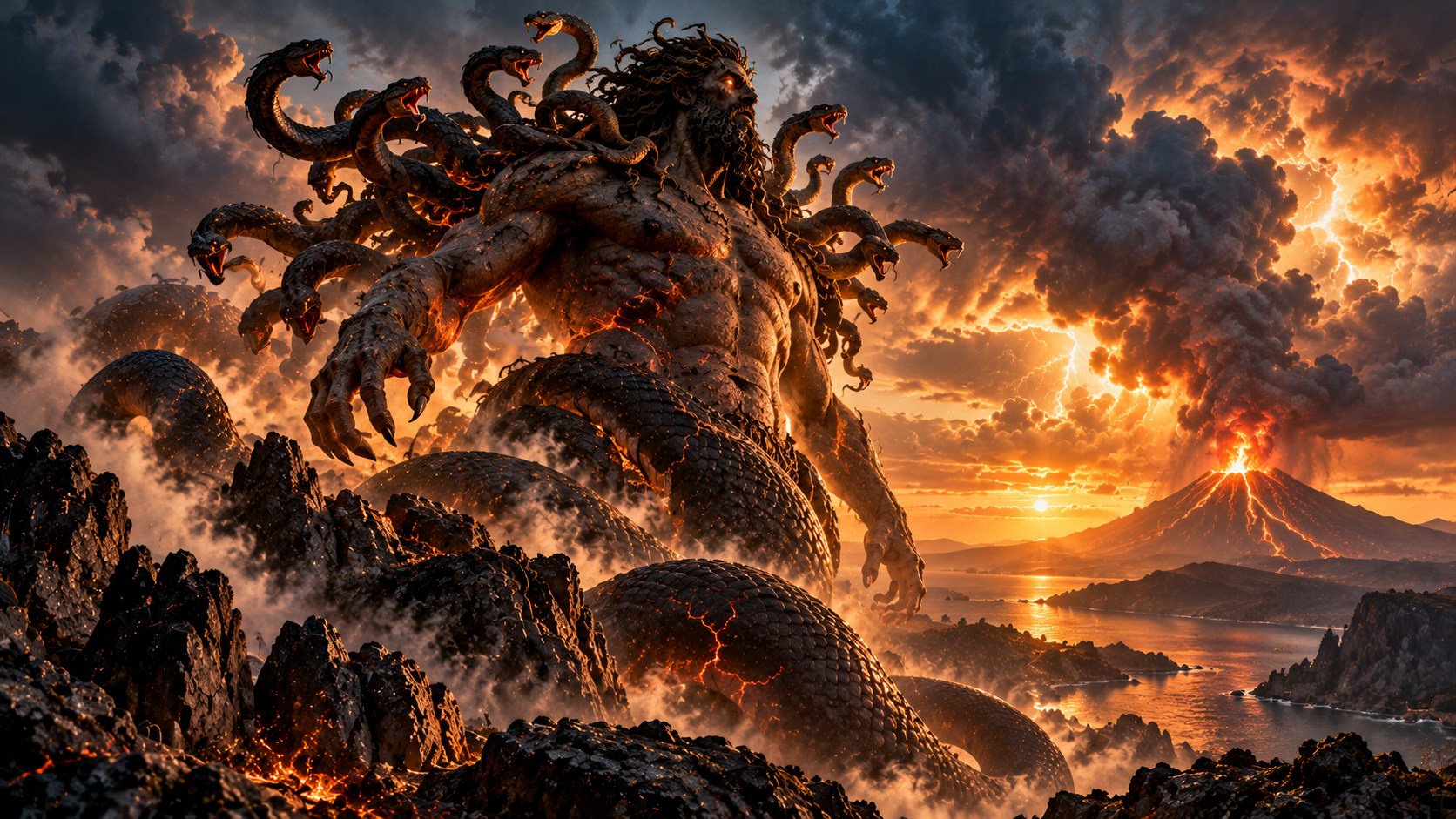
Hesiod describes a creature with a hundred serpentine heads, extraordinary voices, and fire. His menace threatens the rule of the gods themselves. This is the poem's imaginative portrayal of a cosmic adversary, not independent testimony to a historical being. [2]
Hesiod: Zeus' thunderbolts and the defeat
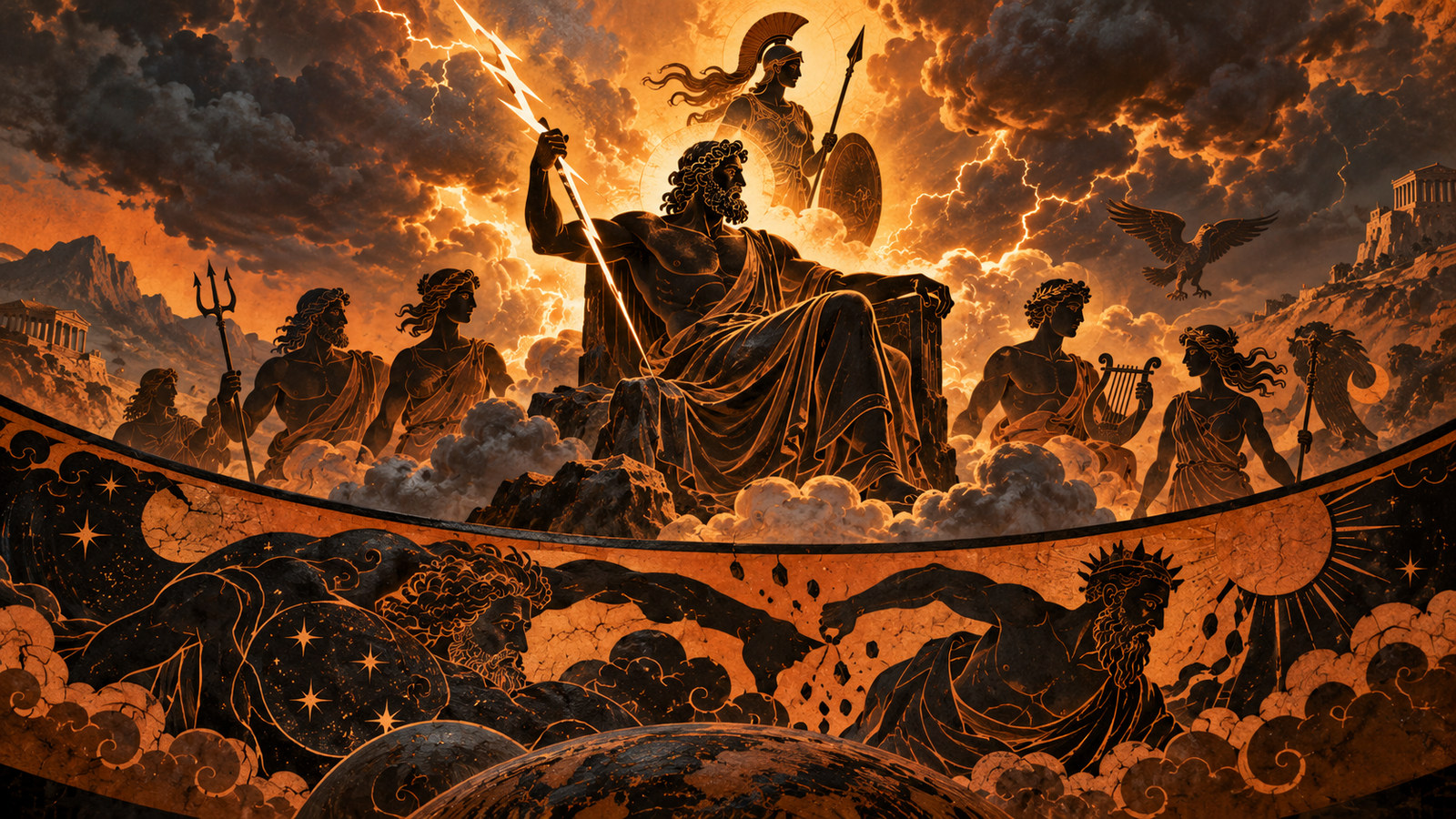
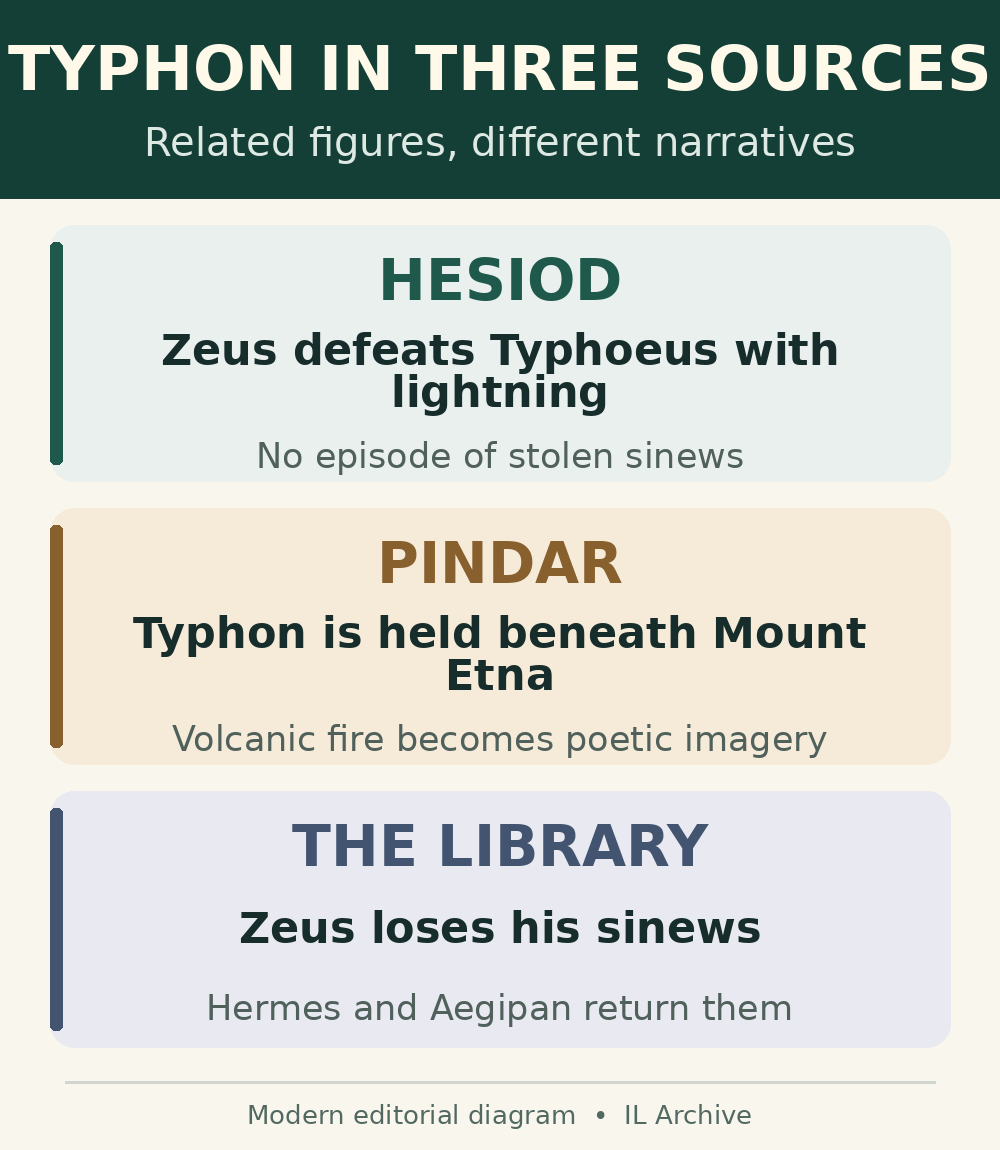
In Theogony 820–868, ZeusZeusZeus is the sky god and leading deity in many Greek traditions. In the Iliad he presides over divine gatherings while others can still speak and object.Glossary · Click to read the explanation, leader of the Olympian gods, confronts Typhoeus after the overthrow of the Titans. Thunder, fire, and upheaval shake the earth, sky, and sea. Zeus strikes the monster with his thunderbolts and casts him into TartarusTartarusDeep abyss in Greek poetic imagination, named by Zeus as a place of punishment in the Iliad.Glossary · Click to read the explanation. The following verses connect Typhoeus with destructive storm winds while distinguishing several beneficial winds. [2][10]
These verses never say that Zeus' sinews were removed or returned by HermesHermesGreek god acting as a messenger in the Odyssey passages examined here.Glossary · Click to read the explanation. That episode belongs to a different telling preserved later. The distinction is between literary witnesses and their contents, not between two independently documented historical events. [2][6]
Pindar: Typhon beneath Mount Etna
In his first Pythian ode, connected with an athletic victory in 470 BCE, the lyric poet PindarPindar, Greek lyric poetGreek poet, about 518–438 BCE, linking athletic victories with gods, genealogies and cities.Glossary · Click to read the explanation locates Typhon's confinement beneath parts of southern Italy and Sicily. A cave in CiliciaCiliciaHistorical region on Anatolia’s southern coast in modern Türkiye, with plains and uplands connected to the Levant and Anatolian interior.Glossary · Click to read the explanation belongs to his earlier story. Snowy Mount Etna becomes a crushing weight upon the monster, while its fiery eruptions supply a striking image of mythical punishment. [7]
Pindar's language combines Tartarus with Mediterranean geography instead of simply replacing one location with another. The ode shows how poetic settings and symbols could change; it does not offer a geological account of volcanoes. [7]
The Library: sinews taken and recovered
The Library, traditionally ascribed to ApollodorusPseudo-ApollodorusName used for the author of the Bibliotheca, a Greek mythographic collection usually dated to the first or second century CE.Glossary · Click to read the explanation, is a later compilation of Greek myths. Its attribution to the earlier Alexandrian scholar is rejected, and the surviving work is commonly placed in the Roman period. In book 1 (1.6.3), Zeus chases Typhon towards CiliciaCiliciaHistorical region on Anatolia’s southern coast in modern Türkiye, with plains and uplands connected to the Levant and Anatolian interior.Glossary · Click to read the explanation. The monster coils around him, takes his weapon, and severs the sinews of his hands and feet. [6][8]
Typhon carries Zeus to the Corycian cave, hides the sinews in a bearskin, and entrusts them to a guardian called Delphyne. HermesHermesGreek god acting as a messenger in the Odyssey passages examined here.Glossary · Click to read the explanation and Aegipan steal them back and restore them to Zeus, who resumes the pursuit. Eventually Zeus throws Mount Etna upon Typhon. These are details in this later witness, not in Hesiod's account. [6][8]
What does comparison with Illuyanka show?
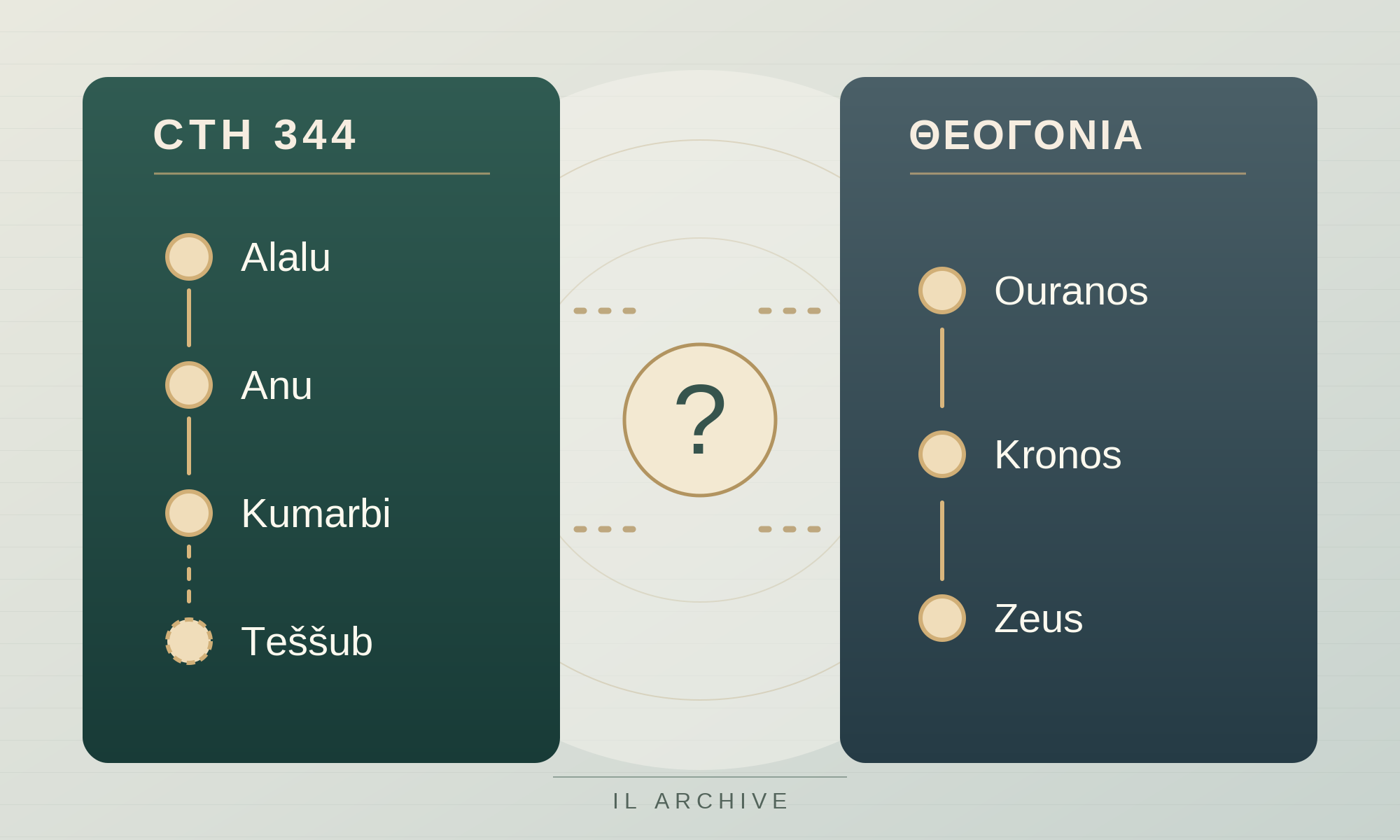
In the second Hittite telling of IlluyankaIlluyankaIlluyanka, Hittite for “serpent,” opposes the Storm-god in two CTH 321 accounts. In one, Inara and Hupasiya help trap it; in the other, the god’s son retrieves his stolen heart and eyes.Glossary · Click to read the explanation, preserved in the textual dossier CTH 321, the serpent takes the Storm-god's heart and eyes. The god recovers them through his son, who has married the serpent's daughter, before returning to battle. This invites comparison with Zeus regaining strength after his sinews are restored, but the stolen parts, helpers, and narrative settings are different. [9]
The edition by Hittitologist Gary BeckmanGary BeckmanScholar of the Hittite language, Hittite religion and ancient Near Eastern history, associated with the University of Michigan.Glossary · Click to read the explanation places the two Illuyanka narratives in a ritualRitualAn organised or distinguished practice meaningful to a community; it may leave traces, but its form alone does not reveal an associated doctrine.Glossary · Click to read the explanation and festival context. Their surviving copies should not simply be equated with the date of the stories' composition. Moreover, Hesiod never describes the loss of Zeus' sinews. Historical connections therefore require more than the shared image of a storm god and serpent: one must compare the dated witnesses, detailed motifs, and plausible contacts. The wider question is developed in the study of Typhon, Illuyanka, and Baal. [2][9]
What the witnesses establish
Hesiod portrays a cosmic enemy defeated by Zeus' thunderbolt; Pindar places the subdued Typhon under Etna; and the Library adds the removal and recovery of Zeus' sinews. Reading each in its own context reveals developments within Greek storytelling and provides a more precise basis for comparison with Anatolian texts. [2][6][7][9]
References and notes (6)
- Hesiod, Theogony 820–885, Typhoeus’ description, defeat, and the winds; H. G. Evelyn-White’s 1914 translation, with the opening checked against Greek. Theogony 820–885, especially 820–868 and 869–885; Evelyn-White (1914) Return to the text ↑
- Pseudo-Apollodorus, Library 1.6.3, the Typhon episode. The university anthology presents Kevin Aldrich’s translation adapted by T. Mulder. Bibliotheca 1.6.3, “Zeus Defeats Typhon”; Mythoi Koinoi Return to the text ↑
- Pindar, Pythian Ode 1.15–29, concerning Cilicia, Sicily, Cumae and Etna, in the English edition on Perseus; checked against the Greek passage reproduced by Exeter. Pythian 1.15–29 (470 BCE) Return to the text ↑
- Pseudo-Apollodorus, Library 1.6.3; James George Frazer’s Loeb English translation (1921), including the Corycian cave and the recovery of Zeus’ sinews. Bibliotheca 1.6.3; Frazer (1921) Return to the text ↑
- Gary Beckman, “The Anatolian Myth of Illuyanka,” JANES 14 (1982), 11–25; text editions and translation, chronological note on surviving copies, and discussion of ritual context. pp. 11–12, 19–21, 24–25, especially CTH 321 §§21’–26’ Return to the text ↑
- Greek original of Hesiod’s Theogony, lines 820–835, consulted for the name and opening description of Typhoeus; the victory scene was read in English translation. Greek 820–835 (compared with Evelyn-White 820–885) Return to the text ↑
Suggest a correction · Suggest a source for this record
Cite this record
IL Archive, «Typhon / Typhoeus», https://ilarchive.com/en/entities/typhon
Continue reading