Entity
Stone-born People in Deucalion’s Story
A reference page linking a name, group, or concept to the materials that discuss it.
A Greek mythical motif: humanity renewed from stones after Deucalion and Pyrrha’s flood. Pindar mentions it; Ovid and Pseudo-Apollodorus detail the transformation, differing on the oracle and how the stones are cast.
Estimated reading time: 8 min Published Last reviewed:
Share article

Text
Introduction
The “stone-born people” are a Greek narrative motifLiterary motifA narrative or imagistic element recurring within or across stories; its role and context matter, and repetition alone cannot prove borrowing.Glossary · Click to read the explanation explaining how a human community is renewed after the flood of Deucalion and Pyrrha. Ordinary reproduction is replaced by stones becoming men and women through divine agency. Pindar mentions a people of stone-born descent; later accounts specify how stones are thrown. These witnesses are not interchangeable, however, and details found in one version should not automatically be read into another.
This entry examines the motif rather than retelling Deucalion’s entire life or claiming to settle the eastern origins of the Greek flood story. It compares Greek and Latin texts, separating their actual statements from linguistic or symbolic interpretation and from hypotheses about the ages of underlying traditions. [2][3][4]
Stone-born descent in the poetic witnesses
A passage from the Hesiodic Catalogue of WomenHesiodic Catalogue of WomenGreek genealogical poem, mostly lost, whose fragments preserve Deucalion’s family and Greek lineages.Glossary · Click to read the explanation may preserve an early allusion. It does not survive in a complete manuscript of the poem but is quoted by the geographer Strabo in Geography 7.7.2, in a discussion of the Leleges and Locrians. The quotation describes ZeusZeusZeus is the sky god and leading deity in many Greek traditions. In the Iliad he presides over divine gatherings while others can still speak and object.Glossary · Click to read the explanation giving Deucalion the following: [5]
The phrase allows a reading of “stones selected from the earth,” alongside an interpretive play on “people selected from the earth.” The ambiguity between “stones” and “people” belongs to how the fragment is understood, not to a proven etymology. The surviving lines describe neither a throwing of stones nor Pyrrha’s role: reconstructing the entire throwing episode from them would exceed the evidence. Strabo himself proposes an interpretation involving people drawn together from different groups, indicating that the wording could be understood in more than one way. Nor does the attribution to HesiodHesiodGreek poet whose major work is generally dated to the late eighth or early seventh century BCE, including the Theogony.Glossary · Click to read the explanation guarantee that every part of the Catalogue was composed in his lifetime. Many scholars place its final composite form in the sixth century BCE, although its formation and dating remain disputed. [5][6]
An unmistakable reference to stone-born offspring appears in PindarPindar, Greek lyric poetGreek poet, about 518–438 BCE, linking athletic victories with gods, genealogies and cities.Glossary · Click to read the explanation’s Olympian 9, an ode celebrating the wrestler Epharmostus of OpusOpus, ancient Locrian cityAncient Greek city linked with Deucalion’s genealogies and Pindar’s ninth ode, near present-day Atalanti.Glossary · Click to read the explanation, in Locris, around the middle of the fifth century BCE. Describing PyrrhaPyrrha in Deucalion’s flood storyGreek figure surviving with Deucalion and associated with humanity’s renewal from stones.Glossary · Click to read the explanation and DeucalionDeucalion in Greek Flood TraditionsDeucalion and Pyrrha in Greek and Latin flood accounts: genealogy, survival, stone-born people, local traditions and Near Eastern parallels, with attention to variant sources and dates.Glossary · Click to read the explanation after their descent from Mount ParnassusMount ParnassusMountain massif in central Greece near Delphi, associated with Deucalion and Pyrrha’s survival.Glossary · Click to read the explanation, he writes: [2]
Our translation from Greek is: “Without sexual union they founded a stone-born lineage sharing a single homeland; and they were called a people.” The ode connects this ancestry with the city’s forebears and, in the following verses, tells of the floodwaters receding through Zeus’s contrivance. It does not describe stones being thrown, the sex of those produced, or an oracle’s wording. Such details belong to other attestations, not to Pindar’s own lines. [2]
How do stones become human? Two distinct accounts
In the Roman poet OvidOvidOvid was a Roman poet writing in Latin, who lived from 43 BCE to about 17 CE. His best-known works include the Metamorphoses.Glossary · Click to read the explanation’s MetamorphosesOvid’s MetamorphosesLatin epic from the early first century CE collecting transformations, including Lycaon and Deucalion’s flood.Glossary · Click to read the explanation, Deucalion and Pyrrha approach the sanctuary of ThemisThemisGreek goddess instructed in the Iliad to gather the gods for a meeting with Zeus.Glossary · Click to read the explanation, a goddess associated with divine order and oracles, after the flood has devastated humankind. Her answer is deliberately cryptic. Book 1, line 383, reads in Latin: [4]
Our translation: “And cast the bones of the great mother behind your backs!” Pyrrha first objects to what seems like the violation of her mother’s remains. Deucalion then interprets the “mother” as the Earth and her “bones” as stones. Ovid makes this reading explicit: [4]
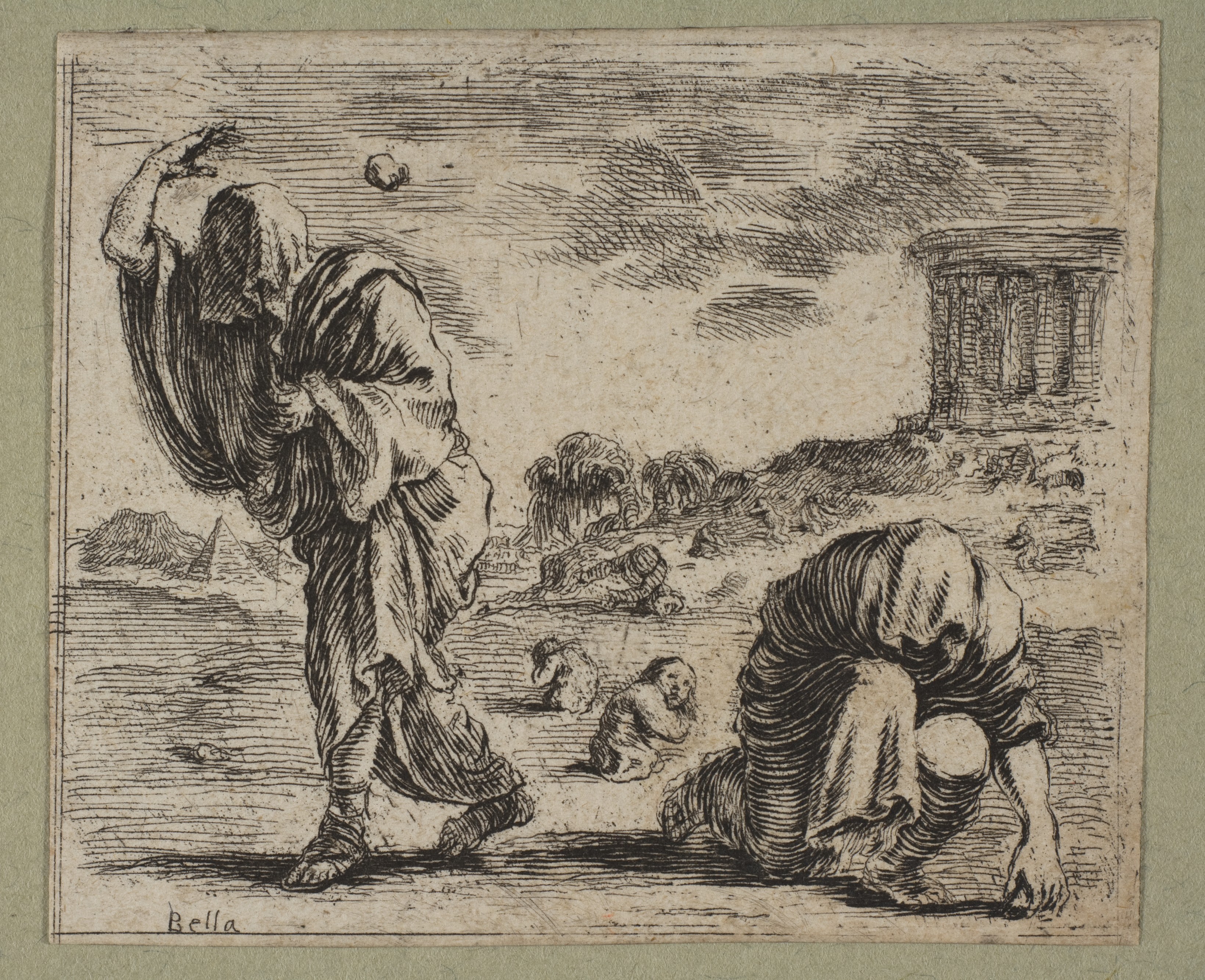
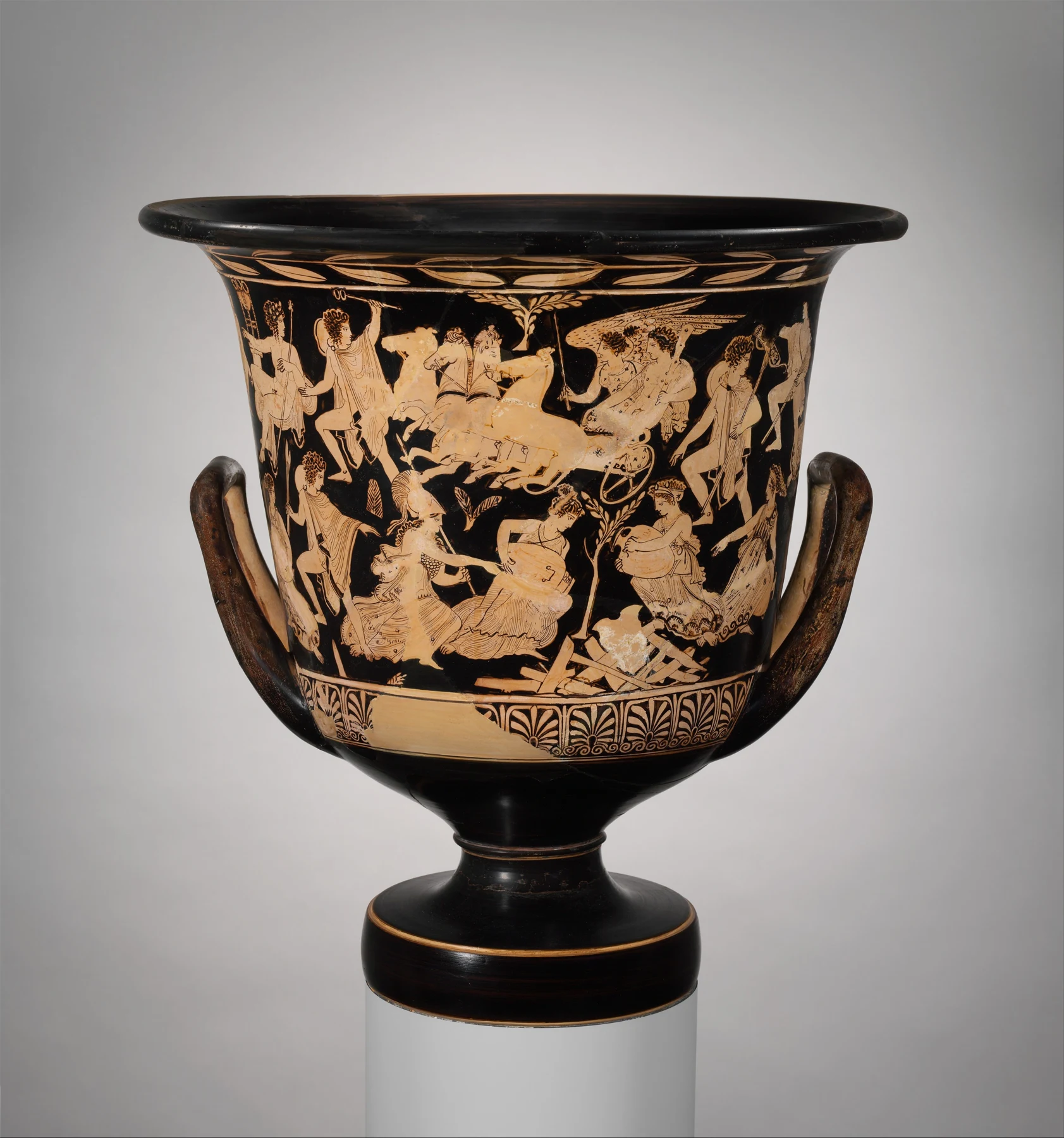
“The great mother is the Earth; I believe stones in the Earth’s body are called bones.” Covering their heads and loosening their garments, they throw stones behind them. The stones slowly soften and acquire human outlines, resembling unfinished marble statues; stones thrown by the man become men, those thrown by the woman become women. Ovid thus makes the rebirth depend on interpreting an oracle’s metaphor and portrays the bodily transformation as gradual rather than as a mere instantaneous result. [4]
By contrast, in Library 1.7.2, the anonymous author conventionally known as Pseudo-ApollodorusPseudo-ApollodorusName used for the author of the Bibliotheca, a Greek mythographic collection usually dated to the first or second century CE.Glossary · Click to read the explanation relates how PrometheusPrometheusGreek divine figure advising and protecting humans in some Deucalion accounts.Glossary · Click to read the explanation, Deucalion’s father, advised him to build a chest for himself and Pyrrha. After nine days and nights adrift it reached Parnassus, where the survivor sacrificed to Zeus. Zeus sent HermesHermesGreek god acting as a messenger in the Odyssey passages examined here.Glossary · Click to read the explanation to offer the fulfilment of a wish; Deucalion asked that people should come into being. The instruction therefore comes from Zeus, not from Themis’s oracle, and stones are cast over the head, rather than behind the back as in Ovid. The Greek states: [3]
“The stones Deucalion cast became men, while those cast by Pyrrha became women.” Both narratives assign male and female offspring to the respective throwers, but the commanding deity, physical action, and narrative framework differ. The Library also explicitly says that some other people survived by reaching high mountains. It is therefore inaccurate to present the couple as its unquestionably sole survivors, or to confuse the stone-born group with their biological children. The same passage separately names their genealogical offspring, including HellenHellen, Greek genealogical figureFigure associated with Greek genealogies, presented as Deucalion and Pyrrha’s son.Glossary · Click to read the explanation. [3]
Parnassus or Mount Etna?
A noteworthy geographical variation appears in the Fabulae traditionally attributed to Hyginus, section 153a. Here the couple flees to Mount Etna in Sicily, not Parnassus. Their loneliness drives them to ask Jupiter either to provide other human beings or to subject them to the same fate as the dead. He orders them to throw stones behind themselves: his stones turn into men and hers into women. The Latin reads: [7]
That is, “who fled to Mount Etna, said to be the highest mountain in Sicily.” This divergence does not, by itself, tell us when the Etna variant arose or how it circulated. Furthermore, the date and authorship of the received Fabulae are textually problematic. Its first printed edition of 1535 depended on a later manuscript, and modern editors caution against simply assigning its current wording to Hyginus, who lived under Augustus. The passage is evidence of a transmitted version, not proof that one geographical variant predates another. [7][9]
What do the stones mean? Survival, wordplay, and the Earth
Pindar’s descent from stone without sexual union provides an alternative genealogy for a people, connecting Opus and its ancestors with the aftermath of the flood. Ovid makes the hardness of stone an explanation for human resilience. His closing line that “we are a hardy race, experienced in toil” (1.414–415) is a literary explanation, not an anthropological account of humanity’s material origin. His image of the Earth’s “bones” also allows new life to emerge from a universal mother without requiring an actual offence against a human mother’s remains. These are readings of the texts’ literary effects, not a claim about one uniform Greek belief. [2][4]
The Library explicitly explains Greek λαοί (laoi, “people”) by appealing to λᾶας (laas, “stone”), and calls the link metaphorical. Pindar likewise brings the sound of the word for “people” into proximity with “stone-born offspring.” Such associations belong to ancient explanatory wordplay or folk etymology, not to a proven historical derivation of the word “people” from the word “stone.” Indeed, specialist comparative-lexical research notes that the origin of λᾶας itself remains unsettled. The older wording preserved by Strabo is open to more than one interpretation and cannot resolve the question of linguistic descent. [3][5][10]
Chronology, composition, and transmission
- Time within the myth: the flood and renewal belong to a legendary past without a demonstrable calendar date.
- Hesiodic Catalogue: lines quoted by Strabo in Geography 7.7.2; many scholars place the poem’s final composite form in the sixth century BCE. Neither claim securely dates each individual line or establishes that the full throwing story stood in this fragment. [5][6]
- Pindar: Olympian 9, mid-fifth century BCE; an ode using stone descent in praise of a city, without spelling out the act of throwing. [2]
- Ovid: Metamorphoses, early first century CE; Latin poetry supplying Themis’s riddle and the physical sequence of transformation. [4]
- Pseudo-Apollodorus: the Library is usually placed in the Roman Imperial period, approximately the first or second century CE, rather than assigned to the second-century-BCE scholar Apollodorus of Athens. Frazer’s 1921 translation is a modern means of accessing it, not its date of composition. [3][8]
- Hyginus’s Fabulae: the surviving compilation resists a secure, single compositional date. The manuscript used for the 1535 printed text witnesses later transmission, not the creation of the account. [9]
The order of surviving witnesses is not necessarily the order in which the narrative components originated. A later writer may retain earlier traditions or refashion them to different literary ends. The extant passages do not establish a complete stemma in which every detail can be traced back to one reconstructed original. [5][6][9]
Comparison with earth-made humanity and other flood stories
Within the Metamorphoses itself, Ovid describes an earlier formation of human beings from earth and water (1.82–86), while Deucalion later wishes he could shape humans using the arts of his father Prometheus and breathe life into moulded earth (1.363–365). The poem thus accommodates both an initial creation from earth and a post-disaster renewal from its stones. These need not represent successive historical stages of a single religious doctrine. [4]
The Oxford Electronic Text Corpus of Sumerian Literature preserves a Sumerian flood narrative in which human creation precedes the catastrophe (section A.10–14), followed by ZiusudraZiusudraA literary king-priest in the fragmentary Sumerian Flood Story (ETCSL 1.7.4). He survives by boat, sacrifices, and receives divine life from An and Enlil in Dilmun. The surviving copy is Old Babylonian; his historicity is unproven.Glossary · Click to read the explanation, a warning, and a flood in the surviving sections C–E. Those extant sections do not narrate human beings emerging from thrown stones; substantial gaps, however, make categorical claims about every lost passage unwarranted. The AkkadianAkkadianAn ancient East Semitic language written in cuneiform from the third millennium BCE; its varieties include Babylonian and Assyrian, and it served in international diplomacy.Glossary · Click to read the explanation AtrahasisAtrahasis: Epic and HeroAkkadian narrative on human creation, relations with the gods and the flood, named for its survivor warned by Enki. Its surviving manuscripts differ in date and preservation; its hero must not be equated uncritically with every Utnapishtim version.Glossary · Click to read the explanation tradition is mentioned here only within the limits of the published scholarly edition’s bibliographical description and publisher synopsis: the Akkadian text of the tablets was not examined in this review, so the stones episode or other unverified details must not be attributed to it. [11][12]
Shared patterns such as “devastating flood, survivor, renewed humanity” invite functional comparison. They do not by themselves show that Deucalion’s stones were borrowed from a Sumerian or Akkadian text. A historical claim of transmission would require distinctive shared details, a demonstrable chain of evidence, and a plausible route of contact. The secure conclusion is narrower: birth from stones is expressly present in certain surviving Greek and Roman accounts, but the detailed prehistory of the motif remains open to investigation. [2][3][4][11][12]
References and notes (11)
- Pindar, Olympian 9.40–56, especially 42–56; Greek text presented after Christ–Schroeder (1937), read directly in Gadsden Classics. Pindar, Olympian 9, lines 40–56, Greek text (Christ–Schroeder 1937) Return to the text ↑
- Pseudo-Apollodorus, Library 1.7.2, Greek text and J. G. Frazer’s 1921 translation compared; editorial supplements in the travel-duration clause are bracketed in the online Greek. Pseudo-Apollodorus, Library, book 1, §7.2; Greek and Frazer translation (1921) Return to the text ↑
- Ovid, Metamorphoses 1.82–86 and 1.313–415, especially 1.363–415; Latin read in The Latin Library (online transcription without critical apparatus); an older English rendering was consulted as a check, not reproduced. Ovid, Metamorphoses, book 1, lines 82–86, 313–415 (especially 363–415) Return to the text ↑
- Strabo, Geography 7.7.2; original Greek quoting three lines attributed to the Hesiodic Catalogue, plus Strabo’s own explanation; compared with Evelyn-White’s old fragment 82 rendering without treating its expansion as preserved Greek verse. Strabo, Geography 7.7.2; Hesiodic Catalogue quotation (older fragment no. 82) Return to the text ↑
- Richard Hunter, ed., The Hesiodic Catalogue of Women: Constructions and Reconstructions (Cambridge University Press, 2005), Introduction, printed pp. 1–3 (especially p. 2), publisher’s open PDF excerpt; dating and genealogical structure. Hunter (ed.), Introduction, printed pp. 1–3; PDF pages 1–3 of the 10-page excerpt Return to the text ↑
- Hyginus, Fabulae 153a, “Deucalion and Pyrrha”; Latin section read in LinguaLatina/texts; composition and attribution remain uncertain. Hyginus (attributed), Fabulae, section 153a, paragraphs 1–3 Return to the text ↑
- Stephen M. Trzaskoma, “Apollodorus,” Oxford Bibliographies in Classics (29 November 2017); freely available introduction/extract only, for disputed authorship and early-Imperial dating; paywalled remainder not read. Trzaskoma, “Apollodorus,” accessible Introduction/extract only (2017) Return to the text ↑
- Wilfred Major, review of Peter K. Marshall’s edition of Hyginus, Fabulae, Bryn Mawr Classical Review 2003.06.37; opening discussion of textual transmission, the manuscript behind the 1535 print, and insecure attribution. Major (2003), BMCR 2003.06.37, opening paragraphs on textual history Return to the text ↑
- IE-CoR, comparative cognate set 5105 for Greek λᾶας “stone”; database entry and its quoted assessments from Frisk, Chantraine and Beekes read; the underlying books themselves were not read. IE-CoR, Cognate Set 5105, entry “stone,” etymological notes Return to the text ↑
- Oxford ETCSL, “The Flood story” t.1.7.4; surviving English translation, sections A–E, especially A.10–14, C.1–27, D.1–11, E.3–11, including lacunae; no direct reading of the Sumerian signs/tablets. ETCSL t.1.7.4, surviving sections A–E and indicated lacunae Return to the text ↑
- W. G. Lambert, A. R. Millard, with Miguel Civil, Atra-Hasis: The Babylonian Story of the Flood, with the Sumerian Flood Story (1969; Eisenbrauns publisher listing); publisher description and bibliographical information only, NOT the Akkadian tablets or full book. Replaces a broken inherited secondary PDF link. Lambert, Millard & Civil, Atra-Hasis, publisher listing/description only; no tablet lines or page claims Return to the text ↑
Suggest a correction · Suggest a source for this record
Cite this record
IL Archive, «Stone-born People in Deucalion’s Story», https://ilarchive.com/en/entities/stone-born-people-deucalion
Continue reading