Entity
Apotheosis: acquiring divine status
A reference page linking a name, group, or concept to the materials that discuss it.
Apotheosis grants divine standing to a hero or ruler through myth, ritual or official act. The entry compares Heracles, Mesopotamian kings and Roman emperors, distinguishing it from hero cult and spiritual deification.
Estimated reading time: 7 min Published Last reviewed:
Share article
Text
Introduction
How did human beings or heroes acquire divine standing in some ancient traditions, and what evidence actually marks that change? This entry treats apotheosis not as a single universal event but as several distinguishable practices: a mythical transformation, religious honours, or a public recognition of a ruler's new status, sometimes after death and sometimes during life.
The point of departure is HeraclesHeracles, Greek heroA hero of Greek traditions, also known as Hercules; rescues Alcestis in Euripides’ play, while other witnesses depict his apotheosis.Glossary · Click to read the explanation in Greek poetry and art, followed by royal ideology in MesopotamiaMesopotamiaHistorical region associated with the Tigris and Euphrates: Uruk, Ur, Eridu, cuneiform, Sumer, Akkad, Babylon and Assyria, their languages and cults, and the limits of archaeological evidence.Glossary · Click to read the explanation and official honours at Rome. Keeping these cases distinct explains why returning from death or travelling to heaven is not, by itself, equivalent to becoming a god.
Guide to the sections
- What apotheosis means and how it is evidenced.
- Heracles in Greek poetry and historiography.
- The Attic vessel in the Metropolitan Museum.
- Ovid's Latin retelling.
- Divine worship and the cult of heroes.
- Royal deification in Mesopotamia and Rome.
- Related experiences that do not amount to apotheosis.
- What comparison can and cannot establish.
What counts as apotheosis?
The English word apotheosis, from Greek for making someone a god, denotes the attribution of divine rank to a figure formerly presented as human or heroic. It does not name a fixed universal procedure. A myth may tell of a hero's reception among the gods; an inscription may document divine titles and offerings; a government may institutionalise honours for a dead ruler. Our task is to describe the evidence rather than to pronounce on the truth of its religious claims. [9]
For each case, the questions are who bestowed the new standing, when, and according to which source? Calling a king “godlike” does not alone prove that he was worshipped. Nor does memorialising the dead automatically mean believing they have become gods. The time attributed to an event in a story must be kept separate from the date on which the surviving text or image was made.
Heracles in Greek poetry and historical writing
In Hesiod's TheogonyHesiod’s TheogonyGreek poem on divine generations and Zeus’s kingship; its surviving form does not identify all of Hesiod’s sources.Glossary · Click to read the explanation, attributed to the poet HesiodHesiodGreek poet whose major work is generally dated to the late eighth or early seventh century BCE, including the Theogony.Glossary · Click to read the explanation, lines 950–955 place Heracles, after his labours, on Mount OlympusMount OlympusMountain in northern Greece associated in ancient traditions with the divine community’s dwelling.Glossary · Click to read the explanation as the husband of Hebe, daughter of ZeusZeusZeus is the sky god and leading deity in many Greek traditions. In the Iliad he presides over divine gatherings while others can still speak and object.Glossary · Click to read the explanation and Hera. He lives among the immortals without ageing. This is literary testimony about a mythic destiny, not an independently dated event in a person's life. It also predates the surviving vase under discussion; neither text nor object should be treated as a direct copy of the other without evidence. [10]
In the fifth century BCE, HerodotusHerodotusFifth-century BCE Greek historian whose account of the Persian Wars includes reports on peoples, court and empire.Glossary · Click to read the explanation observed in Histories 2.44.5 that certain Greeks honoured Heracles in two ways: sacrifices as to an immortal Olympian god, and offerings as to a dead hero. His report attests to distinctions he perceived in practice; it cannot be turned into a rule that every Greek city followed one uniform ritualRitualAn organised or distinguished practice meaningful to a community; it may leave traces, but its form alone does not reveal an associated doctrine.Glossary · Click to read the explanation. [11]
What the Metropolitan Museum vase shows
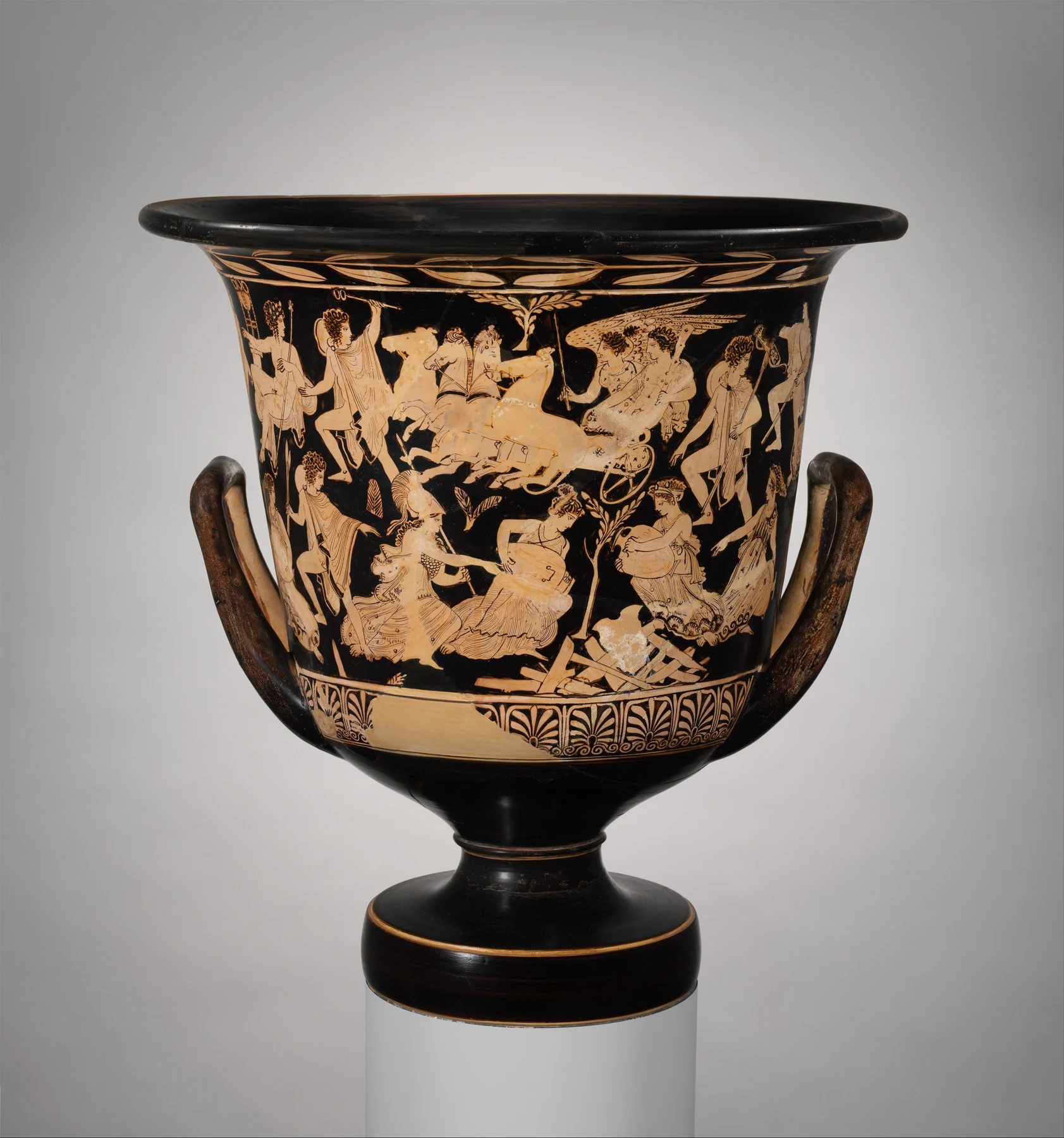
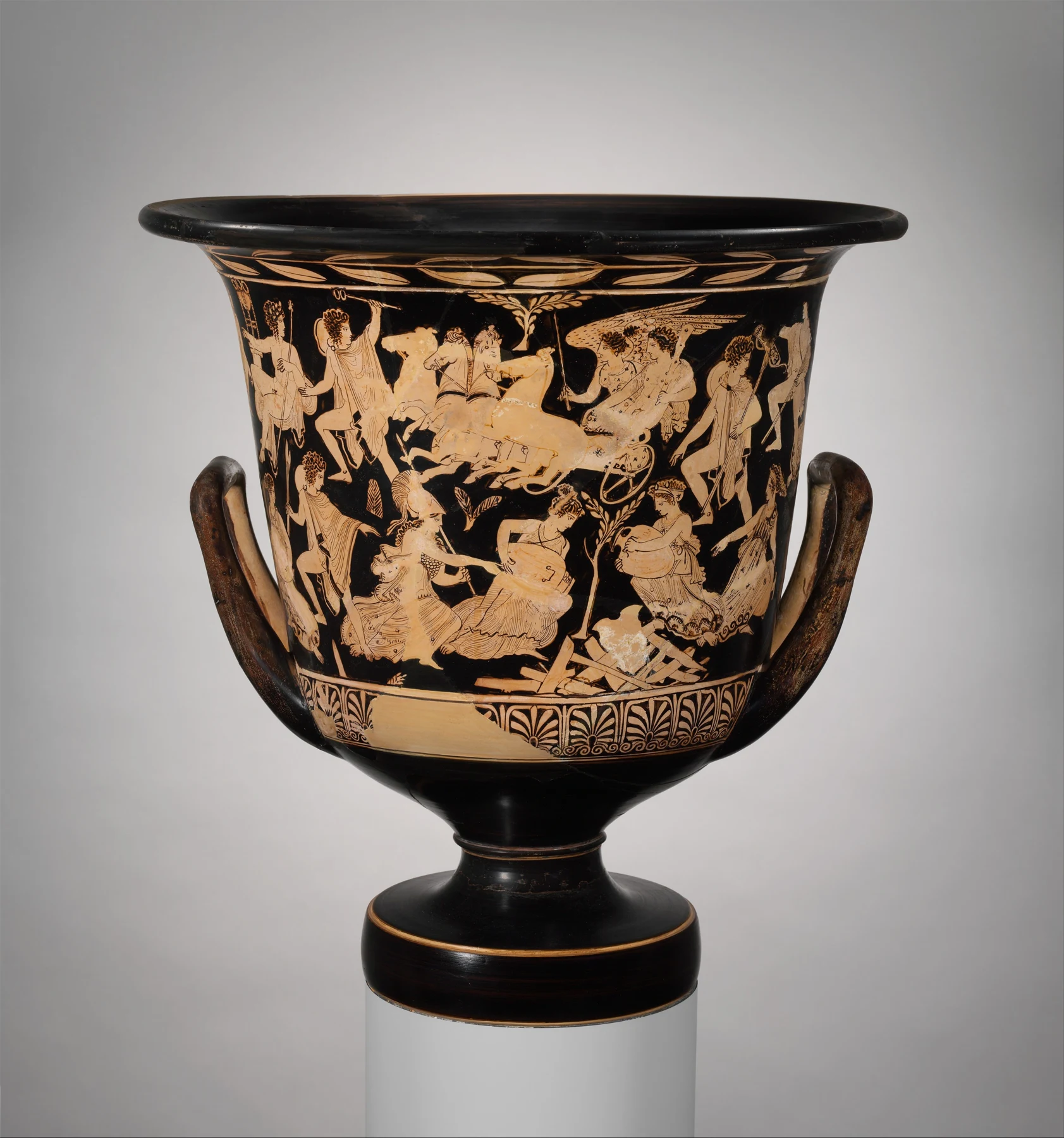
An Attic red-figure calyx-krater, a vessel for mixing wine and water made in the fourth century BCE, shows Heracles travelling to Olympus in a four-horse chariot driven by Nike (Victory), preceded by HermesHermesGreek god acting as a messenger in the Odyssey passages examined here.Glossary · Click to read the explanation. Deities wait for him above, while below a funeral pyre and a corselet mark what he leaves of his mortal condition. The Metropolitan Museum labels this side “the death and apotheosis of Herakles”; the reverse portrays Amymone and satyrs. Its accession number is 52.11.18. The date belongs to the vase, not to the mythic action depicted. [8]
The vessel is evidence for the representation of apotheosis in fourth-century Attic art. It does not depict AlcestisAlcestis in Euripides’ playA Greek narrative figure who accepts death for her husband Admetus and returns at the end of Euripides’ play, performed in 438 BCE.Glossary · Click to read the explanation returning home, nor does it document a Mesopotamian or Christian rite. Our cover is a modern photograph of an identified ancient object; the museum labels its image Public Domain. [8]
Ovid's different literary explanation
In the MetamorphosesOvid’s MetamorphosesLatin epic from the early first century CE collecting transformations, including Lycaon and Deucalion’s flood.Glossary · Click to read the explanation, book 9, lines 239–272, the Roman poet OvidOvidOvid was a Roman poet writing in Latin, who lived from 43 BCE to about 17 CE. His best-known works include the Metamorphoses.Glossary · Click to read the explanation (active around the turn of the common era) reworks Heracles' death. JupiterJupiter, Roman deityRoman counterpart of Greek Zeus, deciding the flood in Ovid’s Metamorphoses.Glossary · Click to read the explanation explains that the fire consumes the portion inherited from the hero's mortal mother; the part derived from Jupiter is immortal and the hero is taken heavenward. This account can be checked against the Latin passage and a published French translation without reproducing that translation at length. [12]
Differences between a Greek poem and a Roman narrative do not represent rival eyewitness reports of a datable historical episode. They are distinct literary treatments of myth. Nor does the presence of a chariot in both Ovid's later poem and the much earlier vase establish that he copied this particular artwork.
A god, a hero, or both?
Herodotus' observation already complicates any simple classification of Heracles. In the abstract of a specialist chapter, Jennifer Larson describes cult practices that varied widely across Greek locations: some resembled honours to a hero, others treated Heracles as a god. A separate scholarly study stresses how his exceptional status between hero and deity was expressed by his story of apotheosis as well as by cult practice. This review used both abstracts and checked an available opening extract of Emma Stafford’s chapter, but did not read either complete chapter. [13][9]
Hero cult could centre on the memory, powers and local worship of a dead exceptional person. Apotheosis, as in Heracles' story, could additionally present accession to the company of immortals and divine worship. The boundaries were not absolute: the same figure could receive different kinds of honours. Ritual, locality, titles and images are therefore more informative together than a bare label of “hero” or “god”.
Mesopotamian kings: exalted images and royal praise
Royal divine status in Mesopotamia should not be fitted to the model of Heracles. The Metropolitan Museum's account of third-millennium art describes an AkkadianAkkadianAn ancient East Semitic language written in cuneiform from the third millennium BCE; its varieties include Babylonian and Assyrian, and it served in international diplomacy.Glossary · Click to read the explanation ruler, Naram-Sin, represented as exceptionally large and wearing a horned crown associated with deities. But the exalted visual portrayal of a king does not, by itself, narrate an ascent to heaven or specify the rites performed for him. [14]
In royal praise poems for Šulgi of Ur's Third Dynasty, the Oxford Electronic Text Corpus of Sumerian Literature translates Šulgi D, lines 1–13, as presenting the king in a “diadem of godhead” and as favoured by the gods. Other hymns openly describe the promotion of his praises. These are sources for royal religious language, to be set alongside administrative texts, inscriptions and cult evidence; poetic self-celebration is not a literal inventory of everyday religious practice. Here the published English translation was read, not the Sumerian originals independently deciphered. [15]
Art historian Tallay Ornan argues in the published abstract of a specialised chapter that Mesopotamian images were often more restrained about openly deifying kings than written formulations. We must therefore distinguish textual titles, visual conventions and actual rites, and distinguish the Akkadian age of Naram-Sin from Šulgi's later Ur III kingdom. [16]
Rome: a religious and political institution
Roman imperial divinisation acquired a public and institutional form. After Julius Caesar's assassination in 44 BCE, he became Divus Iulius, officially recognised in 42 BCE; the divinisation of Augustus after his death in 14 CE helped establish a line of rulers honoured as divi. Honours to a living ruler, posthumous consecration, provincial practice and central decisions at Rome were not necessarily the same thing. [17][18]
Michael Koortbojian studies the monuments, coins, ritual and changing iconography through which the new status was made visible. Reviewing his book, W. Jeffrey Tatum notes that Koortbojian's distinction between the honours Caesar received while alive and his divinity after death is contested. The date of a formal decision thus cannot settle every contemporary belief about Caesar's standing. The source access for this review comprises the university's book description and an academic review, not all chapters of Koortbojian's book. [17][18]
Related cases that are not identical
In Euripides' Alcestis, performed in 438 BCE, Heracles brings AlcestisAlcestis in Euripides’ playA Greek narrative figure who accepts death for her husband Admetus and returns at the end of Euripides’ play, performed in 438 BCE.Glossary · Click to read the explanation back to her husband AdmetusAdmetus in AlcestisAlcestis’s husband in Greek narrative, allowed to escape death if another person dies for him; his wife accepts the exchange.Glossary · Click to read the explanation after grappling with Death, according to the closing scene. She returns as a living woman to her household; the play does not announce her entry among the Olympian gods. This makes the episode a useful contrast, not a correct identification of the scene on the vase. [19]
Genesis 5:24 says that God took EnochEnoch son of JaredEnoch son of Jared is a figure in the genealogy of Genesis 5, seventh when counted from Adam.Glossary · Click to read the explanation, while 2 Kings 2:11 describes Elijah ascending to heaven in a whirlwind. Neither cited verse declares the figure to be a new god receiving worship. Christian discourse on theosis or deification commonly concerns participation in divine life through grace—for instance in relation to 2 Peter 1:4—and needs to be described in its own theological terms, rather than equated with the imperial consecration of a Roman ruler. [20][21]
What the comparison establishes
It is reasonable to speak of Heracles' apotheosis when a text or an image presents his reception among the gods, and of a ruler's deification when titles, institutions or cult evidence substantiate divine rank. Each instance should identify its evidence, date and voice: poetry, artwork, royal inscription, ritual, law or modern scholarly explanation.
The comparison shows several mechanisms of elevation: a mythic reward for deeds, the sacral praise of a living king, and political consecration after death. Sharing the same modern term does not establish direct borrowing between cultures, and a literary narrative is not a chronicle of a verified event. This is why apotheosis is useful as an analytic term without being a synonym for every rescue from death or every ascent to the divine world.
References and notes (14)
- The Metropolitan Museum of Art, object 52.11.18. Its catalogue identifies the obverse as Heracles’ death and apotheosis and the reverse as Amymone, and marks the image Public Domain. The catalogue and local image were checked; the API was not separately accessed in this review. Object 52.11.18; Attic red-figure calyx-krater, fourth century BCE; both scenes and Public Domain notice. Return to the text ↑
- Emma Stafford, “Herakles Between Gods and Heroes”, in The Gods of Ancient Greece: Identities and Transformations, ed. Jan N. Bremmer and Andrew Erskine (2010), pp. 228–244. Only the abstract and a Cambridge opening extract were consulted, not the complete chapter. Chapter 12, pp. 228–244 (2010); abstract and introductory extract only. Return to the text ↑
- Hesiod, Theogony 950–955; English translation published by Harvard’s Center for Hellenic Studies, passage only; no full-poem reading or independent Greek critical collation. Theogony 950–955; indexed English translated passage only. Return to the text ↑
- Herodotus, Histories 2.44.5, available English passage in the Perseus index excerpt, contrasting Olympian sacrifice with offerings to a dead hero; rest of book not read. Histories 2.44.5; indexed English translation excerpt only. Return to the text ↑
- Ovid, Metamorphoses IX.239–272, Latin text alongside the French translation by A.-M. Boxus and J. Poucet (2007), passage read on Bibliotheca Classica Selecta; not the whole poem. Metamorphoses IX.239–272; paired Latin text and French translation (2007). Return to the text ↑
- Jennifer Larson, “The Greek Cult of Heracles”, The Oxford Handbook of Heracles (2021), abstract only on ritual diversity and hero/divine honours; full chapter unavailable. Oxford Handbook of Heracles (2021), pp. 447–463; abstract only. Return to the text ↑
- Metropolitan Museum, “Art of the First Cities” exhibition overview (2003), paragraphs on Mesopotamian iconography and Naram-Sin’s horned crown; not the full exhibition catalogue. Art of the First Cities (2003), exhibition overview; Naram-Sin and horned-crown paragraphs. Return to the text ↑
- Oxford ETCSL, Sumerian royal praise poem Šulgi D, English translation lines 1–13, 18–31 and 40–52; Šulgi E 1–46 also viewed. No independent Sumerian reading. ETCSL 2.4.2.04, translated Šulgi D, lines 1–13, 18–31 and 40–52. Return to the text ↑
- Tallay Ornan, “A Silent Message: Godlike Kings in Mesopotamian Art” (2014), pp. 569–595, peer-reviewed chapter: university-published abstract only, full chapter not read. Critical Approaches to Ancient Near Eastern Art (2014), pp. 569–595; abstract only. Return to the text ↑
- Michael Koortbojian, The Divinization of Caesar and Augustus (Cambridge, 2013): Princeton University book description only, not the inaccessible full chapters. The 42 BCE dating is checked separately in Tatum [18]. Princeton University faculty-book description (2013); book itself not read. Return to the text ↑
- W. Jeffrey Tatum, review of Koortbojian, Bryn Mawr Classical Review 2014.08.51, complete review read. Notes honours in Caesar’s lifetime, formal Divus Iulius in 42 BCE, and disagreement over the claim that he was not divine before death. BMCR 2014.08.51; complete review, especially formal deification in 42 BCE. Return to the text ↑
- Euripides, Alcestis (performed 438 BCE), Richard Aldington’s English translation at the MIT Internet Classics Archive; final recognition/return scene read, no independent Greek collation. Alcestis, final scene: return of the veiled woman to Admetus. Return to the text ↑
- Genesis 5:24 and 2 Kings 2:11, English ESV/KJV verses compared at Bible Gateway. No independent critical Hebrew text collation or claim of dated historical events. Genesis 5:24; 2 Kings 2:11; verses in English translations only. Return to the text ↑
- 2 Peter 1:4, English passage on participation in the divine nature, and an online theological encyclopaedia discussion of differing approaches to theosis; theological interpretations not treated as uniform. 2 Peter 1:4, English verse; theological encyclopaedia entry on deification. Return to the text ↑
Suggest a correction · Suggest a source for this record
Cite this record
IL Archive, «Apotheosis: acquiring divine status», https://ilarchive.com/en/entities/apotheosis
Continue reading