Entity · Deity
Tarhunna, the Hittite Storm God
A reference page linking a name, group, or concept to the materials that discuss it.
- Names
- Storm God of Hatti · Tarḫunna
- Region
- Hittite Anatolia (present-day Türkiye)
The Hittite Storm God appears in royal worship, treaties and local festivals. Two stories associated with Nerik tell how he regains the advantage after a serpent defeats him.
Estimated reading time: 5 min Published Last reviewed:
Share article
Text
Introduction
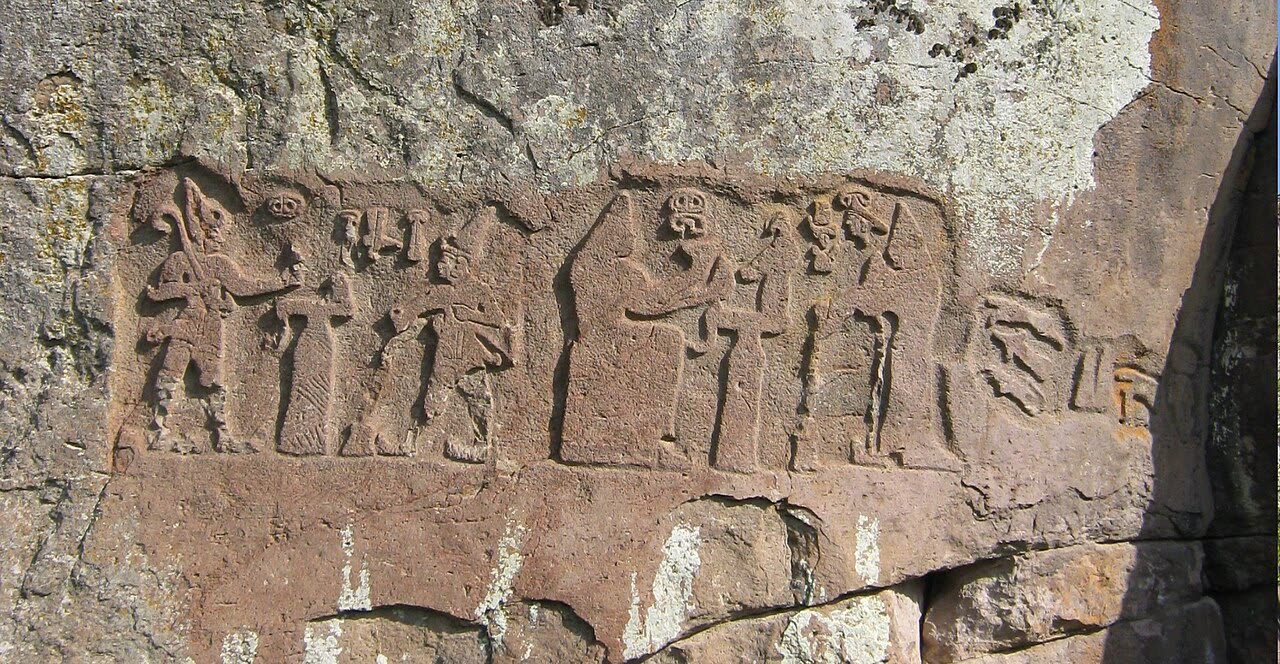
Tarhunna is a Hittite name for the Storm God, a figure at the head of the pantheon whose local forms were named separately in ritualRitualAn organised or distinguished practice meaningful to a community; it may leave traces, but its form alone does not reveal an associated doctrine.Glossary · Click to read the explanation and diplomatic texts. A treaty may call the Storm God of Hatti and the Storm God of Nerik in the same list, while a story preserved in the voice of a priest of Nerik describes the god’s conflict with a serpent. An image of royal worship survives at Fıraktın, where a Hittite king makes a liquid offering before the deity. [1] [2] [3] [4]
Reading the names
Daniel Schwemer distinguishes the Hattian name Taru, Hittite Tarḫunna, and forms used in Luwian, including Tarḫunt and Tarḫunza. He relates the Hittite and Luwian names to a verbal base expressing strength or overcoming. The writing can make such distinctions hard to recover from a single passage. The sources often use signs conventionally read as logograms for a storm deity, such as the sign transcribed as divine IŠKUR or the divine numeral ten. A place name, a grammatical ending or the surrounding text can help a reader decide how to identify the god in a particular occurrence. [1]
Michele Cammarosano discusses how storm deities in traditions from AnatoliaAnatoliaAnatolia is the region occupying the Asian part of present-day TurkeyGlossary · Click to read the explanation and northern Syria came to be associated. In areas where crops relied heavily on rainfall, these gods had overlapping responsibilities. The Hattian Taru and the Hurrian Teššub are therefore relevant to the history of the Hittite Storm God even while their own names and traditions remain identifiable in sources. Late Bronze AgeLate Bronze AgeAn archaeological period around 1600–1200 BCE in much of the Near East, with international diplomacy, exchange and religious diversity; its endpoints vary by region.Glossary · Click to read the explanation records for Šamuḫa, for example, attest a festival for Teššub and Ḫebat of Aleppo. That specific designation supplies more information than the shared label Storm God. [1] [5]
Royal witnesses and local offerings
The bronze treaty of Tudhaliya IV with Kurunta of Tarhuntassa invokes many deities as witnesses. The translation by Harry Hoffner distinguishes the Storm God of Heaven and the Storm God of Hatti from the Storm God of the Army and the Storm Gods of Zippalanda, Nerik, Aleppo and other named places. Near the witness list, the Sun Goddess of Arinna and the Storm God of Hatti are invoked together against anyone who deprives Kurunta’s descendants of their rights or changes the tablet’s words. The individual names and the terms of the oath make clear what these gods are being asked to guarantee. [2]
Local cult inventories offer a different view. The tablet KUB 17.35, found at Boğazköy, includes a spring festival and a rite of lots for the Storm God of Guršamašša. Cammarosano interprets the latter as part of the selection or installation of a new priest. The account includes a sheep that was adorned and presented to the god, then released alive. Offerings, personnel and a particular community are central to this record. A general account of the Storm God’s powers would give little sense of these responsibilities without such a document. [5]
Two encounters with the serpent
The Hittite composition catalogued as CTH 321 opens with a statement attributed to Kella, priest of the Storm God of Nerik. Its opening calls for the land to grow, flourish and be protected, and names the purulli festival. Hoffner considers a spring setting possible and discusses traditions that locate the rite at Nerik and then at Hakmiš and Utruna after the loss of Nerik. In the first story, the serpent defeats the Storm God at Kiškilušša. InaraInaraGoddess in Hittite traditions who plans the feast enabling the serpent’s defeat in the first Illuyanka account.Glossary · Click to read the explanation arranges a feast and enlists a human helper, HupasiyaHupasiyaInara’s human helper in the first Hittite Illuyanka account, who binds the serpent after the feast.Glossary · Click to read the explanation. The serpent and its children emerge to eat and drink. When they are unable to get back into their hole, Hupasiya ties the serpent and the Storm God kills it. [3] [6] [7]
In the second story, the serpent takes the god’s heart and eyes. The Storm God fathers a son who marries a daughter of the serpent. At his father’s instruction the son asks for the missing organs in his wife’s household and brings them back. With his body restored, the Storm God fights again near the sea. The son is with the serpent and calls for his father to include him in what follows. Both die. The versions share an initial defeat and a recovery made possible by a human relationship. Marriage and divided obligations give the second account its particular ending. [3] [7]
The god in a royal relief
On the rock face at Fıraktın near Kayseri, the left scene shows Hattusili III pouring a libation to the Storm God. The adjacent scene shows Queen Puduhepa making a corresponding offering to the goddess Ḫebat. The rock relief is a record of royal ritual imagery from the Hittite imperial period. Its two scenes place the king and queen in distinct acts of devotion, each facing a deity. The relief and the treaty each place the Storm God close to the royal office, through an offering in one case and a divine obligation in the other. [2] [4]
In first-millennium Tabal, Luwian hieroglyphic inscriptions continue to attest the storm deity. The stele from Çiftlik, dated to the mid-eighth century BC, records a dedication by a local official to Tarḫunt, Hebat and other gods. This later association belongs to its own local pantheon. It helps trace the use of a related divine name and the persistence of ties between storm gods and ruling communities beyond the Hittite imperial period. [8]
References and notes (8)
- Daniel Schwemer, The Storm-Gods of the Ancient Near East, Part II §7.1, Hattian, Hittite and Luwian forms, logographic writing and relationships Return to the text ↑
- Harry A. Hoffner Jr., The Treaty of Tudhaliya IV with Kurunta of Tarhuntassa The Context of Scripture 2.18, §§24–26, bronze tablet and divine witness list Return to the text ↑
- TITUS, Corpus of Hittite Mythological Texts, CTH 321 German translation of the festival opening and both episodes Return to the text ↑
- James F. Osborne, Monuments of the Hittite and Neo-Assyrian Empires pp. 90–92, fig. 5.1, identity of the figures and libation at Fıraktın Return to the text ↑
- Michele Cammarosano, Hittite Local Cults Gods and Cult Images, festival discussion and text no. 1, KUB 17.35 Return to the text ↑
- Harry A. Hoffner Jr., A Brief Commentary on the Hittite Illuyanka Myth pp. 119 and 130–131, manuscript framing and purulli festival at Nerik Return to the text ↑
- Gary Beckman, The Anatolian Myth of Illuyanka pp. 18–19 and 24–25, translation of the two stories and discussion of the festival Return to the text ↑
- Luwian hieroglyphic stele of Çiftlik (Tabal), overview of the inscription dedication to Tarḫunt, Hebat and other gods by a local official, mid-8th century BC Return to the text ↑
Suggest a correction · Suggest a source for this record
Cite this record
IL Archive, «Tarhunna, the Hittite Storm God», https://ilarchive.com/en/entities/tarhunna