Entity · Deity
Teshub, the Hurrian Storm-God
A reference page linking a name, group, or concept to the materials that discuss it.
- Names
- Teshub · Tessub · Teššub
- Region
- The Near East
Teshub was a Hurrian storm-god worshipped with Hebat and their divine court. At Yazılıkaya he stands on two mountain gods. Hittite songs tell how his rule was challenged.
Estimated reading time: 5 min Published Last reviewed:
Share article
Text
Introduction
Teshub, also written Teššub, was a Hurrian storm-god. He and his consort Hebat stand at the meeting point of two processions at the rock sanctuary of Yazılıkaya, near the Hittite capital of Hattusa. Offering lists from Hattusa and Sapinuwa also place the pair at the heads of their own circles of gods. The carvings and the lists give two ways to see the company in which Teshub received worship. [1][2][3]
Hittite-language songs give the Storm-god another setting. They describe a succession of rulers in heaven and struggles involving KumarbiKumarbiHurrian god in Hittite songs from Hattusha; he overthrows Anu and carries the storm god. A study of CTH 344, contested genealogy, and Greek parallels.Glossary · Click to read the explanation, who carries the Storm-god in his body in one song and raises a rival against him in another. In the Song of Ullikummi, the attack threatens Teshub’s city and keeps Hebat from hearing what has become of him. [4][5]
Local cults and divine households
Kumme and Kummanni were centres of the worship of Teshub and Hebat. The related name Kummiya occurs in the Song of Ullikummi, where the third tablet calls the Storm-god the heroic king of that city. The myth assigns the god a city and buildings that the rival threatens to take. The study of the similarly named centres draws on documents from more than one language and period. Those texts and the song each supply their own context for a local name. [5][6]
The identities of storm gods could overlap across languages and places. Daniel Schwemer gives examples of the Storm-god of Aleppo addressed by different names, including Addu, Adad, Baalu and Teshub, according to the surrounding cultural setting. Billie Jean Collins observes that Hittite texts could still identify the Storm-god of Aleppo separately from the native storm-god of a city where he was worshipped. His cult at Hattusa had an offering circle that included Anatolian as well as Syro-Hurrian deities. A god’s name, his local title and the names of his companions can all affect how a passage is understood. [2][7]
The Hurrian word kaluti refers to a sequence of offerings to members of a divine circle. Collins compares the circles of Teshub and Hebat preserved at Hattusa and Sapinuwa. The lists usually group male deities with Teshub and female deities with Hebat. There are exceptions. Shaushga of Heaven appears in his circle, and Sharruma appears with his mother Hebat. The ordering preserves details of how the circles were understood in worship. In the thirteenth century, the Storm-god of Hatti also received two attendants associated with Hurrian worship, the bulls Sheri and Hurri. Texts record offerings to them in his temple. [2]
The carved procession
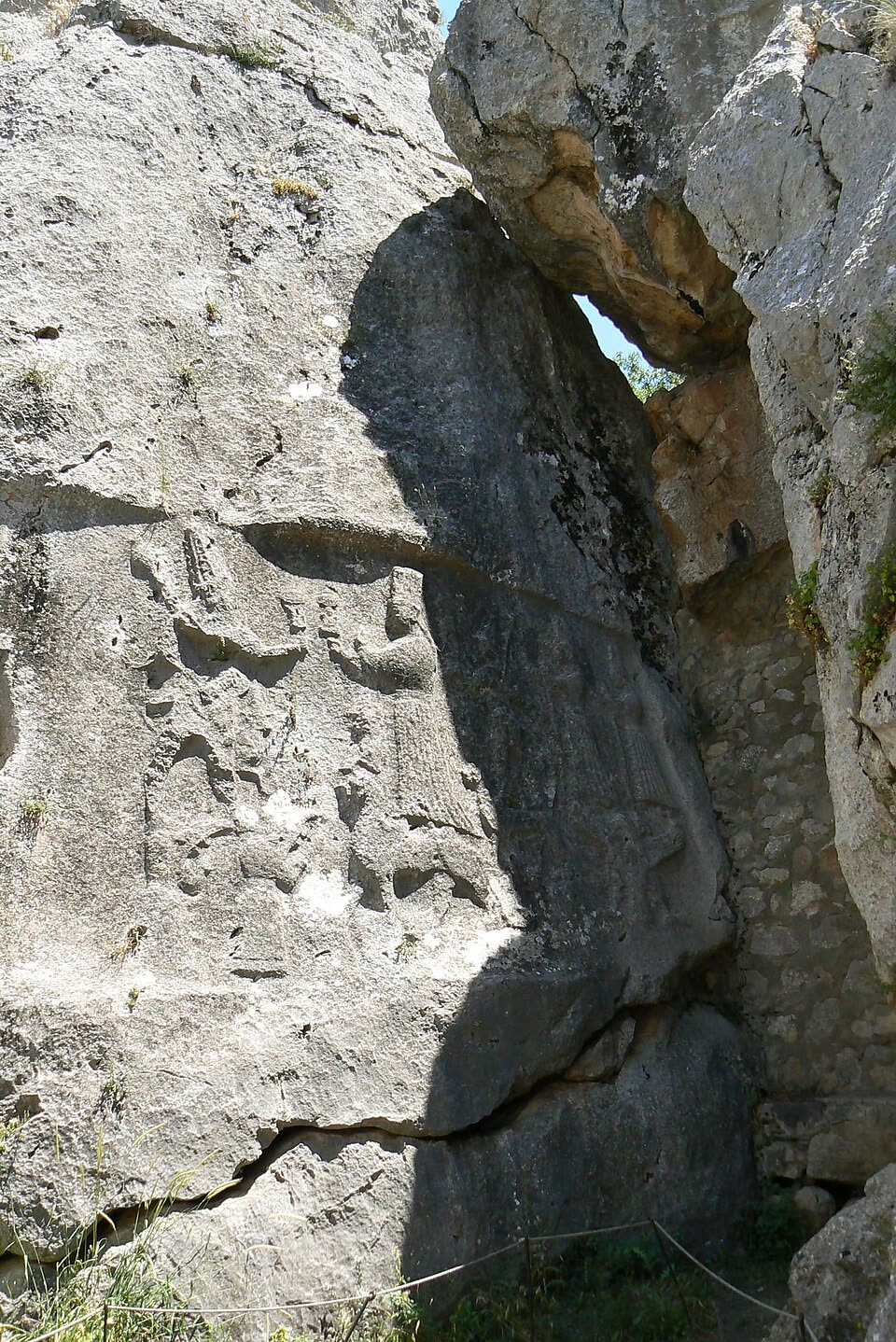
Two processions carved into the limestone meet in Chamber A at Yazılıkaya. Teshub is on the left of the meeting, in the carving numbered 42. He stands on two mountain gods, Namni and Hazzi. Hebat faces him from the right, standing on a large cat identified as a leopard in the archaeological study. Sharruma appears behind her. The mountains give the Storm-god visible attendants and a support raised above the ground on which the processions appear to approach. [1]
Yazılıkaya was an open-air sanctuary about two kilometres northeast of Hattusa. Many figures in Chamber A have labels in Luwian hieroglyphs. Weathering has made some of the labels hard to read. Others preserve the names of Hurrian deities in the hieroglyphic script. The setting and the accompanying signs help identify figures that a visitor might otherwise distinguish only by dress, position or the beings they stand on. [1][3]
A struggle for kingship
The Song of Emergence begins with AlaluAlaluFirst heavenly ruler in the surviving Kumarbi song; defeated by Anu, he flees to the dark earth.Glossary · Click to read the explanation as king in heaven and Anu in attendance. Anu defeats Alalu and assumes the throne. Kumarbi then serves Anu and later fights him. After Kumarbi catches the fleeing Anu and bites him, Anu tells him that he now carries three beings. The first is the Storm-god. The others are the river AranzahAranzahRiver as a divine figure, named among those Kumarbi carries in the Hittite song.Glossary · Click to read the explanation and TashmishuTashmishuDivine figure named in Kumarbi’s pregnancy with the storm god and the river Aranzah.Glossary · Click to read the explanation. The surviving lines present Kumarbi’s challenge to Anu as the event that brings the future Storm-god into being. [4]
In the Song of Ullikummi, Kumarbi plots against the Storm-god. The opening tablet takes him from Urkesh to a pool and a great rock. The later action centres on his rival Ullikummi, which grows until it can reach the divine dwellings. Hebat is confined to her temple and sends her attendant Takiti to find out what has happened to her husband. The scene follows the danger through the interruption of news reaching Hebat. [5][8]
EaEnkiMesopotamian deity also known as Ea, linked with Eridu and the Abzu (deep fresh waters), wisdom, incantations, and narratives of creation and cosmic order. Later written attestations do not identify the deity of Eridu’s earliest layers.Glossary · Click to read the explanation learns that Ullikummi is standing on the shoulder of Upelluri, who feels pain there. He calls for the old tool with which heaven and earth were divided and proposes using it to cut Ullikummi free from his footing. The Storm-god then goes down to the sea with thunder to fight. Ullikummi answers him and speaks of taking Kummiya, the holy places and kingship in heaven. The preserved exchange leaves both the city and the heavenly throne at stake. [5]
The carved procession shows Teshub meeting Hebat at the head of their circles. The songs show how vulnerable that position could become and how the Storm-god called on others. Hittite texts and monuments could make the god and his company visible through an ordered sequence of offerings, an assembly in stone or a story about the dangers faced by a king. [1][2][4][5]
References and notes (8)
- Eberhard Zangger and Rita Gautschy, Celestial Aspects of Hittite Religion Read the description of Chamber A, the divine meeting in reliefs 42–46 and the weathered Luwian hieroglyphic labels. Return to the text ↑
- Billie Jean Collins, Lost and Found in Translation: Religious Encounters in Hittite Anatolia Read the discussion of the Teshub and Hebat offering circles at Hattusa and Sapinuwa and of the distinctions and identifications among storm-gods in Syria and Anatolia. Return to the text ↑
- UNESCO World Heritage Centre, Hattusha: the Hittite Capital Read the property description and the location, natural chambers and carved walls of the Yazılıkaya rock sanctuary. Return to the text ↑
- TITUS and the Marburg edition group, Song of Emergence, CTH 344 Read the German edition’s opening sequence at lines 9–36 and Anu’s declaration of the three beings at lines 43–53. Return to the text ↑
- E. Rieken and colleagues, Song of Ullikummi, CTH 345.I.3.1 Read the German translation’s third tablet, including lines 30–76 on Hebat, 195–236 on Upelluri and the tool, and 253–292 on the fight and Kummiya. Return to the text ↑
- Armen Petrosyan, The Cities of Kumme, Kummanna and Their God Teššub / Teišeba Read pages 55–56 on Kumme and Kummanni, the differing local names, and the cults of Teshub and Hebat. Return to the text ↑
- Daniel Schwemer, The Storm-Gods of the Ancient Near East: Summary, Synthesis, Recent Studies, Part I Read pages 162–165 on Aleppo, the reach of the cult and the use of different storm-god names according to local context. Return to the text ↑
- TITUS and the Marburg edition group, Song of Ullikummi, CTH 345.I.1 Read the first tablet’s opening lines about Kumarbi’s plot, journey from Urkesh and encounter with the rock. Return to the text ↑
Suggest a correction · Suggest a source for this record
Cite this record
IL Archive, «Teshub, the Hurrian Storm-God», https://ilarchive.com/en/entities/teshub