Person · Literary figure
Appu in the Hittite Tale
- Names
- Appu · Appu of Šudul
- Region
- الأناضول
Appu is a wealthy man who asks the Sun God for a child in a Hittite tale. His sons' dispute over the estate takes them before divine judges. The ending is lost.
Estimated reading time: 5 min Published Last reviewed:
Share article
Text
Introduction
Appu is the father in a Hittite tale about a household with wealth and no children. He lives in a city the text calls Šudul and seeks help from the Sun God. Two sons are born and eventually quarrel over the estate. The preserved text follows them from the family home to a dispute before gods at Sippar and NinevehNineveh and KuyunjikNineveh is an ancient Assyrian city near Mosul in northern Iraq; Kuyunjik is one of its archaeological moundsGlossary · Click to read the explanation. The tablets are evidence for a story transmitted in Hittite. They give no independent record of a historical Appu. [1][2]
The owner who had no one to feed
The surviving opening praises an unnamed deity for protecting just people and bringing down the wicked. It then introduces Appu by listing his cattle and sheep and his stores of precious material. Gold, silver and lapis lazuli are heaped up like grain. The story makes his childlessness visible at a meal with the elders of his city. The other men give food or drink to their sons, while Appu has nobody to whom he can give bread. The meal turns a question about keeping property in a family into a scene about who sits and eats together. [1][2]
Appu goes home and lies down still wearing his shoes. His wife notices that something is wrong, asks the servants about him and then speaks to him herself. The narrative records her efforts to find out what has happened, although it gives her no personal name. Appu responds dismissively. His next step is to carry a white lamb out to meet the Sun God, who approaches him in human form. Appu tells him what the gods have given him and what he lacks. The god promises that he will have a son and sends him home to his wife. [1][2]
Two sons and their names
In the surviving first tablet, a nurse places the first child on Appu's knees. He names the boy Wrong and explains the name by saying the gods did not take the right course for him. The next child receives the name Right, with the corresponding explanation. Hoffner gives that order in his translation, as do Reyhan and Cengiz. Gary BeckmanGary BeckmanScholar of the Hittite language, Hittite religion and ancient Near Eastern history, associated with the University of Michigan.Glossary · Click to read the explanation's brief summary gives the order in reverse. The sequence of naming speeches in the translation and edition is the basis for the account here. The father's explanations make the names reflect his view of how the children came to him, while the later scenes invite the audience to judge how the sons act. [1][2][3][4]
The value of a share
The sons grow up and separate from their father. Wrong urges Right to establish a separate household. He points out that mountains stand apart, rivers run their different courses and gods live in different cities. Among the places he names are Sippar for the Sun God and Nineveh for Shaushka. The examples give his proposal the appearance of following an order already present in the world. When the brothers make the division, however, Wrong keeps the good plow ox and leaves the inferior cow to Right. The Sun God looks down and calls for the cow to become healthy and give birth. The text breaks off before the full outcome of that intervention is given. [1][2]
A dispute before the gods
The final line of the first tablet calls it incomplete, and a separate fragment preserves part of what follows. In Hoffner's translation, the Sun God at Sippar awards judgment to Right. Wrong curses, and the god sends the brothers to Shaushka, the goddess associated with Nineveh. The surviving text brings them into her presence. The damage prevents a secure account of her final judgment. Timothy Daniel Leonard observes that the solar deity's judicial role is familiar in the wider tradition, whereas surviving sources seldom show the goddess of Nineveh judging a dispute. The tale gives the goddess a role that has few close parallels in extant Hittite texts. [1][5]
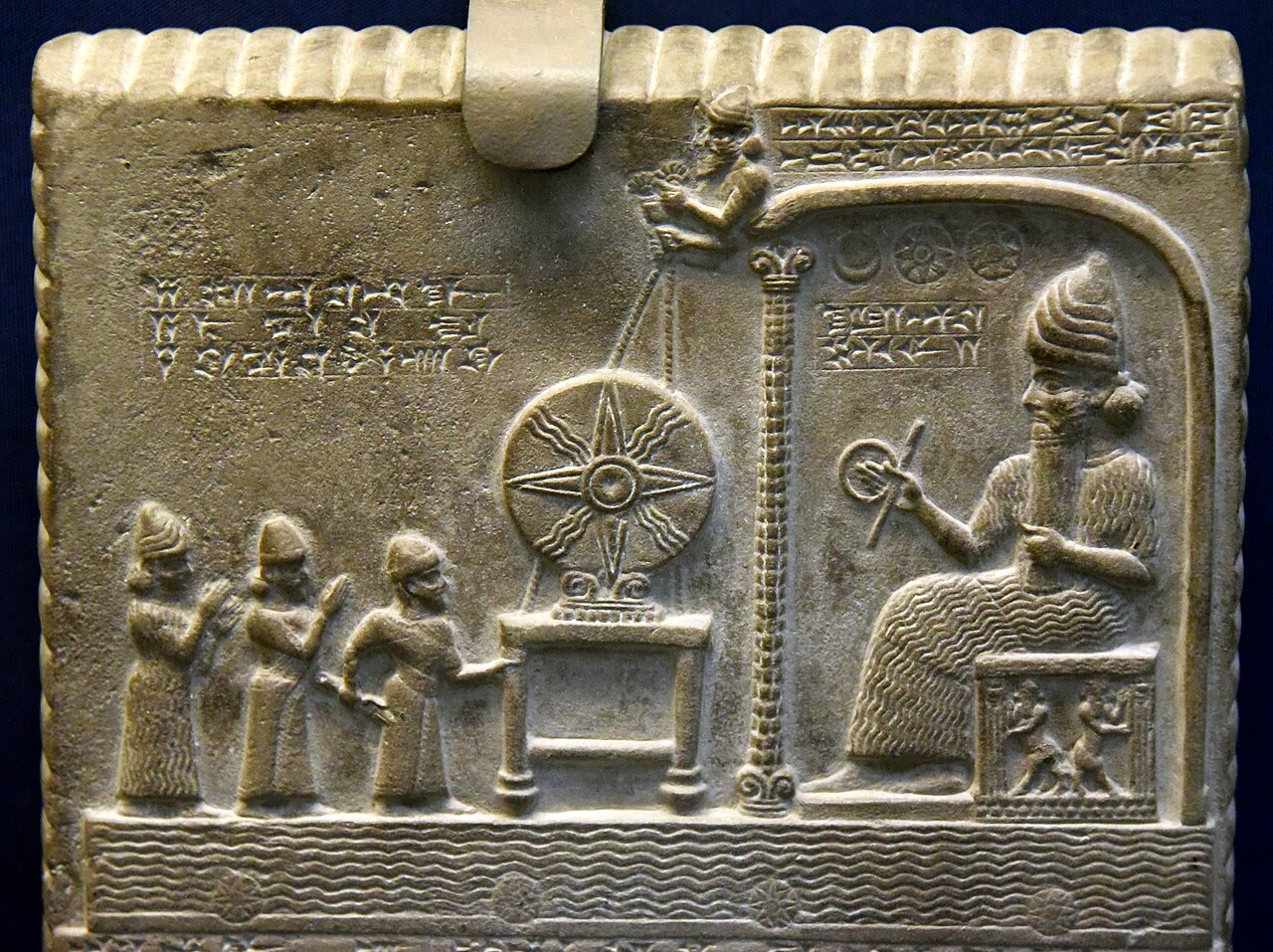
Sippar had a cult of the Mesopotamian sun god ShamashShamashMesopotamian god of the sun and justice, shown before Hammurabi on an eighteenth-century BCE stele preserved in the Louvre.Glossary · Click to read the explanation. The limestone monument known as the Sun God Tablet shows the deity in his shrine as the Babylonian king is led into his presence. Its inscription recounts a restoration of the temple and cult under Nabu-apla-iddina. This object belongs to a later period than the Hittite copies of Appu's story. Its use here is to illustrate how the deity of Sippar could be shown in worship at the city named as the place of judgment in the tale. [1][6]
Where the surviving story stops
The text is known from multiple fragments. The names of deities with centers outside AnatoliaAnatoliaAnatolia is the region occupying the Asian part of present-day TurkeyGlossary · Click to read the explanation and the story's settings have encouraged discussion of the tale's origin. Hoffner notes archaic grammatical features beneath the later copies and records Itamar Singer's argument that the foreign places and deities are insufficient to demonstrate an origin outside Anatolia. Another question concerns the tale of the Sun God, the Cow, and the Fisherman. Some scholars read the latter as a continuation because the god's words over Right's cow seem to anticipate a birth. Hoffner treats it as a separate narrative, observing that its opening presents the god's encounter with the animal as a new scene. The shared figures give a reason to compare the tales. They leave the missing end of Appu's inheritance dispute unrecovered. [1][3][5]
References and notes (6)
- Harry A. Hoffner Jr., Hittite Myths, 2nd edition No. 20, introduction and §§1–26, and no. 21, introduction Return to the text ↑
- Esma Reyhan and Tülin Cengiz, A Hittite Period Tale: Appu and His Two Sons Pp. 205–210, Turkish translation and analysis, including column III, lines 7–22 and division of the estate Return to the text ↑
- TITUS, Goethe University Frankfurt, Corpus of Hittite Mythological Texts CTH 360.1, list of witnesses and text of the first tablet Return to the text ↑
- Gary Beckman, Hittite Literature Pp. 234–235, description of the opening and account of the family and its property Return to the text ↑
- Timothy Daniel Leonard, Ištar in Ḫatti Discussion of Shaushka of Nineveh as a judge and the fragmentary ending Return to the text ↑
- Johannes Gutenberg University Mainz, Sun-God Tablet Front relief, provenance at Sippar and history of the cult image Return to the text ↑
Suggest a correction · Suggest a source for this record
Cite this record
IL Archive, «Appu in the Hittite Tale», https://ilarchive.com/en/people/appu
Continue reading