Person · Figure
Sappho
- Names
- Psappho · Sappho · Sappho of Lesbos
- Timeline
- From 620 BCE to 570 BCE
- Region
- Anatolia and the eastern Mediterranean
A poet of the island of Lesbos, around 600 BCE, whom later Greeks ranked above every other woman poet. Most of her songs survive only in pieces; one names her brother Charaxus, the merchant tied to Rhodopis in Egypt.
Estimated reading time: 6 min Published Last reviewed:
Share article
Text
Introduction
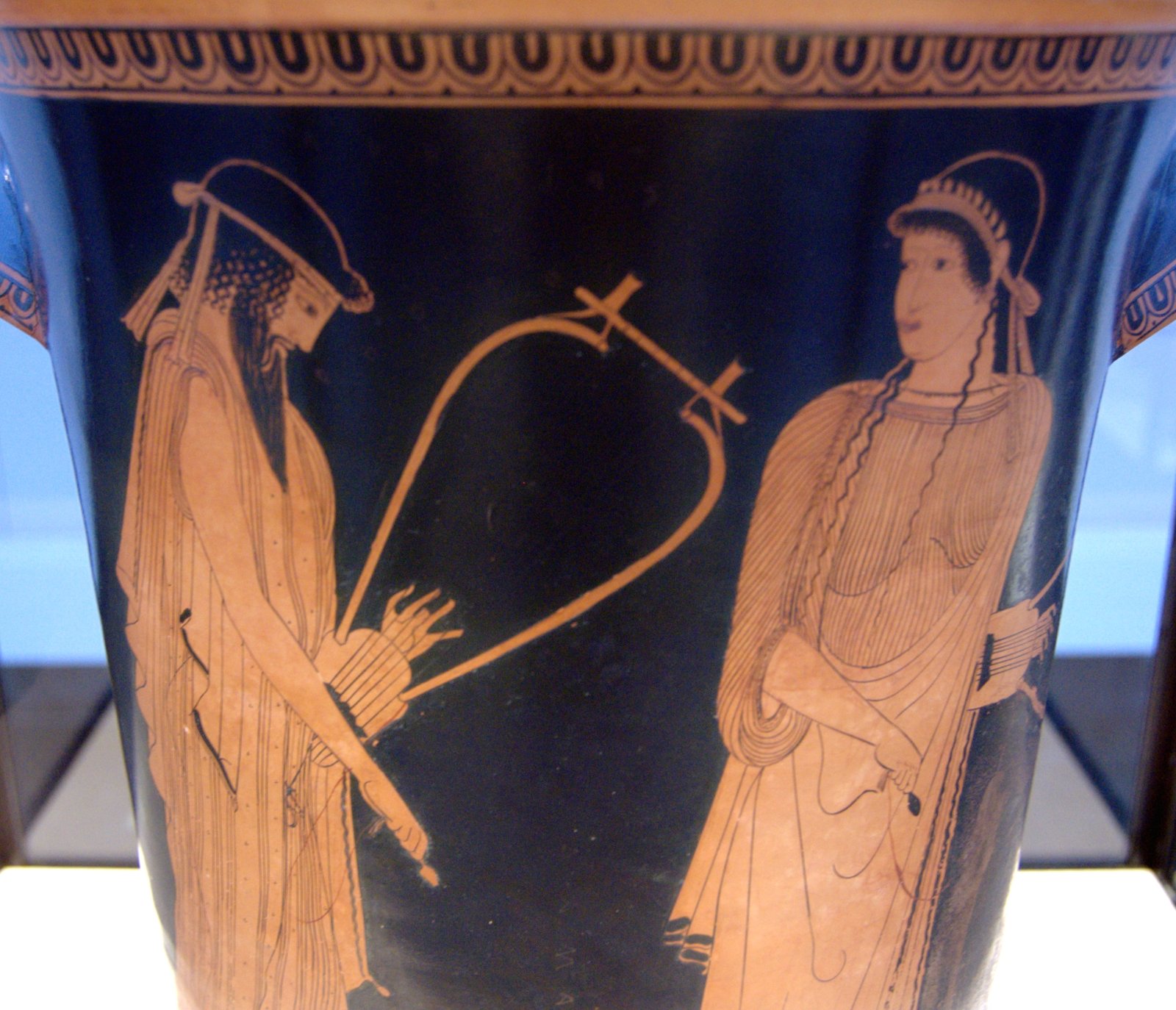
Sappho lived on Lesbos, a large island in the eastern Aegean Sea, around 600 BCE. She composed songs to be sung to the lyre, a small stringed instrument. The geographer Strabo, writing some six centuries after her, called her "a marvellous woman" and said he knew of no woman who could rival her in poetry. [1]
For this archive she matters for a second reason. HerodotusHerodotusFifth-century BCE Greek historian whose account of the Persian Wars includes reports on peoples, court and empire.Glossary · Click to read the explanation says her brother Charaxus, a merchant, paid for the freedom of Rhodopis in the port of Naucratis in EgyptEgyptEgypt lies mainly in northeastern Africa and includes the Sinai Peninsula in AsiaGlossary · Click to read the explanation, and that Sappho attacked him for it in a song. [2] A papyrus published in 2014 brought back a poem that names Charaxus.
Who she was
What we know of her life comes from much later writers. The fullest account is in the Suda, a Byzantine encyclopedia of the tenth century CE. It calls her a lyric poet from Eresus on Lesbos, names her mother Cleis, and lists three brothers: Larichus, Charaxus and Eurygius. It places her in the 42nd Olympiad, 612–609 BCE. An Olympiad is the four years between two Olympic Games, so it works like counting time by World Cups. The Suda also makes her a contemporary of the poet Alcaeus and of Pittacus, a ruler of Mytilene, the main city of Lesbos. [3] Strabo names the same three as the famous people of Mytilene in that age. [1]
Some details are doubtful. The Suda gives her a rich husband, Cercylas of Andros, but its translators note that both names read like crude puns, perhaps from the Greek comedies in which Sappho appeared as a character. [3]
How her poems survive
Scholars at the great library of Alexandria in Egypt gathered her songs into nine books, sorted by metre: the rhythm pattern of a line, much as a modern songbook might group waltzes and marches. [4] Those books are lost. What remains are lines quoted by later authors and scraps of ancient papyrus copies, mostly fragments, many very small. [5] Sappho wrote in Aeolic, the Greek dialect of Lesbos and the nearby coast, which she shares with Alcaeus. [4]
One song is a prayer to AphroditeAphroditeGreek goddess whose origin Hesiod relates to foam after the assault on Ouranos.Glossary · Click to read the explanation, goddess of love, asking her to come and help as before. It pictures the goddess riding down in a chariot drawn by swift sparrows and asking the singer, "who wrongs you, Sappho?" [6]
Charaxus, Doricha and Rhodopis
Herodotus, writing in the fifth century BCE, tells the story from the Egyptian side. Rhodopis, a Thracian woman, was brought to Egypt enslaved. Charaxus of Mytilene, son of Scamandronymus and brother of Sappho, paid a large sum to set her free. When he returned home, Sappho mocked him bitterly in one of her poems. [2]
Later writers add a second name. Strabo says Sappho called the woman Doricha, and that Charaxus was carrying wine from Lesbos to Naucratis to sell; others, he says, called her Rhodopis. [7] Athenaeus, writing around 200 CE, says Sappho accused Doricha of stripping Charaxus of much of his property, and he insists that Doricha and Rhodopis were two different women. He also quotes the poet Posidippus, who says that Sappho's pages keep Doricha's name alive. [8]
Among the surviving fragments, one asks Aphrodite and the Nereids, the nymphs of the sea, to bring "the brother" home unharmed; it does not give his name. [9] Another, badly damaged, asks Aphrodite to be harsh to a woman so that she may not boast. Editors read her name as Doricha, but the first letter of the name is a modern restoration. [10]
The Brothers Poem
In January 2014 Dirk Obbink of the University of Oxford announced two new poems by Sappho on a privately owned papyrus. [5] The longer one is called the Brothers Poem. Twenty lines, five stanzas, survive, and one to three stanzas are lost from the beginning. [11]
In the surviving part the speaker answers someone who keeps talking about Charaxus coming home with a full ship. She tells the listener to pray to Queen Hera instead, that Charaxus may arrive safely with his ship. Everything else should be left to the gods, for calm weather comes quickly after great winds. Those whom the king of the gods chooses to turn away from trouble are blessed. The poem ends with a hope: if Larichus, the younger brother, grows into a man of standing, the family would soon be freed from its heavy sorrow. [11][12]
The poem names two brothers that the Suda also lists, and its worry about a brother at sea fits a merchant who sailed to Egypt. [3][7] It does not mention Rhodopis, Doricha or Egypt, so it does not confirm Herodotus's story. Scholars also ask whether the speaker is Sappho in her own voice or a role in a song for performance; one suggestion places it at a festival of Hera on Lesbos. [13] Even the first verb is debated: it may mean that Charaxus should come, has come, or has gone. [11]
Where did the papyrus come from?
A new papyrus is normally published with its provenance, the record of where it was found and who owned it, like the papers that come with a used car. This one was not. Obbink first wrote that it came from the papier-mâché wrapping of a mummy; in 2015 he said instead that it came from glued layers of papyrus of a household kind, such as a book binding, bought at a Christie's auction in 2011. In 2020 the papyrologist Michael Sampson studied a Christie's sale brochure for the papyrus and the hidden date data in its photographs, and showed that the published accounts could not be trusted. [5] In March 2021 the publisher Brill retracted Obbink's chapter on the papyrus's origins in the book The Newest Sappho (2016), because it presented false information about where the papyri came from. [14]
The dispute is about the papyrus's history, not its age. The editors of that book said they had seen no evidence that the papyri are not authentic, and many specialists take them to be genuine ancient copies. Few scholars have seen the papyrus itself, and its present location is unknown. [14][5]
A later legend
Stories about Sappho grew on the comic stage. [3] One said that she leapt from the white cliff of Leucas, an island in western Greece, for love of a man called Phaon. Strabo quotes this from the comic poet Menander, three centuries after her, but adds that better-informed writers gave the first leap to someone else. [15]
What can be said
Sappho was a poet of Lesbos around 600 BCE whose nine books survive only in fragments. Her family's link with Egypt rests on Herodotus, Strabo and Athenaeus. The Brothers Poem names Charaxus and Larichus in verse attributed to her, but the history of the papyrus that carries it is still unclear. [2][5][11]
References and notes (15)
- Strabo, Geography, translated by H. L. Jones (Loeb Classical Library), Book 13, on LacusCurtius 13.2.3–4 read: the famous people of Mytilene (Pittacus, Alcaeus, Sappho), Strabo's praise of Sappho as a marvellous woman whom no woman poet rivalled, and Callias of Lesbos as an interpreter of Sappho and Alcaeus. Return to the text ↑
- Herodotus, Histories, translated by A. D. Godley (Loeb Classical Library, 1920), Book 2, on LacusCurtius 2.134–135 read in full: Rhodopis in the reign of Amasis, brought to Egypt by Xanthes of Samos, freed for a large sum by Charaxus of Mytilene, son of Scamandronymus and brother of Sappho, and Sappho's poem attacking Charaxus after his return to Mytilene. Return to the text ↑
- Suda, entry Sigma 107 “Sappho”, translated by Elizabeth Vandiver (Suda On Line, 1998; vetted by D. Whitehead, E. Vandiver and C. Roth, revised to 2021) Whole entry with the translators' notes: Eresus on Lesbos, parents (Cleis as mother), brothers Larichus, Charaxus and Eurygius, the husband Cercylas of Andros and the note that the names look like comic puns, daughter Cleis, the 42nd Olympiad, Alcaeus, Stesichorus and Pittacus, companions and pupils and the hostile charges, nine books of lyric poems. Return to the text ↑
- Heather Waddell, Sappho: Introduction (Dickinson College Commentaries) Introduction read: the nine books of Sappho's songs in the library of Alexandria, arranged by metre; the Aeolic dialect of Lesbos and the nearby Asian coast, shared with Alcaeus; the editorial conventions of the Greek text. Return to the text ↑
- C. Michael Sampson, “Deconstructing the Provenances of P.Sapph.Obbink,” Bulletin of the American Society of Papyrologists 57 (2020) 143–169 pp. 143–146 and 166–169 read in full, the rest skimmed: Sappho's surviving work mostly in small fragments; Obbink's announcement in January 2014 and edition in ZPE 189 (2014); the changing accounts (mummy cartonnage in the TLS, 2014; domestic or industrial cartonnage from a Christie's lot of November 2011, 2015); the Christie's private-sale brochure and the photo metadata pointing to a first private sale in 2013; the unknown present location of the papyrus. Return to the text ↑
- Sappho, fragment 1, Greek text and notes by Heather Waddell (Dickinson College Commentaries) Greek text and line notes read: the prayer to Aphrodite, the chariot drawn by swift sparrows, and the goddess's question to Sappho (line 20). Return to the text ↑
- Strabo, Geography, translated by H. L. Jones (Loeb Classical Library, 1932), Book 17, on LacusCurtius 17.1.33 read with the editor's notes: Sappho calls the woman Doricha, the beloved of her brother Charaxus, who carried Lesbian wine to Naucratis for sale; others call her Rhodopis. Return to the text ↑
- Athenaeus, The Deipnosophists, translated by C. D. Yonge (London: Bohn, 1854), on the Perseus Digital Library 13.596b–d (Book 13, chapter 69) read in full: Doricha and Charaxus in Sappho, Sappho's charge that Doricha stripped him of much property, Athenaeus's view that Doricha and Rhodopis were two women, and the epigram of Posidippus. Return to the text ↑
- Sappho, fragment 5, Greek text (Dickinson College Commentaries, ed. Heather Waddell) Greek text read: the prayer to Kypris and the Nereids that the brother (not named) come home unharmed. Return to the text ↑
- Sappho, fragment 15, Greek text (Dickinson College Commentaries, ed. Heather Waddell) Greek text read: the damaged lines addressed to Kypris and the name Doricha, whose first letter is an editor's restoration. Return to the text ↑
- Sappho, “The Brothers Poem,” Greek text with introduction and notes by Heather Waddell (Dickinson College Commentaries) Whole page read: the twenty surviving lines in five Sapphic stanzas, the note that one to three stanzas are lost at the start, the line notes (Charaxus and the full ship, the prayer to Queen Hera, calm after great winds, the king of the gods, Larichus), and the debate on the tense of the first verb (Obbink, Ferrari, Langseth). Return to the text ↑
- Rachel Hadas, “The New ‘Brothers Poem’ of Sappho” (translation), Dædalus 145.2 (Spring 2016), American Academy of Arts & Sciences; first printed in the Times Literary Supplement, 2 May 2014 Whole page read: the English verse translation and its framing as a sister's prayer for Charaxus's safe return and for Larichus to come of age. Return to the text ↑
- Alexander Dale, review of A. Bierl and A. Lardinois (eds.), The Newest Sappho: P. Sapph. Obbink and P. GC inv. 105, Frs. 1–4 (Brill, 2016), Bryn Mawr Classical Review 2017.08.32 Whole review read: the editors' note that the provenance is contested and the retraction of Obbink's chapter; Lardinois on the contrast between speaker and addressee; Charaxus and Larichus as figures of vice and virtue in the tradition; the festival of Hera at Messon on Lesbos proposed as a performance setting. Return to the text ↑
- Brent Nongbri, “The Retraction of Dirk Obbink's Sappho Chapter and the Question of Authenticity,” Variant Readings (blog), 30 March 2021 Whole post read: Brill's retraction of Obbink's chapter for false information on provenance, the editors' statement that they have seen no evidence that P.GC inv. 105 or P.Sapph.Obbink is not authentic, and the view of most specialists that the fragments are ancient. Return to the text ↑
- Strabo, Geography, translated by H. L. Jones (Loeb Classical Library), Book 10, on LacusCurtius 10.2.9 read: the cliff of Leucas and the temple of Apollo Leucatas; Menander's lines making Sappho the first to leap, in pursuit of Phaon; Strabo's note that those better versed in antiquities give the first leap to Cephalus. Return to the text ↑
Suggest a correction · Suggest a source for this record
Cite this record
IL Archive, «Sappho», https://ilarchive.com/en/people/sappho
Continue reading
Related readings