Site · City
Naucratis
- Names
- Kom Ge'if · Naucratis · Naukratis · Pi-emroye
- Timeline
- 620 BCE
- Region
- Egypt
A river port in the western Nile Delta where Greek, Cypriot and other traders met Egypt from the late seventh century BCE. Its finds tell a more complicated story than the ancient accounts of its founding.
Estimated reading time: 6 min Published Last reviewed:
Share article
Text
Introduction
Naucratis (Greek Naukratis) was a harbour town on the Canopic branch of the Nile, the westernmost of the river's two great branches, in the western Delta of EgyptEgyptEgypt lies mainly in northeastern Africa and includes the Sinai Peninsula in AsiaGlossary · Click to read the explanation. It lay near Sais, the royal city of Egypt's kings in the seventh and sixth centuries BCE, and served as its gateway to the Mediterranean. Its ruins are at Kom Ge'if, near Damanhur in the Beheira governorate. [5][6]
For a time Naucratis was the only Egyptian port open to Greek merchants. Greek ships brought silver, wine and olive oil, and left with linen, papyrus, grain and natron, a natural salt used in Egypt for cleaning and embalming. Ancient writers tell how the town began, but the objects dug from its soil tell a longer and more mixed story. This entry sets the two side by side. [3]
What the ancient writers say
The fullest account is by HerodotusHerodotusFifth-century BCE Greek historian whose account of the Persian Wars includes reports on peoples, court and empire.Glossary · Click to read the explanation, who visited Egypt in the fifth century BCE. He says that King Amasis, who came to the throne around 570 BCE, favoured the Greeks and gave them Naucratis as a city to live in. Traders who did not want to settle were given land for altars and sanctuaries. [1][4]
The largest of these, he says, was the Hellenion, "the sanctuary of the Greeks". Nine cities built it together: Chios, Teos, Phocaea and Clazomenae (Ionians), Rhodes, Cnidus, Halicarnassus and Phaselis (Dorians), and Mytilene (Aeolians). These cities owned it and chose the wardens of the port. Aegina built its own sanctuary of ZeusZeusZeus is the sky god and leading deity in many Greek traditions. In the Iliad he presides over divine gatherings while others can still speak and object.Glossary · Click to read the explanation, Samos one of HeraHeraGreek goddess and Zeus’s wife, appearing in council and family-disagreement scenes in the Iliad.Glossary · Click to read the explanation, and Miletus one of ApolloApolloGod of music and prophecy in Greek traditions, also participating in the Iliad’s events.Glossary · Click to read the explanation. [1]
Herodotus adds that Naucratis was once the only trading port in Egypt. A captain who entered any other mouth of the Nile had to swear that he came there against his will, then sail round to the Canopic mouth. If the winds stopped him, he had to carry his cargo to Naucratis on barges, all the way round the Delta. [1]
The geographer Strabo, writing about four centuries later, tells a different story. In the time of Psamtik IPsamtik IPsamtik I was an Egyptian king of Dynasty 26, reigning about 664–610 BCE during the Saite period.Glossary · Click to read the explanation (Psammetichus in Greek), thirty ships from Miletus landed at another mouth of the Nile and built a walled post there. Later they sailed up into the region of Sais, beat a local town in a river battle and founded Naucratis. [2]
What the ground shows
The earliest Greek pottery at Naucratis, from Corinth, Athens, the eastern Aegean and Caria, dates to the later seventh century BCE, the reign of Psamtik I. That is several decades before Amasis. Most scholars therefore think the town began under Psamtik, probably led by Miletus, and that Amasis later reorganised it: he made it the single port for Greek trade and gave the nine cities their special place. This reading fits Herodotus's words, but the debate is not closed. [3]
There are also doubts about how Egyptian the town was. In Egyptian inscriptions it is called Pi-emroye, "the Harbour House", and some scholars think this was an Egyptian settlement before the Greeks came. The British Museum's excavations of 2019 found a thin layer of worn Nile-silt pottery and charcoal beneath the earliest port deposits. The team says a small settlement may have stood there first, but that this needs more study. [3][6]
A town of many peoples
Most of the evidence comes from sanctuaries. Visitors wrote their names on pots they gave to the gods; more than 2,500 such pieces are known. Almost all the names are Greek. A few may be Lydian or Carian, one is in the script of the PhoeniciansPhoeniciansCommunities of Levantine coastal cities known for Mediterranean contact during the first millennium BCE.Glossary · Click to read the explanation, and two later ones are Cypriot. Samians brought special mugs for Hera, made from the clay of Samos itself. One cup was painted with a dedication to "AphroditeAphroditeGreek goddess whose origin Hesiod relates to foam after the assault on Ouranos.Glossary · Click to read the explanation at Naukratis", the goddess AphroditeAphroditeGreek goddess whose origin Hesiod relates to foam after the assault on Ouranos.Glossary · Click to read the explanation. [3]
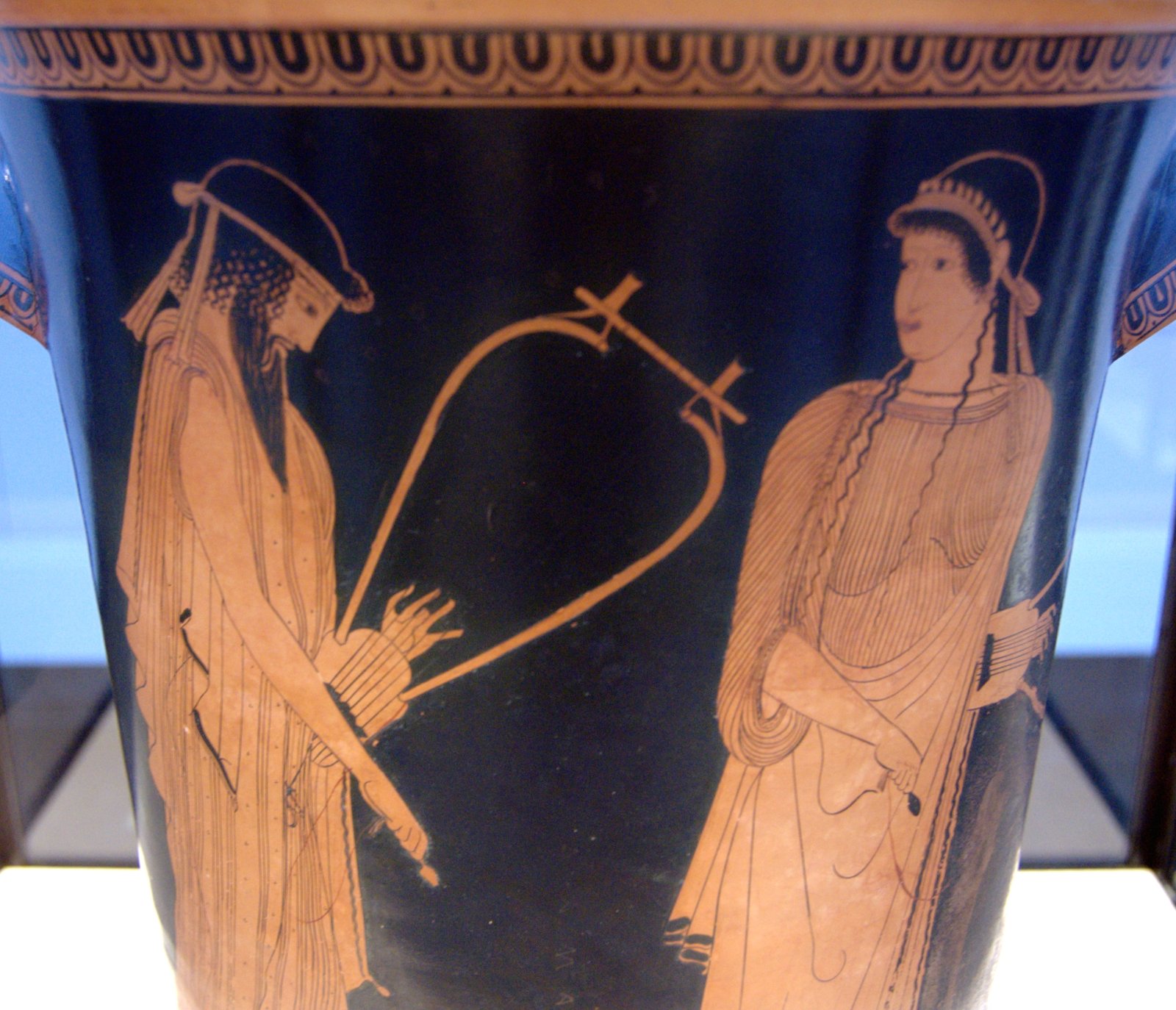
The town was also famous for its courtesans, among them Rhodopis, freed by the wine trader Charaxus of Lesbos, brother of the poet Sappho. [1][3]
Craftsmen worked here too, making scarabs (small beetle-shaped amulets), faience, and Greek-style pottery. On the old riverbank the British Museum found trade jars from Cyprus, Chios, Clazomenae, Miletus, Lesbos and Corinth, fine Greek tableware, and pots made in Cypriot and Greek styles from local Egyptian clay. Seeds of grapes, olives and figs, and pieces of imported pine that may come from ships' planks, show what moved through the harbour. [3][6]
Egypt keeps watch
Naucratis was not left to itself. A second port, Thonis-Heracleion, guarded the mouth of the Canopic branch, and it seems that goods were taxed there first. Two stone decrees of King Nectanebo I, set up in the fourth century BCE at both ports, order that one tenth of the taxes on imports and on trade at Naucratis go to the goddess Neith of Sais. Egyptian officials called "Overseers of the Gate of the Foreign Lands of the Great Green", that is, of the Mediterranean, probably watched over both sites. [3]
In the south of the town stood the "Great Temenos", a large walled sacred area. Many scholars now see it as a fourth-century temple precinct of AmunAmunAmun is an Egyptian deity centered on Thebes and Karnak, the “hidden one,” also worshipped as Amun-Re. His names and images were targeted under Akhenaten before royal support resumed.Glossary · Click to read the explanation. Others still think it began as an earlier Egyptian fort. [3][5]
The Hellenion: found or not?
In 1899 the archaeologist David Hogarth dug a walled sacred area in the north-east of the town, about 150 by 100 metres, and identified it as Herodotus's Hellenion. Doubts about this have never quite gone away. The remains suggest three phases: stone buildings from about 570 BCE; a rebuilding in mud brick, perhaps after the Persian conquest of Egypt in 525 BCE, which would be the Hellenion that Herodotus saw; and a Ptolemaic phase. [4]
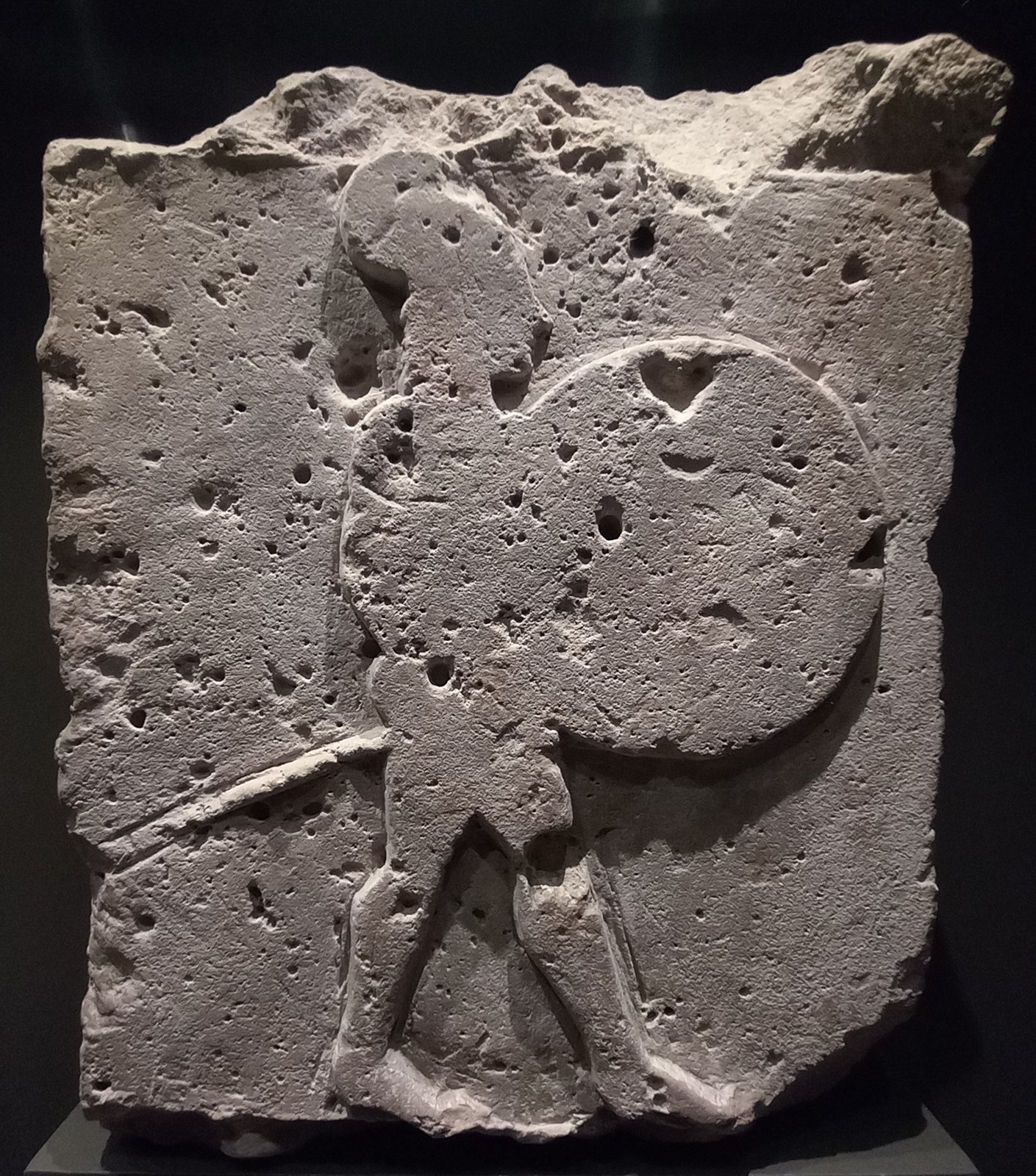
The picture at the head of this entry comes from this area: an unfinished limestone relief of a Greek warrior with helmet, spear and shield, from the late sixth century BCE. [4]
Digging Naucratis
Flinders Petrie found the site in 1884 and recognised it as Herodotus's town. In two seasons, he and Ernest Gardner uncovered the sanctuaries of Apollo, Hera, the Dioscuri and Aphrodite, a scarab workshop and the Great Temenos. Hogarth returned in 1899 and 1903. They all raced against the sebakhin, local diggers who took the ancient soil for fertiliser. The finds were shared among subscribers and are now scattered across some 40 museums, about half of them in the British Museum. [3]
The old digging left a deep hollow that filled with water and became a lake; most of it was drained only shortly before the latest work. An American team worked at the site from 1977 to 1983, and the British Museum carried out seven seasons between 2012 and 2019. Sediment studies show that the Nile ran along the west side of the town, and that in Roman times the river moved west, so that the town built a new waterfront almost 100 metres further out. Naucratis lasted for more than a thousand years, through the Ptolemaic and Roman periods into Byzantine times. It had been an important hub of trade long before AlexandriaAlexandria (Egypt)Alexandria is a city on Egypt’s Mediterranean coast, founded by Alexander the Great in 331 BCE and an important center of trade and culture.Glossary · Click to read the explanation was founded. [5][6]
References and notes (6)
- Herodotus, Histories, translated by A. D. Godley (Loeb Classical Library, 1920), Book 2, on LacusCurtius 2.135, 2.154 and 2.178–182 read: the courtesans of Naucratis, Rhodopis and Charaxus; the Ionian and Carian soldiers settled by Psammetichus; Amasis gives Naucratis to the Greeks, the Hellenion and its nine founding cities, the sanctuaries of the Aeginetans, Samians and Milesians, Naucratis as the only trading port with the oath and the barges round the Delta, and Amasis's dealings with Greek cities. Return to the text ↑
- Strabo, Geography, translated by H. L. Jones (Loeb Classical Library, 1932), Book 17, on LacusCurtius 17.1.18 and 17.1.23 read with the translator's notes: the Milesians with thirty ships at the Bolbitine mouth in the time of Psammitichus, their walled post, the river battle with the town of Inaros and the founding of Naucratis above Schedia; Naucratis on the river in the Delta and Sais two schoeni from it. Return to the text ↑
- Alexandra Villing and Udo Schlotzhauer, “Naukratis and the Eastern Mediterranean: Past, Present and Future,” in A. Villing and U. Schlotzhauer (eds), Naukratis: Greek Diversity in Egypt (British Museum Research Publication 162, London: British Museum, 2006), pp. 1–10 Pp. 1–7 read in full: the trade goods; the excavations of Petrie, Gardner, Hogarth and the American team, the sebakhin and the dispersal of finds to some 40 collections; the earliest pottery under Psammetichos I and the debate on foundation and reorganisation under Amasis; Thonis-Herakleion and the Nectanebo I stelae with the tithe to Neith; the Egyptian name Pi-emroye and the Great Temenos debate; the 2,500 inscribed pots, the dedicators' origins, the Samian mugs for Hera, the cup for Aphrodite at Naukratis, workshops and trade links. Return to the text ↑
- Ursula Höckmann and Astrid Möller, “The Hellenion at Naukratis: Questions and Observations,” in A. Villing and U. Schlotzhauer (eds), Naukratis: Greek Diversity in Egypt (London: British Museum, 2006), pp. 11–22 Pp. 11–12 read: the nine founding cities, Hogarth's excavation from 1899 of a walled area of about 150 by 100 m, doubts about the identification, the three building phases (sandstone from about 570 BCE, mud brick perhaps after 525 BCE, Ptolemaic), Herodotus's visit in the 440s or 430s BCE, and the limestone hoplite relief of the end of the sixth century BCE. Return to the text ↑
- Egypt Exploration Society, “Naukratis in its riverine environment” (EES Delta Survey, directed by Ben Pennington), 25 August 2017 Whole page: Naukratis on the Canopic branch as the gateway of Sais, its rise from the late seventh century BCE and life into Byzantine times, its Greek, Egyptian, Cypriot and Phoenician people, the Amun-Ra precinct and the Greek sanctuaries, the river to the west of the town, its later move west and the Roman waterfront almost 100 m further out, and the lake left by the early digging. Return to the text ↑
- Ross Thomas, Aurélia Masson-Berghoff, Jeffrey Spencer, Penny Wilson and others, “The Harbour of Naukratis, ‘Mistress of Ships’: The British Museum Naukratis Project's seventh fieldwork season at Kom Ge'if, Egypt, March–April 2019” (fieldwork report, Honor Frost Foundation, 2019) English text read in full: earlier fieldwork from Petrie to Coulson and Leonard (1977–1983), the six British Museum seasons from 2012 to 2018, the drained depression, the river-bank trench with late seventh and early sixth century BCE amphorae and tableware, locally made Cypriot vessels, the possible earlier settlement layer, plant remains and pine, the Hellenion well and the Amun-Ra precinct walls. Return to the text ↑
Suggest a correction · Suggest a source for this record
Cite this record
IL Archive, «Naucratis», https://ilarchive.com/en/sites/naucratis
Continue reading
Related readings