Site
Delphi
- Names
- Delphi · Delphic oracle · Delphoi · Oracle of Delphi · Pythia · Pytho · Sanctuary of Apollo at Delphi
- Timeline
- From 800 BCE to 394 CE
The sanctuary of Apollo on the slopes of Mount Parnassus, home of the most famous oracle of the Greek world. For over a thousand years kings, cities and ordinary people brought it their questions and their gifts.
Estimated reading time: 6 min Published Last reviewed:
Share article
Text
Introduction
Delphi lies in central Greece, on steep terraces below the cliffs of Mount ParnassusMount ParnassusMountain massif in central Greece near Delphi, associated with Deucalion and Pyrrha’s survival.Glossary · Click to read the explanation, high above a valley that runs down to the Gulf of Corinth. Here stood the sanctuary of ApolloApolloGod of music and prophecy in Greek traditions, also participating in the Iliad’s events.Glossary · Click to read the explanation. In his temple a woman called the Pythia gave the god's answers to those who came to ask: Greek cities, foreign kings and private people, with questions about war, new settlements, harvests, marriage and money. [3][5]
Delphi was also a treasure-house, full of statues and precious gifts. This entry explains what the sanctuary was, how the oracle worked as far as the sources allow, which famous gifts it received, and what the excavations have found. [1][5]
A sanctuary on the mountain
Delphi was built over a settlement of the Mycenaean age, the Greek Bronze Age. The cult of Apollo took shape there between about 1000 and 800 BCE and grew quickly in the eighth century BCE. Later Greek stories said that the site first belonged to the earth goddess GaiaGaiaEarth as a divine figure, active in the gods’ origins and conflicts in Hesiod.Glossary · Click to read the explanation and was guarded by a serpent, Python, which Apollo killed. Scholars treat this early history as tradition, not dated fact. [5][3]
The older name of the place was Pytho, and the IliadIliadGreek epic attributed to Homer, narrating a phase of the Trojan War.Glossary · Click to read the explanation already speaks of the riches of "rocky Pytho". The geographer Strabo, writing around the turn of the eras, reports a belief that Delphi was the centre of the world: ZeusZeusZeus is the sky god and leading deity in many Greek traditions. In the Iliad he presides over divine gatherings while others can still speak and object.Glossary · Click to read the explanation released two eagles from opposite ends of the earth, and they met here. A stone shaped like a navel, the omphalos, stood in the temple to mark the spot. [3][5]
How the oracle spoke
Strabo describes the seat of the oracle as a hollow deep in the earth with a narrow mouth. A "breath" rose from it, and the Pythia sat on a high tripod (a three-legged stand) above the opening, breathed it in and answered in verse or prose. The Greek Ministry of Culture places her in an underground room beneath the temple's inner hall, which only priests could enter. Two priests, appointed for life, ran the cult. [3][5]
One of them was the writer Plutarch, around 100 CE. He says that the Pythia of his day came from a poor farming family and had little schooling. People now asked her about private matters, such as whether to marry, to sail or to lend money, while kings and states had once brought her questions of war and power. Her answers had also turned from verse to plain prose. Plutarch explains this with an everyday comparison: [4]
Plutarch, The Oracles at Delphi No Longer Given in Verse 24, translated by A. O. Prickard. People change the way they speak as they change their coins, and the god's answers followed. [4]
Vapours from the rock?
The "breath" is still debated. The French excavators of the 1890s found no chasm under the temple, and many scholars stopped believing in any vapour. In 2001 a team led by the geologist Jelle de Boer and the archaeologist John Hale reported that two faults, long cracks in the rock, cross beneath the sanctuary, and that a nearby spring contained methane, ethane and ethylene. They suggested that ethylene, a sweet-smelling gas, could have caused a mild trance. [7]
A study of 2006 by Giuseppe Etiope and colleagues measured the gases again. Gas does escape there, but it is mainly methane, ethane and carbon dioxide, with too little ethylene to affect the mind. A smaller fault under the temple may once have released more gas, and any effect in a closed room might rather come from a lack of oxygen. The question remains open. [8]
Kings, cities and their gifts
The most famous royal visitor in the sources is Croesus, king of LydiaLydiaAncient kingdom in western Anatolia with its capital at Sardis; neither a modern state nor a synonym for Magog.Glossary · Click to read the explanation in western AnatoliaAnatoliaAnatolia is the region occupying the Asian part of present-day TurkeyGlossary · Click to read the explanation. HerodotusHerodotusFifth-century BCE Greek historian whose account of the Persian Wars includes reports on peoples, court and empire.Glossary · Click to read the explanation tells how he tested several oracles, and only Delphi guessed what he was doing that day: boiling a tortoise and a lamb in a bronze pot. Croesus then sent gold bars, a golden lion and great bowls of gold and silver. When he asked whether to attack the Persians, the answer was that he would destroy a great empire. He attacked Cyrus IICyrus IIFounder of the Achaemenid Empire; conquered Babylon in 539 BCE and died in 530 BCE.Glossary · Click to read the explanation and lost his own. The Pythia later said he should have asked which empire the god meant. [1]
When the temple burnt down in the mid-sixth century BCE, the Delphians went from city to city collecting money for a new one. Herodotus says the largest gift came from Amasis, king of EgyptEgyptEgypt lies mainly in northeastern Africa and includes the Sinai Peninsula in AsiaGlossary · Click to read the explanation: a thousand talents' weight of alum, a mineral salt used in dyeing. The new temple was finished around 510 BCE under the Alcmaeonid family of AthensAthensAthens is a Greek city renowned in antiquity for philosophy, arts and political institutions, preserving the Acropolis and monuments from several periods.Glossary · Click to read the explanation. [2][5]
Herodotus also tells of Rhodopis, a freed slave who grew rich as a courtesan in Naucratis, the Greek trading town in the Nile Delta. Wishing to leave a memorial in Greece, she spent a tenth of her wealth on iron spits for roasting oxen and sent them to Delphi. In his day they lay behind the great altar that the people of Chios had built for Apollo. Five centuries later Plutarch's guides still showed the place where they had stood. Whether any object found at Delphi comes from her gift has not been established. [2][4][5]
Many cities also built small temple-like "treasuries" along the Sacred Way, the path up to the temple, to hold their offerings. [5][6]
Games, wars and the end
A league of neighbouring peoples, the Amphictyony, looked after the sanctuary. After a war over Delphi in the early sixth century BCE it organised the Pythian Games, held every four years: songs to the lyre at first, then athletics and chariot races. The poet PindarPindar, Greek lyric poetGreek poet, about 518–438 BCE, linking athletic victories with gods, genealogies and cities.Glossary · Click to read the explanation wrote twelve surviving odes for Pythian victors. [3][5]
Delphi's wealth drew raiders. In the fourth century BCE the Phocians, a neighbouring people, seized the sanctuary and plundered its treasures. An earthquake destroyed the temple in 373 BCE, and the one whose ruins stand today was finished in 334–333 BCE. The emperor Julian partly restored it in 363 CE. Under Theodosius ITheodosius IRoman emperor in 379–395 CE, during whose reign Constantinople met in 381.Glossary · Click to read the explanation, laws against the old cults ended the Pythian Games in 393 or 394 CE, and the temple was abandoned soon after. [3][5]
Finding Delphi again
The village of Kastri later grew over the ruins. In October 1892 the French School at Athens, led by Théophile Homolle, began the "Great Excavation": the village was moved and a small railway carried away the earth. The diggers found the Treasury of the Athenians, the altar of the Chians, the bronze Charioteer, a gift for a Pythian victory, then the stadium, the gymnasium and the sanctuary of AthenaAthenaGreek goddess associated in Hesiod with Zeus, Metis and birth from the head.Glossary · Click to read the explanation below the main site. [6]
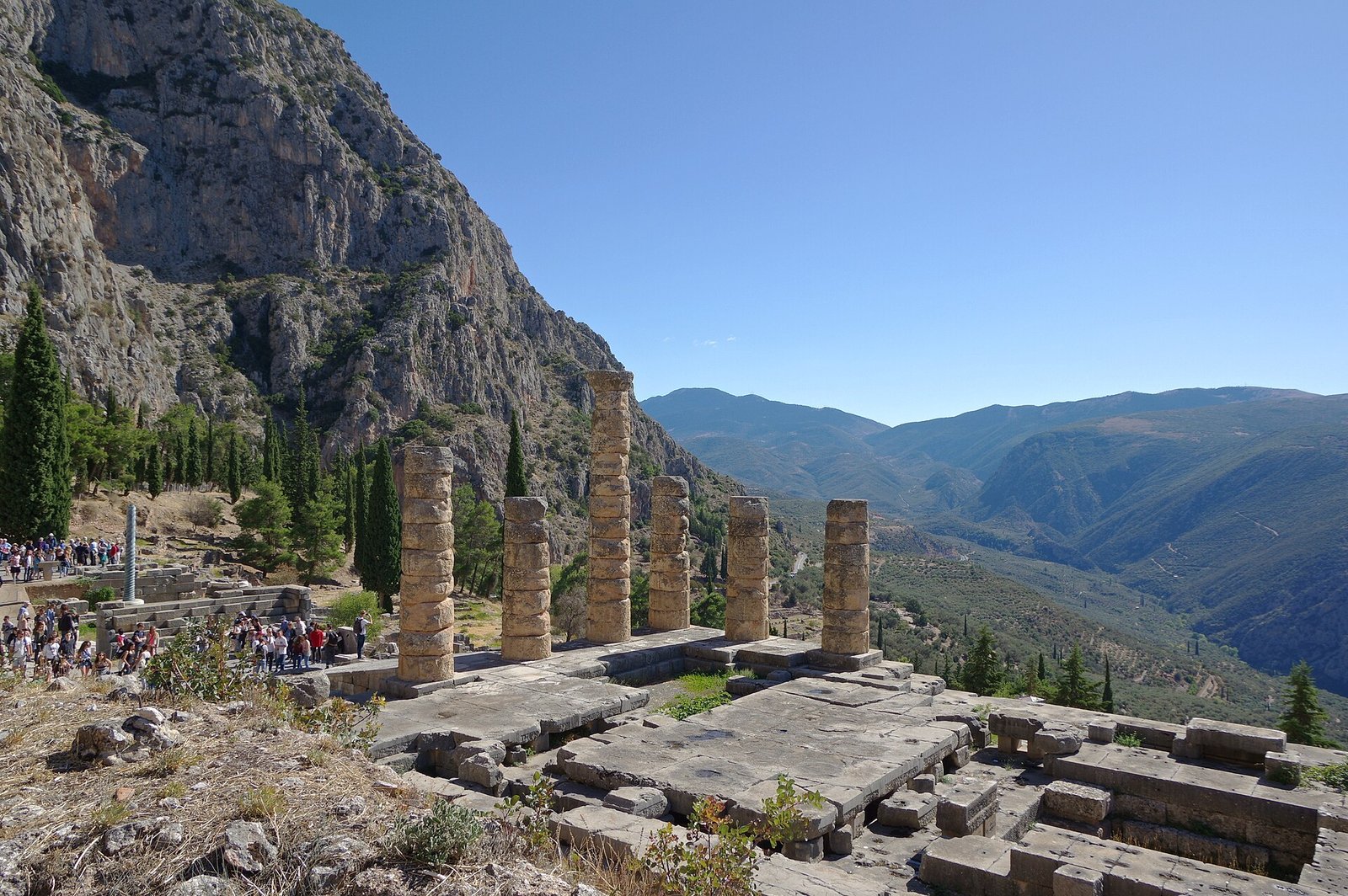
The picture at the head of this entry shows the restored columns of the fourth-century temple of Apollo, with the cliffs of Parnassus behind. [5]
References and notes (8)
- Herodotus, Histories, translated by A. D. Godley (Loeb Classical Library, 1920), Book 1, on LacusCurtius 1.46–56 and 1.91 read: Croesus tests the oracles; the Delphic answer about the tortoise and the lamb boiled in bronze; his offerings at Delphi (117 gold ingots, the golden lion damaged in the temple fire, the gold and silver bowls at the temple entrance, the golden statue said to be his baker); the answer that he would destroy a great empire; the privileges granted to the Lydians; the Pythia's reply after the fall of Sardis. Return to the text ↑
- Herodotus, Histories, translated by A. D. Godley (Loeb Classical Library, 1920), Book 2, on LacusCurtius 2.134–135 and 2.180 read: Rhodopis of Thrace, slave of Iadmon of Samos, freed by Charaxus of Mytilene; the tithe of her wealth spent on iron ox-spits sent to Delphi and lying behind the altar of the Chians; the burnt temple at Delphi, its rebuilding contracted for 300 talents, the Delphians' quarter collected from cities, Amasis's gift of a thousand talents of alum and the twenty minae from the Greeks of Egypt. Return to the text ↑
- Strabo, Geography, translated by H. L. Jones (Loeb Classical Library, 1927), Book 9, on LacusCurtius 9.3.3–12 read: Delphi on the slope of Parnassus; the Crisaean war; the cave with a narrow mouth, the rising breath, the tripod and the Pythia's answers in verse and prose; the name Pytho; the navel of the earth, the two eagles and the omphalos; the Amphictyony; the treasuries and the plundering by the Phocians; the successive temples; the origin of the Pythian Games; Ephorus on Apollo and Python. Return to the text ↑
- Plutarch, The Oracles at Delphi No Longer Given in Verse (De Pythiae oraculis), translated by A. O. Prickard (Oxford, 1918), online text at penelope.uchicago.edu Moralia 394d–409e, chapters 8–16, 22 and 24–29 read: the guided tour of the offerings, including the place of Rhodopis's iron spits and Croesus's golden baker; the background of the Pythia of Plutarch's day; the change from verse to prose and the comparison of language with coinage; the private questions now asked; the new buildings at Delphi in his time. Return to the text ↑
- Hellenic Ministry of Culture, Ephorate of Antiquities of Phocis, Delphi site and museum website: “History of Delphi”, “The Temple of Apollo” and “The altar of the Chians” The three pages read in full: the Mycenaean settlement and the cult of Apollo from about 1000–800 BCE, the tradition of Gaia and Python, the priests and Plutarch, the Amphictyony, the Pythian Games and their end in 393/4 CE, Pindar's Pythian odes; the temples of about 510 BCE (Alcmaeonids) and 334–333 BCE, the earthquake of 373 BCE, the room beneath the cella where the Pythia prophesied, the omphalos, Julian's restoration in 363 CE and the abandonment after Theodosius I; the altar built by Chios and its inscriptions. Return to the text ↑
- Hellenic Ministry of Culture, Ephorate of Antiquities of Phocis, Delphi website: “Excavations” and “Monuments” Excavations page read in full: Cyriacus of Ancona and later travellers, the village of Kastri, the trial digs of 1840 and 1860, the earthquake of 1870, Homolle and the French School's Great Excavation from mid-October 1892, the expropriation of Kastri and the small railway, the order of finds (Treasury of the Athenians, altar of the Chians, the Charioteer, the stadium, the gymnasium, the Marmaria); Monuments index read for the list of treasuries. Return to the text ↑
- Geological Society of America, news release of 6 August 2001 on J. Z. de Boer, J. R. Hale and J. Chanton, “New evidence for the geological origins of the ancient Delphic oracle (Greece)”, Geology 29 (2001), 707–710 (via EurekAlert!) The release read in full (the paper itself was not accessible): the crossing faults under the sanctuary, ethane, methane and ethylene in spring water near the oracle, the proposed link with the Pythia's trance and Plutarch's account, and the earlier French dismissal of vapours. Return to the text ↑
- G. Etiope, G. Papatheodorou, D. Christodoulou, M. Geraga and P. Favali, “The geological links of the ancient Delphic Oracle (Greece): A reappraisal of natural gas occurrence and origin”, Geology 34 (2006), 821–824 Abstract read (repository record): new soil-gas, groundwater and isotope surveys; thermogenic methane, ethane and carbon dioxide rather than ethylene in neurotoxic amounts; a fault under the Temple of Apollo with possibly stronger degassing in the past; oxygen depletion as an alternative effect. Return to the text ↑
Suggest a correction · Suggest a source for this record
Cite this record
IL Archive, «Delphi», https://ilarchive.com/en/sites/delphi
Continue reading
Related readings