Person · Figure
Rhodopis of Naucratis
- Names
- Doricha · Rhodopis
- Timeline
- From 570 BCE to 526 BCE
- Region
- Egypt
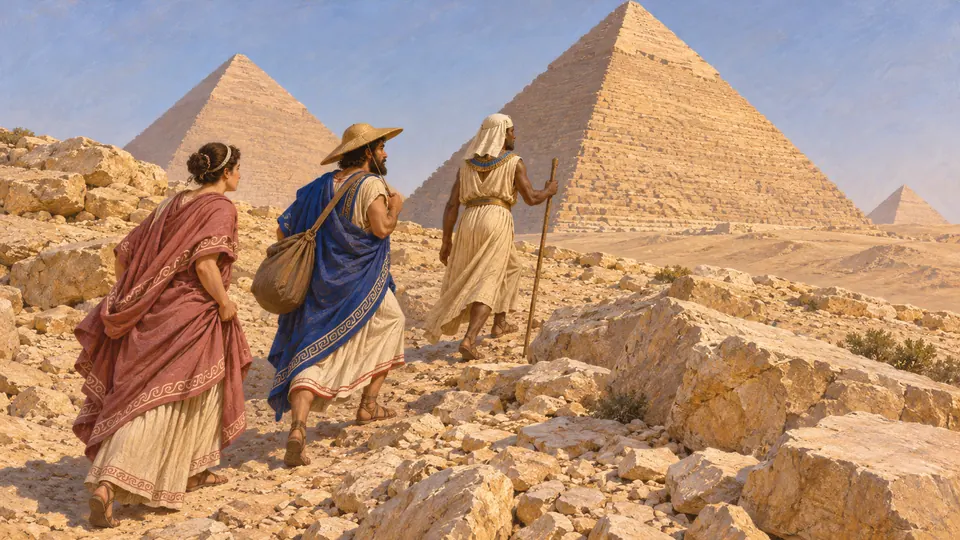
A Thracian woman, once enslaved, who won her freedom and wealth in the Greek port of Naucratis in Egypt in the 500s BCE. Later writers gave her a pyramid and a sandal carried off by an eagle.
Estimated reading time: 6 min Published Last reviewed:
Share article
Text
Introduction
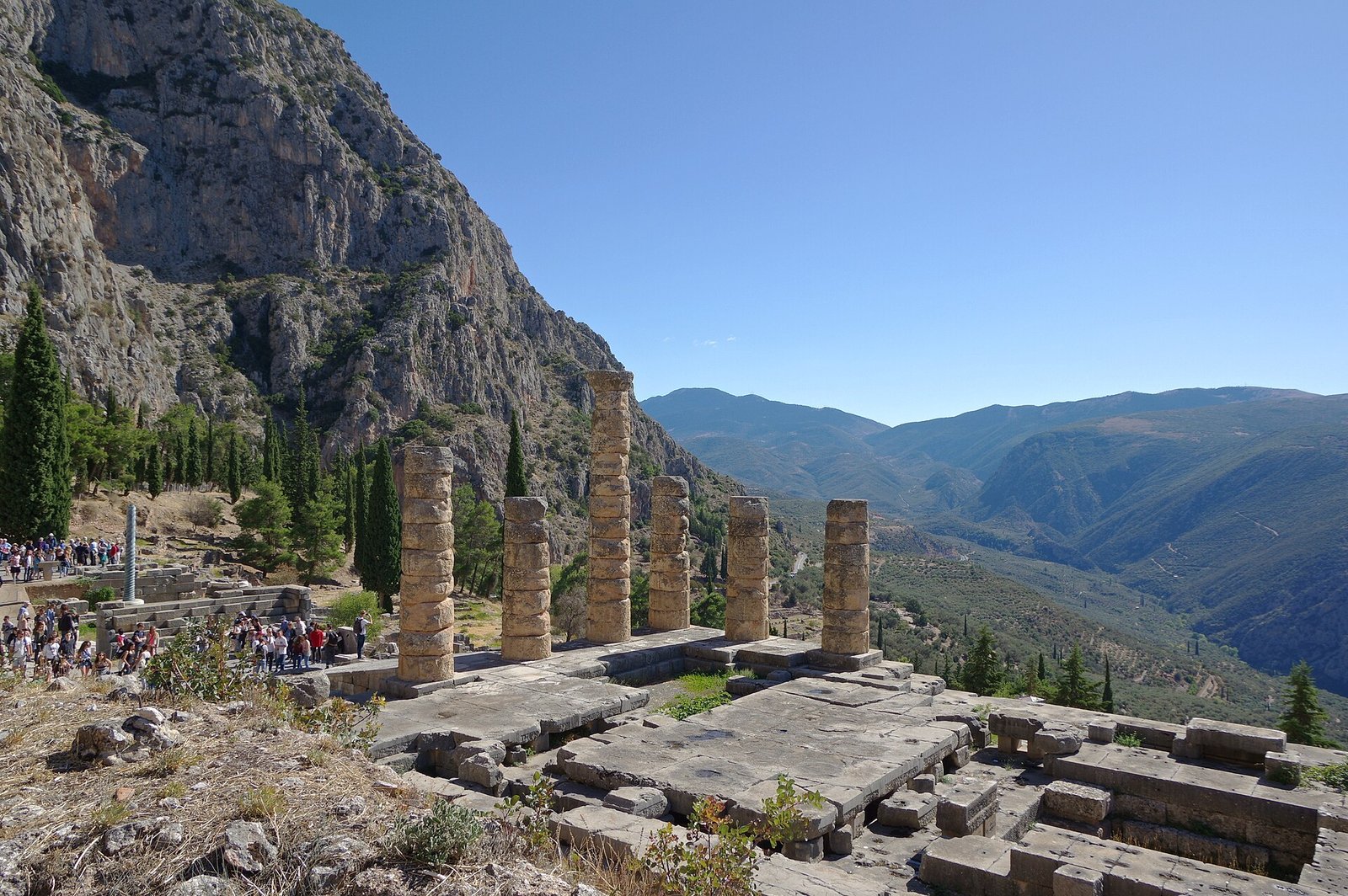
Rhodopis is one of the few ordinary women of the sixth century BCE whose life a Greek historian set down. HerodotusHerodotusFifth-century BCE Greek historian whose account of the Persian Wars includes reports on peoples, court and empire.Glossary · Click to read the explanation says she was born in Thrace, north of the Aegean Sea, was a slave on the island of Samos, and was taken to EgyptEgyptEgypt lies mainly in northeastern Africa and includes the Sinai Peninsula in AsiaGlossary · Click to read the explanation, where a merchant from Lesbos paid for her freedom. She stayed in the port of Naucratis, grew rich, and sent a costly gift to the sanctuary of ApolloApolloGod of music and prophecy in Greek traditions, also participating in the Iliad’s events.Glossary · Click to read the explanation at Delphi. [1]
Her story also shows how a legend grows. Over five centuries, writers gave her a pyramid, powerful lovers and finally a lost sandal that led a king to her. This entry keeps the two apart: first what the earliest sources say, then the legend, then what remains uncertain. [1][2]
What Herodotus says
Herodotus, writing in the fifth century BCE, mentions Rhodopis while describing the pyramids at Giza. Some Greeks, he says, claimed that she built the third and smallest pyramid. He rejects this: such a building cost a sum beyond counting, and Rhodopis lived under King Amasis, long after the pyramid builders. [1]
He then sums up her life. She was Thracian, and a slave of Iadmon of Samos, who also owned Aesop, the famous teller of fables. Xanthes of Samos took her to Egypt to work as a courtesan, a woman paid for her company and her favours. There Charaxus of Mytilene, brother of the poet Sappho, paid a large sum to set her free. She became wealthy, but in Herodotus's words not wealthy enough "for the building of such a pyramid". When Charaxus went home, Sappho mocked him in a poem. [1]
Amasis ruled Egypt from 570 to 526 BCE, so Herodotus places Rhodopis about a hundred years before his own time. [3]
Naucratis, a Greek port in Egypt
Naucratis lay in the Nile Delta, the flat land where the river splits into branches before the sea. It stood on the Canopic branch, near Sais, the royal city of this period. From the late seventh century BCE it was the main meeting point for trade between Egypt and the Greek world, home to Greeks, Egyptians, Cypriots and PhoeniciansPhoeniciansCommunities of Levantine coastal cities known for Mediterranean contact during the first millennium BCE.Glossary · Click to read the explanation, with a temple of the Egyptian god Amun-Ra and Greek temples to Apollo, Hera, AphroditeAphroditeGreek goddess whose origin Hesiod relates to foam after the assault on Ouranos.Glossary · Click to read the explanation and others. [4]
Herodotus says that Amasis gave Naucratis to the Greeks living in Egypt, and that for a time it was the only port open to foreign trade. [5] Athenaeus, a Roman-period writer who came from Naucratis, says Charaxus had come there on business; Strabo adds that he sold wine from Lesbos. [6][2]
The iron spits at Delphi
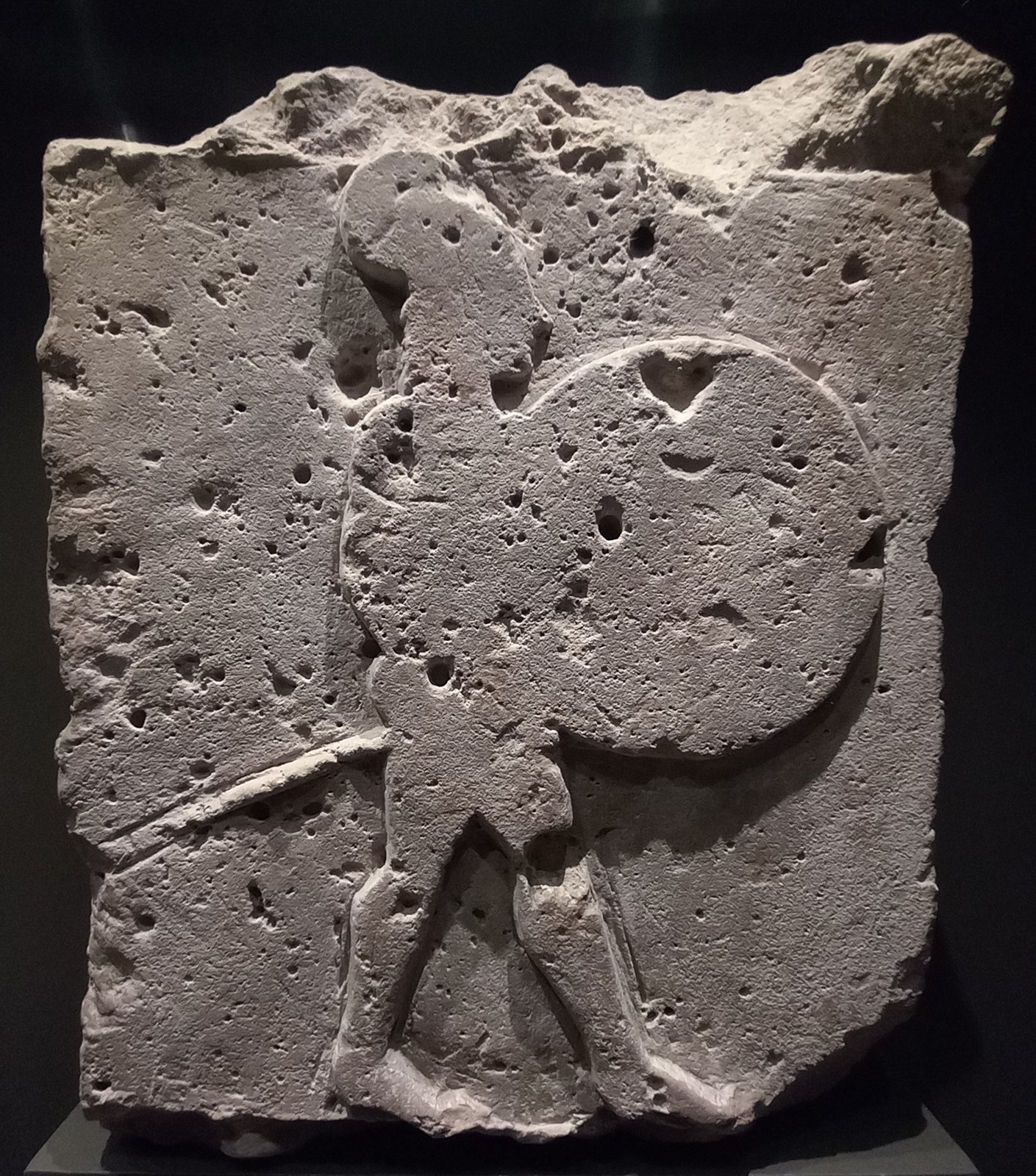
Herodotus's strongest evidence is an object. Rhodopis wanted a memorial in Greece that no one had thought of before. She spent a tenth of her wealth on iron ox-spits, long skewers for roasting the meat of sacrifices, and sent them to Delphi. In his day they lay in a heap behind the altar of the Chians, in front of the temple. [1]
Iron spits were valuable metal, close to a kind of money in early Greece, which is one way scholars explain the gift; others link it to the world of sacrifice. A broken inscription from Delphi has been restored by some scholars as "Rhodopis dedicated", but most of its letters are modern additions, so it is not firm proof. The gift itself is not doubted: Herodotus saw it, and Plutarch says that guides at Delphi still showed where it had stood. [3]
Rhodopis or Doricha?
No surviving poem of Sappho names Rhodopis. Strabo says that Sappho called the woman Doricha, while others called her Rhodopis. Athenaeus disagrees: for him Doricha, the lover of Charaxus, and Rhodopis, who gave the spits, were two different women. He quotes a poem on Doricha's grave by Posidippus, a poet of the third century BCE, here in the English translation of 1854: [2][6]
Modern scholars are divided. Some take Rhodopis, "rosy face", as a nickname for the same woman; others follow Athenaeus. Even the name Doricha appears in Sappho's damaged poems only where editors have filled in missing letters. [3]
The pyramid that was not hers
Later writers repeated the story Herodotus had rejected. Diodorus of Sicily, in the first century BCE, reports that some called the third pyramid her tomb, built by provincial governors who were her lovers. [7] Pliny the Elder calls it the greatest marvel of all that the smallest but most admired pyramid was built by a courtesan. [8] Strabo says it was known as the "Tomb of the Courtesan". [2]
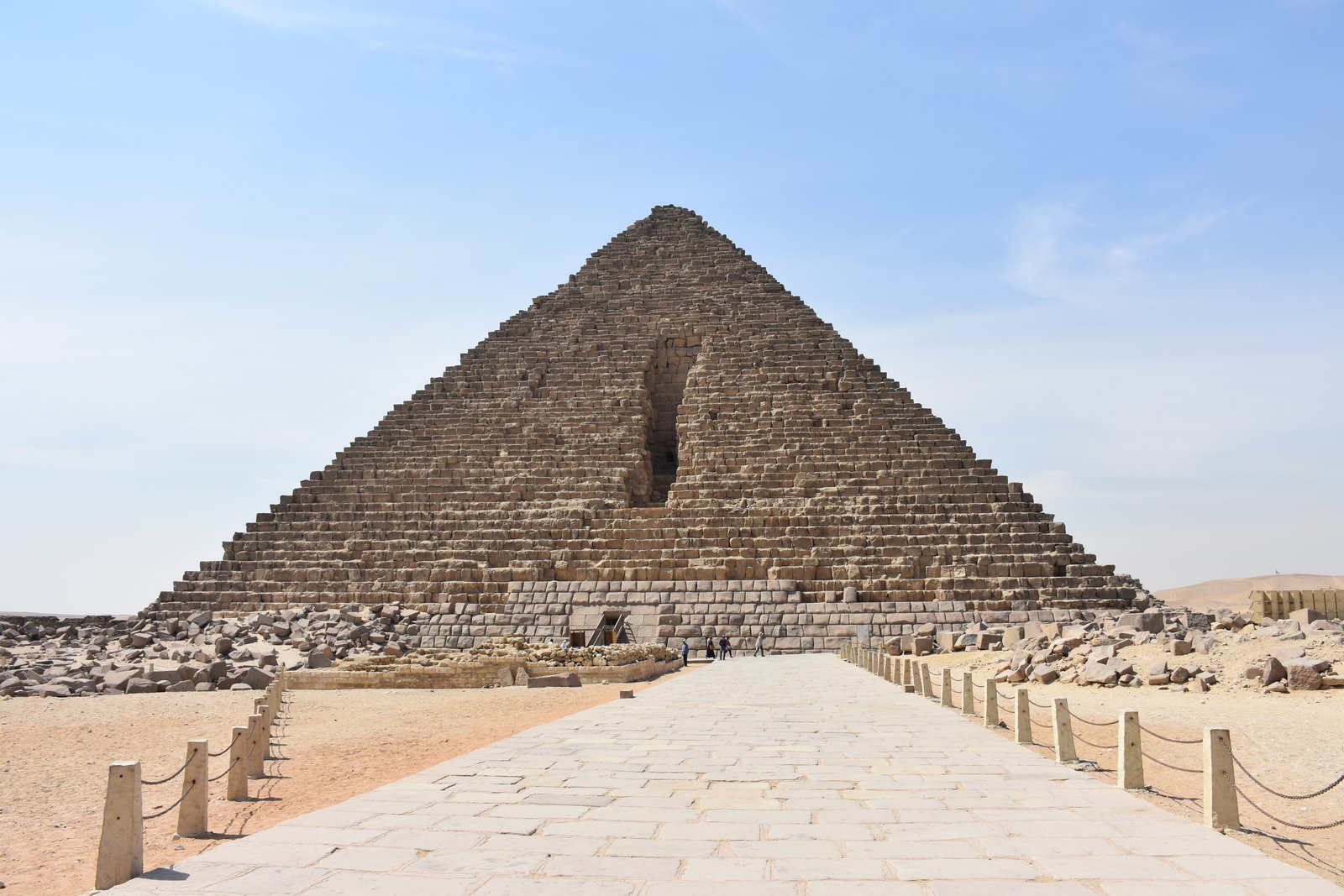
In fact the pyramid belongs to King Menkaure, who ruled about 2532–2503 BCE, two thousand years before Rhodopis. It is the smallest of the three great pyramids at Giza, about 65 metres high when complete. The lower part of its casing is granite from Aswan, more than 800 kilometres to the south: the "Ethiopian stone" that Herodotus mentions. [9][1] Why Greeks tied a famous courtesan to it is not known. One theory is that her story mixed with Egyptian tales of a woman linked to a pyramid, such as Queen Nitocris of the later king lists. [3][8]
The eagle and the sandal
Strabo, writing around the beginning of the Common Era, tells the best-known story and himself calls it a fable. While Rhodopis was bathing, an eagle snatched one of her sandals from her maid, flew to Memphis and dropped it into the lap of the king, who was judging cases in the open air. Struck by the sandal's fine shape and the strange event, the king had the whole country searched for its owner. She was found in Naucratis, brought to MemphisMemphis in EgyptMemphis is an ancient Egyptian city near Mit Rahina south of present-day CairoGlossary · Click to read the explanation and became his wife, and at her death she was honoured with the pyramid as her tomb. [2]
Aelian, writing about two centuries later, tells the same story briefly and names the king Psammetichus, the Greek form of Psamtik, a name of several kings of this era. [10] Herodotus, who knew most about her life, has no sandal and no royal marriage.
A first Cinderella?
A lost shoe, a king's search and a marriage that raises a woman of low rank: the likeness to Cinderella is plain, and Strabo's story is often called its earliest version. Folklorists group Cinderella stories as a "tale type", a family of stories sharing one plot (number 510A in the standard catalogue), and note that Rhodopis lacks its core: the cruel stepmother and stepsisters. [11] Rhodopis is best seen as an early example of the lost-shoe motif, not as the proven source of the fairy tale.
What can be said
A Thracian woman, once enslaved, was freed in Naucratis in the sixth century BCE, grew rich and sent an offering to Delphi that was still shown a century later. Her link with Sappho's brother rests on Herodotus and on Sappho's damaged poems. The pyramid, the powerful lovers and the eagle belong to legend, written down centuries after her. [1][2][3]
References and notes (11)
- Herodotus, Histories, translated by A. D. Godley (Loeb Classical Library, 1920), Book 2, on LacusCurtius 2.134–135 read in full: the claim that Rhodopis built the third pyramid and Herodotus's rejection of it, her Thracian birth, Iadmon of Samos and Aesop, Xanthes, her freeing by Charaxus of Mytilene, her wealth, the tithe of iron ox-spits at Delphi behind the altar of the Chians, Archidice, and Sappho's poem against Charaxus. Return to the text ↑
- Strabo, Geography, translated by H. L. Jones (Loeb Classical Library, 1932), Book 17, on LacusCurtius 17.1.33 read in full with the translator's notes 172–178: the three pyramids, the third built of black Aethiopian stone and called the Tomb of the Courtesan, Doricha in Sappho and the name Rhodopis, Charaxus carrying Lesbian wine to Naucratis, and the eagle-and-sandal story, which Strabo calls fabulous. Return to the text ↑
- Dobrinka Chiekova, “Rhodopis, the Courtesan Who Annoyed Sappho,” Antigone (online journal), January 2025 Whole article: Herodotus, Strabo, Diodorus, Pliny, Plutarch (De Pythiae oraculis 14) and Athenaeus on Rhodopis; the reign of Amasis (570–526 BCE); the Sappho fragments restored with the name Doricha and the Brothers Poem; the Delphi inscription restored as a dedication by Rhodopis (Jeffery; SEG 13.364) and why it is doubtful; the debates on Doricha and Rhodopis, the meaning of the spits and the Nitocris theory. Return to the text ↑
- Egypt Exploration Society, “Naukratis in its riverine environment” (EES Delta Survey, directed by Ben Pennington), 25 August 2017 Whole page: Naukratis on the Canopic branch of the Nile near Sais, its rise from the late seventh century BCE, its mixed population, the temple of Amun-Ra and the Greek sanctuaries, and the shifting river bank. Return to the text ↑
- Herodotus, Histories, translated by A. D. Godley (Loeb Classical Library, 1920), Book 2, on LacusCurtius 2.178–179 read in full: Amasis gives Naucratis to the Greeks, the Hellenion and other sanctuaries, and Naucratis as the only trading port in Egypt. Return to the text ↑
- Athenaeus, The Deipnosophists, translated by C. D. Yonge (London: Bohn, 1854), on the Perseus Digital Library 13.596b–d (Book 13, chapter 69) read in full: the courtesans of Naucratis, Doricha and Charaxus in Sappho, Athenaeus's view that Herodotus confused Doricha with Rhodopis, the spits at Delphi, the epigram of Posidippus on Doricha, and Archedice. Return to the text ↑
- Diodorus of Sicily, Library of History, translated by C. H. Oldfather (Loeb Classical Library, 1933), Book 1, on LacusCurtius 1.64.13–14 read in full: disagreement over the builders of the pyramids, and the report that some called the third pyramid the tomb of the courtesan Rhodopis, built jointly by nomarchs who were her lovers. Return to the text ↑
- Pliny the Elder, The Natural History, translated by J. Bostock and H. T. Riley (London, 1855), on the Perseus Digital Library 36.17 read in full with the translators' notes: the pyramids, Pliny's statement that the smallest but most admired pyramid was built by Rhodopis, fellow slave of Aesop, and the translators' note on Herodotus's rejection and the confusion with Queen Nitocris. Return to the text ↑
- Egyptian Ministry of Tourism and Antiquities, “Pyramid Complex of Menkaure” Whole page: Menkaure's family and dates (c. 2532–2503 BCE), the original height of 65 metres, the smaller base, the granite casing from Aswan on the lower quarter, the unfinished casing and temples, and the queens' pyramids. Return to the text ↑
- Aelian, Various History, translated by Thomas Stanley (London, 1665), Book 13, on Bill Thayer's site (penelope.uchicago.edu) 13.33 read in full: the eagle takes Rhodopis's shoe to Memphis and drops it in the lap of Psammetichus, who has her found and marries her. Return to the text ↑
- D. L. Ashliman, “Cinderella: folktales of Aarne-Thompson-Uther type 510A and other stories of persecuted heroines,” Folktexts, University of Pittsburgh Opening sections: Strabo's Rhodopis as the first entry, with the compiler's note that it is often called the earliest Cinderella variant but lacks the persecuted heroine and her stepmother and stepsisters; the type number 510A. Return to the text ↑
Suggest a correction · Suggest a source for this record
Cite this record
IL Archive, «Rhodopis of Naucratis», https://ilarchive.com/en/people/rhodopis
Continue reading