Person · Figure
Teti of Egypt
- Names
- Sehetep-tawy · Seheteptawy
- Region
- Egypt
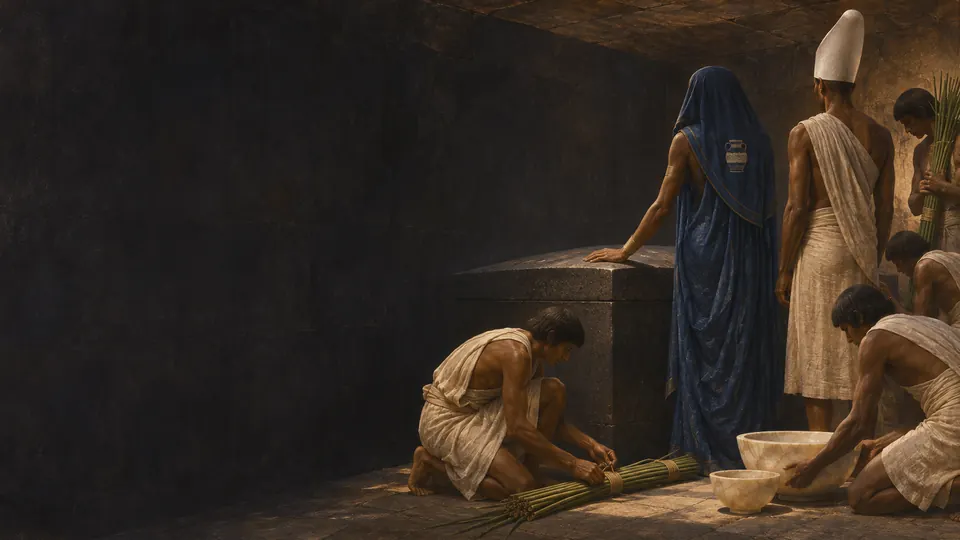
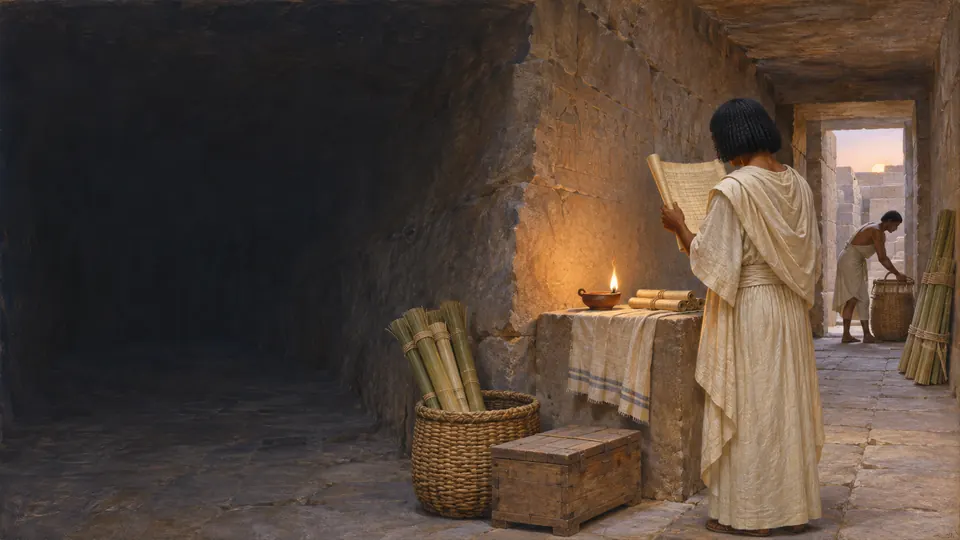
Teti opened Egypt’s Sixth Dynasty and built an inscribed pyramid at Saqqara. Its funerary texts and a sistrum bearing his five royal names preserve different aspects of his kingship.
Estimated reading time: 5 min Published Last reviewed:
Share article
Text
Introduction
Teti was the first king of Egypt’s Sixth Dynasty. His pyramid at Saqqara preserves a large body of funerary recitations, and an inscribed stone sistrum preserves the names and titles by which he presented himself as king. Surviving records establish his place in the succession more securely than the duration of his rule or the circumstances of his death. [1] [2] [3] [4]
The first king of the Sixth Dynasty
Teti’s Horus name was Sehetep-tawy, which Miroslav Bárta translates as the king who pacifies the Two Lands. University College London lists surviving attestations that include a calcite vessel from Abydos, a fragment from the pyramid inscriptions and a decree found at Abydos. Teti’s court included the viziers Kagemni and Mereruka. Their mastabas, rectangular tomb buildings, lie near the royal pyramid. Bárta identifies both men as Teti’s sons-in-law and connects the marriages with an established practice of linking the royal family and influential officials. Queen Iput I, Teti’s wife, was the mother of Pepy I. The shorter reign of Userkare intervened between Teti and Pepy. [1] [3] [4] [5]
Sources do not use a single absolute chronology for Teti. Egypt’s antiquities ministry gives about 2345–2323 BCE. James P. AllenJames P. AllenEgyptologist and Brown professor emeritus, studying ancient Egyptian language, literature and religion, including the Pyramid Texts.Glossary · Click to read the explanation places him about 2323–2291 BCE, the same range the Metropolitan Museum assigns to his sistrum. Michel Baud notes that the surviving part of the South Saqqara annals keeps none of Teti’s dates or the lines separating his year compartments, so he considers that stone insufficient for estimating the total length of the reign. Bárta reads the annals as confirming a reign of no more than twelve years. Their different assessments matter because the annals are often invoked to support a precise duration. [2] [3] [4] [5] [6]
Baud also discusses a quarry graffito at Hatnub that refers to the year after a sixth count, and an ink inscription dating an official’s burial to an eleventh count. The latter lacks a king’s name. Baud considers attribution to Teti likely, but the inscription itself supplies no direct identification. A count was an administrative event used to date documents. Working from count dates to a total number of regnal years also depends on how often the counts took place. Baud notes that the older assumption of a regularly biennial census has been challenged. [4]
Names on a ritual instrument
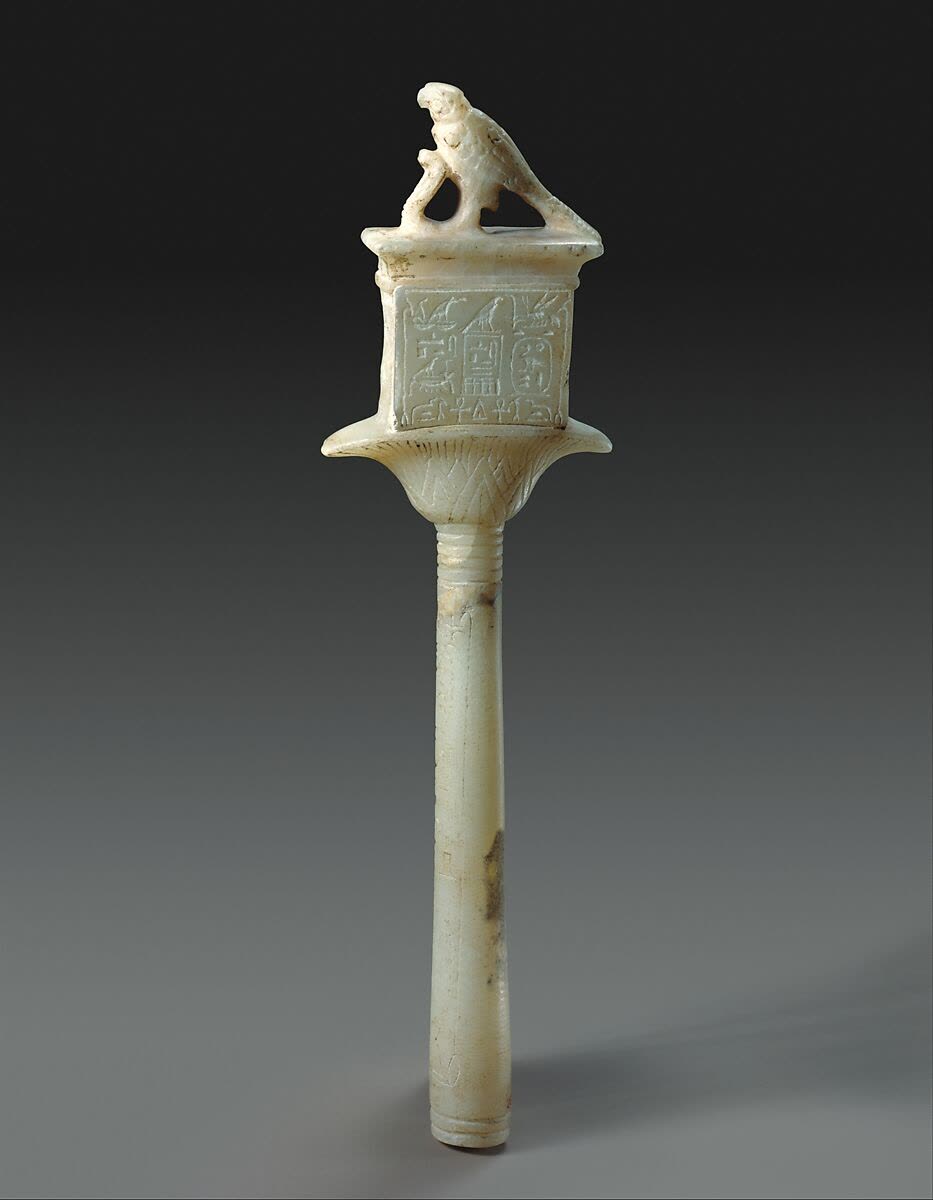
The Metropolitan Museum’s sistrum 26.7.1450 is made of travertine, also called Egyptian alabaster, with traces of pigment and resin. A carved papyrus stalk supports a small shrine, with a falcon and a raised cobra above. On the surviving face of the shrine, the sistrum places the king’s five names together. The longer inscription on the handle identifies Teti with his titles as king and Son of Re and calls him beloved of Hathor of Dendara. Here the royal titulary appears in an object associated with a particular goddess and the performance of a ceremony. [2]
A sistrum is a rattle shaken to mark rhythm in ritualRitualAn organised or distinguished practice meaningful to a community; it may leave traces, but its form alone does not reveal an associated doctrine.Glossary · Click to read the explanation. Part of this example’s sound box and its metal rods are missing. Holes for the rods and traces of copper corrosion lead the museum to suggest that the object may once have been playable. The museum identifies it as an early example of a shrine-shaped sistrum. Its place of discovery is uncertain, and the museum lists Memphis as a possibility. [2]
Texts inside the pyramid
The pyramid once rose about 52.5 metres and was faced with fine limestone. Removal of the casing left an irregular mound above the passage and chambers. Remains of the mortuary temple have been found, and the antiquities ministry reports that the valley temple has yet to be located. Within the pyramid, Allen counts six of fourteen inscribed walls as destroyed, with parts surviving as fragments. His edition uses their surviving positions and relationships to other corpora to reconstruct aspects of the sequence while acknowledging the losses. Teti’s decorators placed the sign for recitation at the top of each column as well as at the start of spells, a practice Allen also identifies in the later pyramids of Pepy IIPepi IIPepi II was an Egyptian king of the Sixth Dynasty in the late third millennium BCEGlossary · Click to read the explanation and Neith. [3] [6]
The burial chamber’s west gable commends the king’s body to Nut, the sky goddess. The north wall held much of the offering ritual, which continued onto the east wall. The sarcophagus itself bears a sequence of spells on its inner walls and lid. In the passage, recitation 359 asks the Sun to commend the speaker to the ferryman of the Winding Canal so that he can reach the eastern sky. Recitation 360 addresses Nut’s portal and asks that it be opened. These are words for passage through a ritual geography, preserved in the material passage between the pyramid’s chambers. [6]
The end of the reign
Manetho’s much later account says that Teti was killed by his bodyguards. Naguib Kanawati examines the report as a question, noting the problems in the transmission of Manetho’s history and the differing weight modern scholars give to it. Bárta cites the unpainted inscriptions and the wooden beams still beneath the sarcophagus as possible signs of a burial finished in haste. The Egyptian antiquities ministry also regards the decorative program as unfinished, while stating that little evidence supports the murder story. The pyramid preserves signs of how the burial was prepared. Assigning a cause to the king’s death requires evidence the surviving decoration does not supply. [3] [5] [7]
References and notes (7)
- University College London, Digital Egypt, Teti Royal names and selected object, monument and biographical attestations Return to the text ↑
- Metropolitan Museum of Art, Sistrum Inscribed with the Names of King Teti 26.7.1450, proposed provenance, dating, inscription, form and remains of the sounding mechanism Return to the text ↑
- Egyptian Ministry of Tourism and Antiquities, Pyramid Complex of Teti Chronology, measurements, fabric, temple remains, cemetery and assessment of Manetho Return to the text ↑
- Michel Baud, The Relative Chronology of Dynasties 6 and 8 pp. 144–146, limits of the annals, Teti’s count dates and Userkare’s position Return to the text ↑
- Miroslav Bárta, Radjedef to the Eighth Dynasty Sixth Dynasty section, Teti’s royal name, families, succession, reign estimate and burial evidence Return to the text ↑
- James P. Allen, The Ancient Egyptian Pyramid Texts, second edition pp. 69–70, chamber layout and surviving walls, and pp. 80–81, recitations 359–360 Return to the text ↑
- Naguib Kanawati, Conspiracies in the Egyptian Palace Publisher preview, chapter 1 opening, Manetho and limits of the later tradition Return to the text ↑
Suggest a correction · Suggest a source for this record
Cite this record
IL Archive, «Teti of Egypt», https://ilarchive.com/en/people/teti
Continue reading
Related readings