Person · Figure
Vaballathus of Palmyra
- Names
- Septimius Vaballathus · Vabalathus · Vaballathus · Vaballathus Athenodorus · Wahballat
- Timeline
- From 267 CE to 272 CE
- Region
- The Levant
Son of Odaenathus and Zenobia, who inherited his father's titles as a boy in 267 CE. His coins show Palmyra turning from Rome's partner into its rival; what became of him after Aurelian's victory in 272 is unknown.
Estimated reading time: 6 min Published Last reviewed:
Share article
Text
Introduction
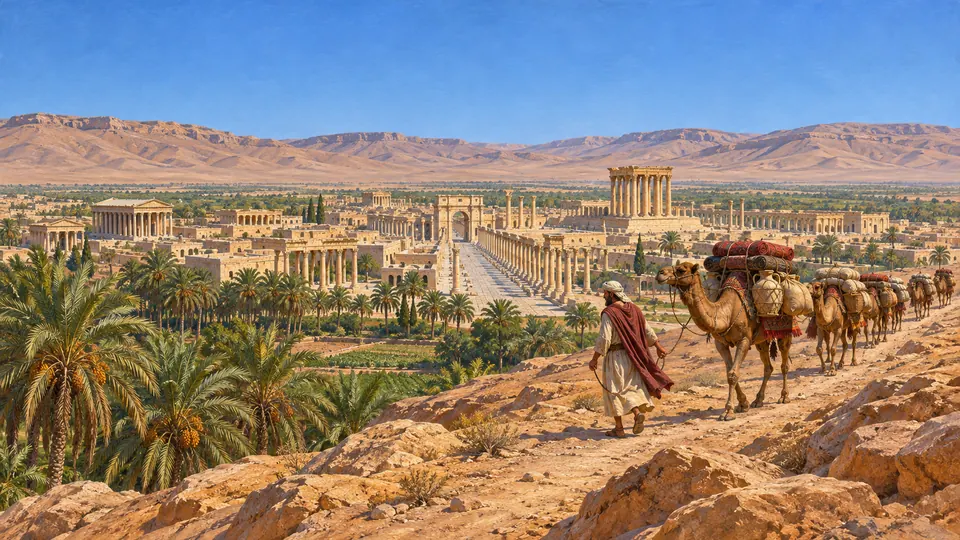
Vaballathus was the son of Odaenathus and Zenobia, the rulers of Palmyra, a rich caravan city in the Syrian desert. When his father was murdered in 267 CE, the boy inherited his titles, and his mother governed in his name. For five years his name and portrait travelled across Rome's eastern provinces on coins, milestones and papyri, while Palmyra moved from serving Rome to challenging it. In the summer of 272 the emperor Aurelian defeated the Palmyrenes, and Vaballathus disappears from the record. [1][2][3]
He left no words of his own. What we know comes mostly from the titles his mother's government gave him. Read in order, they show him moving from a Roman officer's titles, to partner of the emperor, to emperor in his own right. The later histories pay him little attention. [2][4][5]
His names
In Palmyrene AramaicAramaicNorthwest Semitic language varieties documented since the early first millennium BCE, including Old and Imperial Aramaic, Syriac, Jewish dialects, and living Neo-Aramaic forms.Glossary · Click to read the explanation his name is written whblt, Wahballat, a name usually explained as "gift of AllatAllatAn ancient Arabian goddess attested by Safaitic and Nabataean inscriptions, monuments in Palmyra, and the Quran; her roles and interpretations vary with period and context.Glossary · Click to read the explanation", a goddess worshipped at Palmyra. His Greek name, Athenodorus, means "gift of Athena", and Greeks recognised their Athena in Allat, so the two names may say the same thing in two languages. On coins his full style is Julius Aurelius Septimius Vaballathus Athenodorus. Odaenathus' own grandfather had borne the name Vaballathus. The Oldenburg database of Palmyrene names records Zenobia, honoured on two columns of the city's main colonnaded street, as the mother of Septimius Wahballat. [1][4][6]
Heir at a young age, 267
Odaenathus, who had defended Rome's East against the Persians after 260, was murdered at Emesa (modern Homs) in 267 or 268, together with his eldest son. Vaballathus, the younger son, was still a child; one modern estimate puts his birth around 260. [1][3][5]
He inherited his father's two great titles. A Palmyrene inscription calls him "king of kings", the old title of the Persian rulers. It also gives him a Greek word written in Aramaic letters, ʾpnrtt, from epanorthōtēs, "the one who sets things right". This was the Greek name for a Roman corrector, an official with authority over the Roman governors of a region. The historian Byron Nakamura concludes that at this stage Vaballathus "was still a subject of the emperor". His years of rule were counted from his father's death, so a coin of 270/271 calls itself his "year 4". [2][4]
Partner of the emperor, 270–271
In 270 Palmyrene armies took Egypt and the great Syrian city of Antioch. Both had imperial mints, and both began to strike coins with the emperor Aurelian on one side and Vaballathus on the other. On the Latin coins of Antioch, Vaballathus' side reads:
The letters are abbreviations: vir clarissimus, rex, imperator, dux Romanorum, "most distinguished man, king, commander, general of the Romans" (legend of the Antioch coins, as read by Nakamura). The Latin word imperator could mean a victorious commander as well as an emperor. [2]
The Greek coins of AlexandriaAlexandria (Egypt)Alexandria is a city on Egypt’s Mediterranean coast, founded by Alexander the Great in 331 BCE and an important center of trade and culture.Glossary · Click to read the explanation say the same thing in a different way. One type of 270/271 calls Aurelian "Emperor Caesar Lucius Domitius Aurelianus Augustus", year 1. On the other side Vaballathus is "consular, emperor, general of the Romans", year 4. Only Aurelian is Augustus, the title of a reigning Roman emperor. The partnership was unequal, much as a junior partner's name sits below the senior partner's on a firm's letterhead. A second type, of 271/272, keeps the same pairing, and papyri from Egypt were dated by the years of both rulers. [2][4]
Nakamura reads these coins as "a period of joint-rule" and suggests that the large Antioch issues may have paid Zenobia's soldiers. Whether the partnership was sincere or a polite cover is still debated. [2]
Augustus, 272
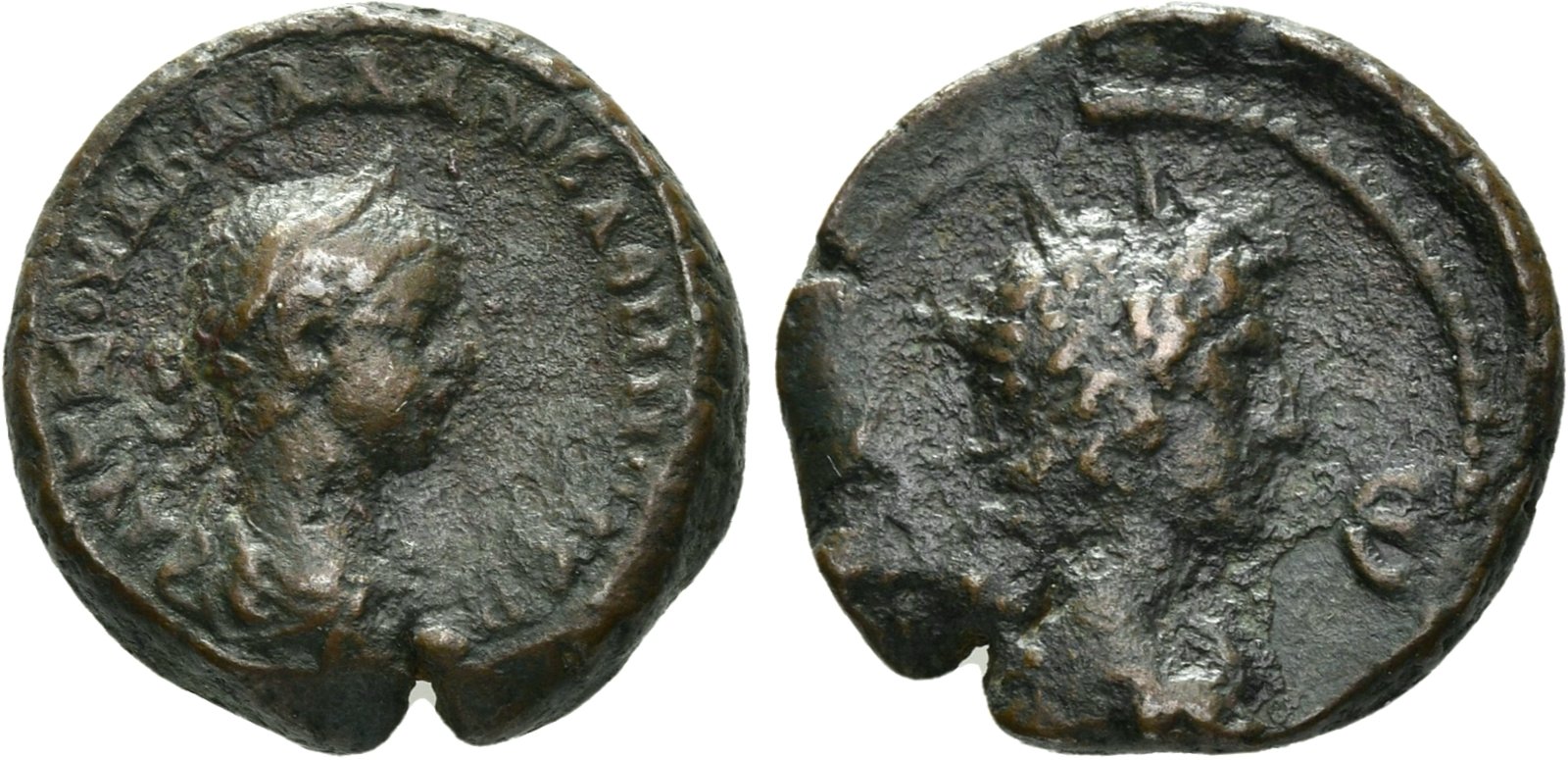
In the spring of 272 the pairing ended. New coins from Alexandria show Vaballathus alone, laureate, with the legend "Emperor Caesar Vaballathus Athenodorus Augustus", dated to his year 5. The coin in the picture is one of them; its other side shows Helios, the sun god, and the specialist catalogue dates it to about March–June 272. Coins of Antioch now named Vaballathus and Zenobia as sole rulers, she with the title Augusta, Roman empress. [2][7]
Milestones on the roads around Bostra, the capital of the Roman province of Arabia, carry his full imperial style in Latin, with three victory titles: Persicus Maximus, Arabicus Maximus and Adiabenicus Maximus, "greatest victor over the Persians, the Arabs and Adiabene" (a kingdom east of the Tigris). An ostracon from Egypt (a pottery sherd used for writing) even calls "our lords Aurelian and King Athenodorus" Augusti together. Nakamura dates it to the short moment between the junior title and the claim to rule alone. A damaged papyrus may preserve a proclamation in Vaballathus' name to the people of Alexandria, promising them a visit, but the attribution is uncertain: one scholar who studied it titled his article "A Proclamation of Vaballathus?", with a question mark. [2]
No ancient source explains why the break came at this moment. Nakamura sees Zenobia's policy as shaped more by practical pressures than by any national programme. [2]
Defeat and an unknown end
Aurelian marched east in 272, defeated the Palmyrene armies near Antioch and at Emesa, and besieged Palmyra. Zenobia was captured as she tried to escape across the Euphrates. No source describes what happened to Vaballathus in the fighting. [3][8]
The Greek historian Zosimus, writing more than two centuries later, says that Aurelian set off towards Europe, taking with him Zenobia, "her son" and the other leaders of the revolt. Zenobia died on the way, and the rest were drowned in the strait between Chalcedon and Byzantium. Here the translations disagree: the English version of 1814 drowns them all, while a French version reads "all except her son". A modern reference work says only that he died in captivity, at an unknown date. [3][8][9]
The Historia Augusta, a late Latin collection of imperial lives, says instead that Zenobia ruled for two sons, Herennianus and Timolaus, who walked in Aurelian's triumph at Rome. Its modern editor notes that these two are "known from no other source", and the same collection's life of Aurelian admits that she ruled "in the name of her son Vaballathus". It also claims that descendants of Zenobia still lived among the Roman nobility, but names none. [5][10]
Quick answers
Who was Vaballathus?
The son of Odaenathus and Zenobia of Palmyra, who inherited his father's titles as a boy in 267 CE and in whose name his mother ruled much of Rome's East. [1][2]
Was he really a Roman emperor?
He claimed it in the spring of 272, on coins and milestones, but Rome never recognised the claim, and Aurelian ended it within months. [2][7]
What happened to him?
It is not known. Zosimus says he was taken west with his mother, and the translations of the next sentence disagree on whether he survived. [8][9]
References and notes (10)
- Prosopographia Palmyrena (Carl von Ossietzky Universität Oldenburg), person entries 860 (spṭmyws ˀdynt / Σεπτίμιος Οδαινάθος) and 868–869 (spṭmyˀ btzby / Σεπτιμία Ζηνοβία; PAT 0317 = CIS II 3971, PAT 0293 = CIS II 3947) All three entries in full: the genealogy of Odaenathus (son of Hairan, grandson of Vaballathus/whblt, great-grandson of Nasor), his children Septimius Hairan and Septimius Wahballat, and Zenobia recorded as "Mother of spṭmyws whblt", queen, daughter of Antiochus, on two columns of the Great Colonnade (one dated 271). Return to the text ↑
- Byron Nakamura, “Palmyra and the Roman East,” Greek, Roman and Byzantine Studies 34 (1993): 133–150 Pp. 135–136, 138 and 143–146 with notes 11, 23, 46–53 and 57–61: the milestones of Vaballathus from Bostra to Philadelphia, the Antioch antoniniani as army pay, the titles corrector / ʾpnrtt (epanorthōtēs) and "king of kings", the joint coinage with Aurelian (vir clarissimus rex imperator dux Romanorum), the papyri and the ostracon O.Mich. III 1006, the sole-Augustus coins of spring 272, the milestone AE 1904.60, and the possible proclamation of Vaballathus to the Alexandrians (Parsons 1967). Return to the text ↑
- Jona Lendering, “Vaballathus,” Livius.org (last modified 10 August 2020) The whole entry: full name, birth c. 260, titles of 267, 270 and spring 272 (including Persicus, Arabicus and Adiabenicus maximus), capture in summer 272 and death in captivity at an unknown date. Return to the text ↑
- Roman Provincial Coinage Online, vol. X, type IDs 75752 (Alexandria, Aurelian year 1 with Vaballathus year 4, AD 270/1) and 75753 (Aurelian year 2 with Vaballathus year 5, AD 271/2) Both type records in full: obverse and reverse designs, the Greek legends with the editors' expansion and translation ("Julius Aurelius Septimius Vaballathus Athenodorus, consular emperor, strategos of the Romans"), dates, references to Bland 2011 and the specimen notes. Return to the text ↑
- Historia Augusta, “The Thirty Pretenders,” 15–17, 24, 27–28 and 30, translated by David Magie, Loeb Classical Library (1932), on LacusCurtius, with the editor's notes Chapters 15–17 (Odaenathus, Herodes, Maeonius), 24.4 (the triumph), 27–28 (Herennianus and Timolaus) and 30.1–3 (Zenobia), with the editor's notes 55, 85, 96 ("known from no other source"; Vaballathus Athenodorus as Odaenathus' successor) and 101–103. Return to the text ↑
- Jona Lendering, “Athena,” Livius.org (last modified 30 April 2020), with Marco Prins, “Palmyra, Temple of Allat, cult statue,” Livius.org (last modified 24 September 2020) The Athena article on the Greek identification of Athena with foreign goddesses, "like the goddess Allat of the Arabs", and the picture page of the Athena-type cult statue from the temple of Allat at Palmyra. Return to the text ↑
- Roman Provincial Coinage Online, vol. X, type IDs 75755 and 75757 (Alexandria, Vaballathus Augustus, year 5, AD 272), and Münzkabinett der Staatlichen Museen zu Berlin, object 18257711, “Alexandria: Vaballathus”, tetradrachm, 272 CE Both RPC type records (legend ΑΥΤ Κ ΟΥΑΒΑΛΛΑΘΟϹ ΑΘΗΝΟ ϹΕΒ, "Emperor Caesar Vaballathus Athenodorus Augustus", year 5; Helios and Homonoia reverses; Bland 2011 nos. 51–54) and the Berlin object record in full (legend, Helios reverse, year 5, 10.40 g, Bland 2011 no. 51 dated c. March–June 272, Dattari 5508, acquisition 1892/96). Return to the text ↑
- Zosimus, New History, book 1, English translation (London: Green and Chaplin, 1814), online at the Tertullian Project Book 1, the passages on Odaenathus' death at Emesa, Zenobia's regency, Aurelian's campaign (Antioch, Daphne, Emesa, the siege of Palmyra, Zenobia's capture on the Euphrates) and the journey west with Zenobia and "her son", her death and the drowning of the others between Chalcedon and Byzantium (1.59). Return to the text ↑
- Zosime, Histoire romaine, livre I, French translation, in the Bibliothek der Kirchenväter (Université de Fribourg) Book 1, chapter 59: Aurelian's return to Europe with Zenobia and her son; "les autres, excepté son fils, furent noyés" in the strait between Byzantium and Chalcedon. Return to the text ↑
- Historia Augusta, “The Deified Aurelian,” 37–38, translated by David Magie, Loeb Classical Library (1932), on LacusCurtius, with the editor's notes Chapters 37.5–38.4 and notes 140–142: "it was in the name of her son Vaballathus and not in that of Timolaus or Hennianus that Zenobia held the imperial power". Return to the text ↑
Suggest a correction · Suggest a source for this record
Cite this record
IL Archive, «Vaballathus of Palmyra», https://ilarchive.com/en/people/vaballathus