Site
Amurru, Late Bronze Age kingdom
Levantine kingdom in Hittite treaties; its political name differs from the broader designation Amorites.
Last reviewed:
Text
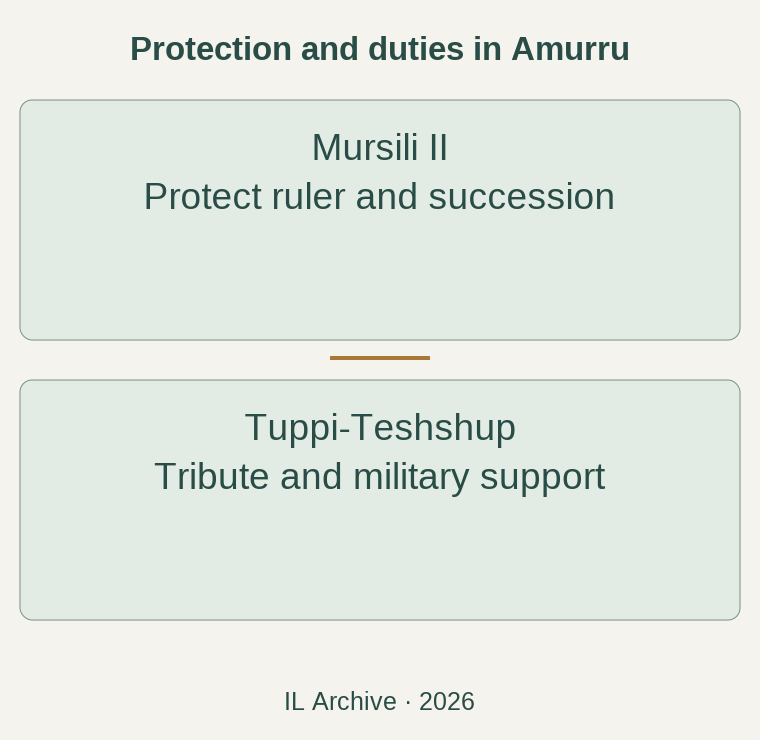
Amurru was a Levantine kingdom in the Late Bronze AgeLate Bronze AgeAn archaeological period around 1600–1200 BCE in much of the Near East, with international diplomacy, exchange and religious diversity; its endpoints vary by region.Glossary · Click to read the explanation, appearing here in subordination to the Hittite throne in the late fourteenth century BCE. Tuppi-TeshshupTuppi-TeshshupRuler of Amurru in the late fourteenth century BCE and party to Mursili II’s treaty.Glossary · Click to read the explanation’s treaty places it in a network of tribute, protection and relations with Egypt. [1][2][3]
This entry concerns a political entity in a particular setting, rather than all groups called AmoritesAmoritesGroups associated with West Semitic speech in the Levant and Mesopotamia, whose dynasties were particularly prominent in the nineteenth and eighteenth centuries BCE (ca. 1900–1700 BCE).Glossary · Click to read the explanation at different times. The diagram explains treaty obligations, not the kingdom’s borders. [1]
References and notes
- CTH 62 treaty; complete German translation, sections 1–27, cola 1–209 and notes read; no independent collation of tablet photographs. Return to the text ↑
- CTH 62 introduction, witnesses, dating, structure and history read fully; treaty concluded after Mursili II’s ninth year. Return to the text ↑
- Koç University Library, catalogue of notes on Mursili II’s prayer,CTH378; catalogue metadata read, including approximate reign ca.1321–1295BCE. Restricted manuscript images not reused. Return to the text ↑
Suggest a correction · Suggest a source for this record
Cite this record
IL Archive, «Amurru, Late Bronze Age kingdom», https://ilarchive.com/en/sites/amurru-late-bronze-age-kingdom
Continue reading