Study
Covenant and Imperial Treaties: Was Israel’s Bond with YHWH Expressed in the Language of Ancient Kings?
An extended study of a topic, with evidence and references.
- Timeline
- From 1400 BCE to 500 BCE
- Region
- The Levant, Anatolia and Mesopotamia
From Muršili’s Hittite treaty to Esarhaddon’s oath and Deuteronomy 13 and 28: comparing loyalty and curses while distinguishing shared tradition from demonstrable borrowing.
Share article
Text
# Covenant and Imperial Treaties: Was Israel's Bond with YHWHYahwehThe divine proper name written YHWH in the Hebrew Bible.Glossary · Click to read the explanation Expressed in the Language of Ancient Kings?
“Love YHWH your God with all your heart,” teach his words to your children, and beware of a relative who urges you to follow other gods; blessings for obedience and curses for disobedience follow. Readers of ancient Near Eastern treaties encounter familiar language: loyalty to a ruler and his heir, its transmission to children, reporting a seducer even within the family, and promises of protection or punishment. Did TorahTorah / PentateuchGenesis, Exodus, Leviticus, Numbers and Deuteronomy: Mosaic corpus with a compositional history. Torah can also mean teaching or law beyond these five books.Glossary · Click to read the explanation writers borrow this language from a particular treaty? [3][5][6][8][11]
The answer is neither a simple “yes, they copied it” nor “no, it is coincidence.” Shared forms and vocabulary can be demonstrated, and closer parallels between parts of Deuteronomy and a dated Assyrian loyalty oath can be tested. Showing that a Judean writer read one particular tablet, however, or that the entire book of Deuteronomy was written in one year, requires different evidence. The careful comparison separates documentary form, distinctive wording, routes of access, and reuse within a religious book with multiple layers.
Treaty and covenant
In an ancient suzerainty treaty, a subordinate ruler pledged loyalty to a greater king. A document might identify the parties and recall their history before giving obligations, divine witnesses, curses for breach and blessings for fidelity. That describes a family of texts, not an obligatory sequence reproduced by every tablet. “Covenant,” HebrewHebrewA Northwest Semitic language in the Canaanite group, with ancient and modern forms.Glossary · Click to read the explanation *berit*, also names several kinds of relationships and obligations in the Torah; each occurrence is not a copy of a surviving diplomatic contract. [1][2][10]
In Deuteronomy, MosesMosesCentral figure in Exodus, Torah traditions and the Qur’an; childhood accounts differ in detail.Glossary · Click to read the explanation speaks to Israel in YHWH's name. The discourse recalls the escape from Egypt and the wilderness, demands worship of YHWH alone, and announces consequences for fidelity and betrayal. Treaty comparison thus helps explain how a regional language of political loyalty could be made into a discourse about a people's relationship with its god. It does not turn every commandment into a royal transaction. [5][6][7][8][9]
An earlier example: Muršili's treaty with Amurru
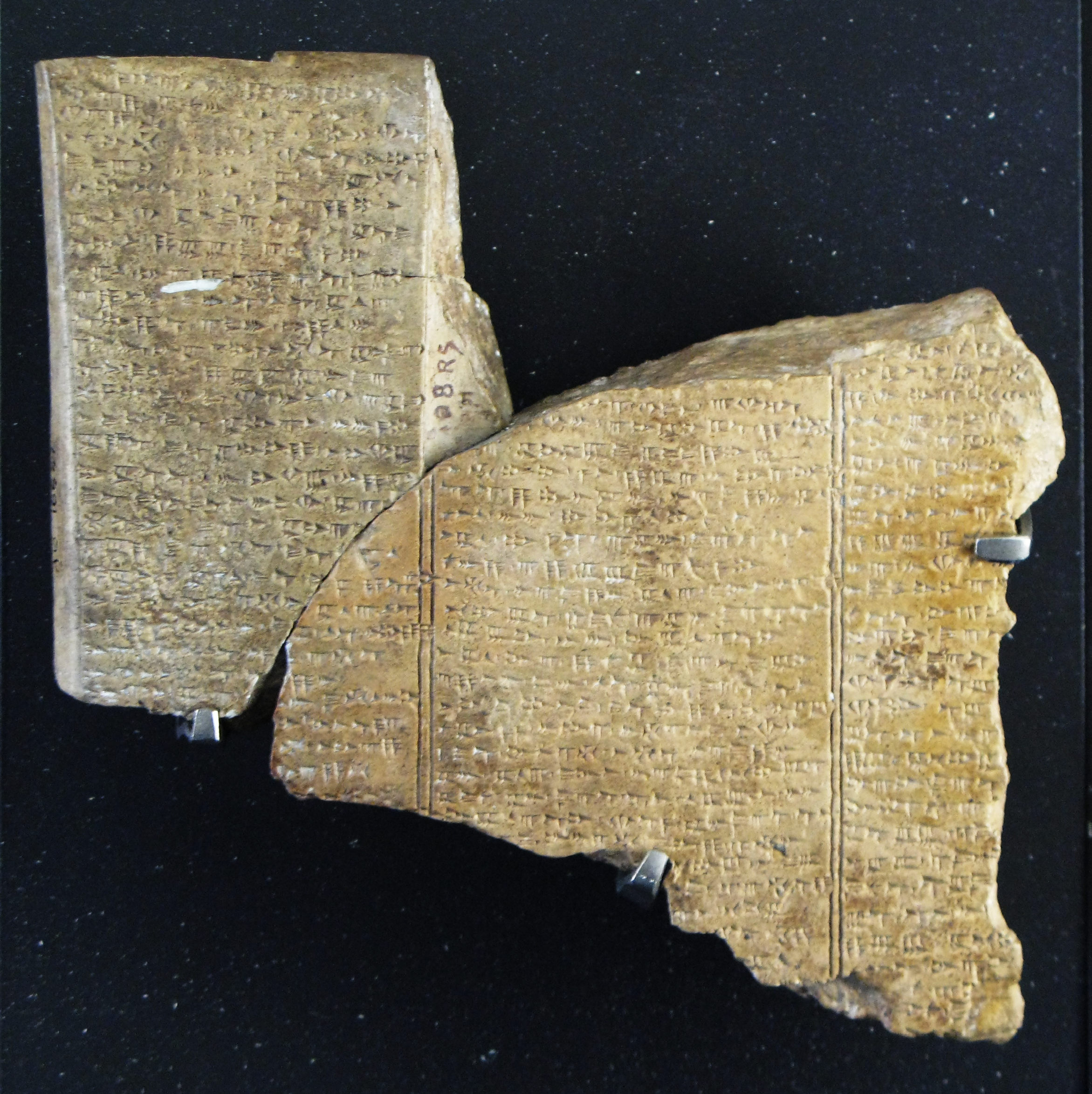
The Hittite king Muršili II made a treaty with Tuppi-Teššup, ruler of Amurru, in the Late Bronze AgeLate Bronze AgeAn archaeological period conventionally around 1600–1200 BCE in much of the Near East, with regional variation.Glossary · Click to read the explanation. The Mainz Hittite text edition preserves it through Hittite copies and a fragmentary AkkadianAkkadianAn ancient East Semitic language written in cuneiform in Mesopotamia.Glossary · Click to read the explanation witness. The text opens by identifying the great king, recounts Amurru's relationship with the Hittite throne, and sets specific duties: tribute, no transfer of allegiance to Egypt, support for allies and opposition to enemies, and reporting rebels and fugitives. It ends with divine and natural witnesses, curses, and blessings. These are readable elements of an ancient diplomatic document, not just a modern scholar's theory about a “treaty pattern”; the editors mark broken or restored passages. [1][2]
This sequence resembles some broad features of Deuteronomy: a prior relationship is reviewed, obedience required, and the consequences of keeping or breaking the commitment stated. Yet the Amurru treaty concerns two rulers, tribute and particular geopolitical boundaries, whereas Deuteronomy places the Exodus, worship and communal justice at the center. Centuries and different writing settings separate them. Resemblance of structure does not establish copying of this particular Hittite treaty. Nor should its surviving witnesses be treated as one intact original tablet signed by both parties. [1][2][5][8]
672 BCE: Esarhaddon's succession oath
A later, more specific comparison is possible. In 672 BCE, Esarhaddon bound subjects by oath to secure the succession of his son AshurbanipalAshurbanipalAshurbanipal was an Assyrian king of the seventh century BCE, reigning about 668–631 BCEGlossary · Click to read the explanation to the Assyrian throne. Scholars call the document Esarhaddon's Succession Treaty, although it is more precisely a succession and loyalty oath than an agreement between equals. It commands protection of the heir, reporting speech that threatens his succession even from a relative or a prophetic figure, and teaching the obligation to children. Numerous gods are invoked as witnesses, followed by a long series of curses. [3][10][11]
Archaeologists found a copy of the oath at Tell Tayinat, ancient Kunalia in the Assyrian administrative sphere of northern Syria. The discovery shows that oaths of this kind reached the empire's western provinces. It does not establish that a copy was found in JerusalemJerusalemJerusalem is a city of religious importance in Judaism, Christianity and IslamGlossary · Click to read the explanation, or that a Deuteronomic writer handled this copy or read its Akkadian wording. It makes a historical route of contact plausible, without documenting every link in a chain of transmission. [4][10]
A relative incites; a prophet speaks
Deuteronomy 13 tests people who urge the worship of other gods: a prophet or dreamer, then a brother, child, wife or intimate friend, then a whole town. Kinship may not conceal the incitement or protect its author. Provisions of Esarhaddon's oath likewise demand disclosure of speech or action against Ashurbanipal's succession, even if it comes from household members or people claiming religious authority. The combination of family, religious figure and disclosure makes this more precise than the generic observation that both laws punish treachery. [3][6][10]
But the lists are not word-for-word counterparts and their procedures are not ordered identically. The Assyrian oath secures a human heir and royal dynasty; Deuteronomy 13 guards against worship of other gods within Israel's bond with YHWH. Its chapter also includes an entire town and an inquiry into its conduct. Some scholars see creative reuse of imperial loyalty language here. C. L. Crouch examines differences in wording and sequence and cautions against treating them as decisive proof of direct copying from the extant oath. [3][6][10][12]
A bronze sky and an iron earth
Deuteronomy 28 starts with blessings and extends into curses affecting body, fields, war, siege and exile. In 28:23–26 the sky above becomes bronze and the earth beneath iron; rain turns to dust and corpses become food for birds and beasts. Images of iron earth, bronze sky and a devastated landscape also occur among the curses of Esarhaddon's oath. This is among the most substantial points of textual comparison. [3][8][10][12]
The force of the image does not erase the differences. In the surviving Assyrian text, iron earth and bronze sky occur in separate clauses; Deuteronomy joins them in one sentence. Other details of soil and precipitation change. Moreover, famine, defeat and abandoned bodies occur in curse traditions from more than one culture. Some scholars judge Assyrian influence on these lines, whether direct or mediated, likely. Crouch argues that variations of wording and order prevent secure identification of this document alone as the direct source. “A possibly strong connection within a circulating curse tradition” is more accurate than “word-for-word identity.” [8][10][12]
“Love” the king and “love” YHWH
In loyalty-treaty language, “love” is not an emotion isolated from conduct. The Assyrian oath requires wholehearted loyalty to Ashurbanipal and links fidelity to teaching the next generation. Deuteronomy 6:4–9 makes love of YHWH with heart, soul and might the basis of commands that parents repeat to their children. Court language can thus illuminate how “love” may also denote practical fidelity in a political and religious setting. [3][5][11]
Reducing Deuteronomy's love to obedience to a crown prince, however, misses much of its discourse. It frames the covenant with Israel's escape from Egypt and YHWH's prior love, and concerns the life of a people in its land. The Assyrian oath secures a king's son; Deuteronomy narrates a relationship between a god and a people, even where it employs the idiom of allegiance. Deena Grant explains both the convergence and the surplus of meaning. [5][9][11]
These texts did not reach us all at once
If the 672 BCE oath influenced a particular Deuteronomic passage, that passage or a stage of its wording must postdate access to the oath. It does not date every word of Deuteronomy to 672 BCE or automatically to Josiah's court. The book combines discourses, laws and editorial work over time. Scholars differ on the dates of its loyalty and curse layers and on how their formulas circulated. Some propose a role for former Judean court scribes after the monarchy; others investigate western AramaicAramaicA group of Northwest Semitic language varieties with a long history across the Near East.Glossary · Click to read the explanation texts such as the Sefire treaties alongside Akkadian ones. For Pakkala and Ramos, the present research read their published abstracts, not their full studies, so the details of their proposals are not presented here as established events. [10][12][13][14]
The treatment of witnesses also differs. Hittite and Assyrian treaties call on many gods, whereas Deuteronomy 30:19 calls heaven and earth to witness the choice of life or death within the worship of YHWH. Deuteronomy 27 has words of the law written on stones and curses proclaimed in a communal rite. Reusing a familiar device does not negate the religious transformation in its new setting. [1][3][7][9]
What can we establish?
Ancient documents establish the circulation of Near Eastern suzerainty treaties and loyalty oaths before Deuteronomy and around the time of some proposed stages in its development. Biblical texts share arrangements of loyalty, demands and consequences, with some distinctive images worthy of close comparison. The Tell Tayinat copy makes the arrival of Assyrian loyalty language in the western LevantThe LevantThe Levant is a regional name for lands along the eastern MediterraneanGlossary · Click to read the explanation historically concrete. [1][3][4][6][8]
Claims that Deuteronomy is a translation of a Hittite treaty, a literal religious copy of Esarhaddon's tablet, or that a parallel dates the entire Torah exceed the evidence. The live question is the degree and route of connection: direct use in selected passages, mediationIntercessionMediation subject in the cited Quranic texts to permission and approval, not divine independence.Glossary · Click to read the explanation through scribes and Aramaic traditions, or a shared regional repertoire of oath and curse language. Scholars weigh these possibilities differently; the generic treaty outline alone cannot decide among them. [10][12][13][14]
The comparison yields something more informative than a charge of copying or a denial of contact. Deuteronomic writers framed loyalty to YHWH in a language intelligible in a world of kings and covenants, then changed the object of loyalty, its memory and its limits. An imperial oath asks its subject, “Will you preserve the heir's throne?” Deuteronomy asks Israel how to live a covenant tying worship, memory and law to its future. Historical resemblance illuminates the second question without answering it in the text's place.
References and notes
- Muršili II–Tuppi-Teššup treaty, CTH 62 §§1–26; digital German translation with lacunae and restorations Mainz Catalog of Hittite Texts, CTH 62 Muršili II treaty with Duppi-Teššup of Amurru Return to the text ↑
- CTH 62 edition introduction and Hittite/Akkadian witness list; read in full Fuscagni and Wilhelm, Mainz CTH 62 scholarly introduction and manuscript synopsis Return to the text ↑
- Esarhaddon Succession Treaty, SAA 2 no. 6, indexed passages cross-checked with scholarship; full digital edition could not be opened SAA 2 no. 6, Esarhaddon's Succession Treaty, primary edition and translation on ORACC Return to the text ↑
- Jacob Lauinger, Tell Tayinat copy; bibliographic and find record only, not the full article Jacob Lauinger, Esarhaddon's Succession Treaty at Tell Tayinat, JCS 64 (2012), bibliographic record Return to the text ↑
- Deuteronomy 6, Hebrew and JPS; entire chapter Deuteronomy 6, Hebrew/JPS text Return to the text ↑
- Deuteronomy 13, Hebrew and JPS; entire chapter Deuteronomy 13, Hebrew/JPS text Return to the text ↑
- Deuteronomy 27, Hebrew and JPS; selected writing and curse passages Deuteronomy 27, Hebrew/JPS text Return to the text ↑
- Deuteronomy 28, Hebrew and JPS; entire chapter, especially vv. 23–26 Deuteronomy 28, Hebrew text with JPS 1917 English translation Return to the text ↑
- Deuteronomy 30, Hebrew and JPS; vv. 1–8 and 15–20 Deuteronomy 30, Hebrew/JPS text Return to the text ↑
- C. L. Crouch, Israel and the Assyrians, selected pp. 49–89, 106–107, 178–180, not the whole book C. L. Crouch, Israel and the Assyrians (2014), especially chs. 2–3 and conclusion Return to the text ↑
- Deena Grant, complete essay on the language of love for god and king Deena Grant, Loving God Beyond the Way You Love Ashurbanipal (2016) Return to the text ↑
- Gad Barnea, complete essay on blessings, curses and regional tradition Gad Barnea, Enforcing YHWH's Covenant with Blessings and Curses: Imperial Style, online scholarly essay Return to the text ↑
- Juha Pakkala, university article abstract and record only, not the full study Juha Pakkala, The Influence of Treaties on Deuteronomy, Hebrew Bible and Ancient Israel 8.2 (2019), 159–183 Return to the text ↑
- Melissa Ramos, university abstract only on Sefire and Deuteronomy 28 Melissa Ramos, A Northwest Semitic Curse Formula: The Sefire Treaty and Deuteronomy 28 (2016) Return to the text ↑
Suggest a correction · Suggest a source for this record
Cite this record
IL Archive, «Covenant and Imperial Treaties: Was Israel’s Bond with YHWH Expressed in the Language of Ancient Kings?», Edition 1, https://ilarchive.com/en/studies/covenant-and-imperial-treaties
Continue reading