Site
Hayonim Cave
- Timeline
- From 13000 BCE to 9500 BCE
- Region
- Western Galilee (present-day Israel)
A multistratified cave in western Galilee whose Natufian burials reveal ornaments, mortuary practices and repeated use of place, not proven continuous group identity.
Estimated reading time: 3 min Published Last reviewed:
Share article
Text
Introduction
What can the burials at Hayonim Cave in western Galilee tell us about late prehistoric communities? This article distinguishes archaeological observations from interpretations of social identity and collective memory. Dates are approximate and do not imply continuous occupation in every intervening year.
The cave and its layers
Hayonim is a cave site in western Galilee with an archaeological sequence much older than its NatufianNatufian cultureA Levantine archaeological culture, roughly 13,000–9500 BCE, marked at some sites by stone buildings, extended occupation, varied food tools and burials before domesticated farming; not a documented ethnic self-name.Glossary · Click to read the explanation burials. Its strata include Middle Palaeolithic Mousterian, Upper Palaeolithic Aurignacian, Kebaran and Natufian remains. The entire cave should therefore not be described simply as a Natufian cemetery; nor should earlier human tools be attributed to the later buried population.[2][3]
Layer B belongs to the Natufian and contains small, roughly circular stone constructions, hearths, stone and bone artefacts, and graves. Research identifies both Early and Late Natufian activity: the earlier presence was generally more intensive, whereas the later use seems more ephemeral. Chronological estimates depend on samples and calibration methods, so each date must be tied to its archaeological context.[1][2]
Graves and Grave XVII
Leore Grosman and Anna Belfer-Cohen revisited the Hayonim graveyard evidence, incorporating the latest grave excavated, Grave XVII. They describe seven individuals interred in three burial phases rather than assuming a single simultaneous collective burial. Some burials were accompanied by marine shells, bone ornaments and selected teeth; such decorations did not occur uniformly across all graves.[1]
The number buried in one grave must not be confused with the total cemetery population. Nor can ornamentation alone establish the sex, status or precise social role of the deceased or the objects: such inferences demand skeletal, spatial and comparative context. The authors' estimate of more than three millennia of burial use concerns a succession of Natufian phases, not demonstrable visits every year without interruption.[1]
Identity and memory as interpretations
The authors argue that repeated returns to burial areas and apparent awareness of earlier graves may reflect socially transmitted knowledge of a place and mortuary practices. They also identify similarities between selected graves at Hayonim and Eynan (‘Ain Mallaha), potentially indicating contacts among distinct Natufian groups. This is a reasoned interpretation of placement and funerary traditions, not a direct measurement of the memories of people long deceased.[1]
The material does not establish one continuously reproducing biological population, an uninterrupted rite or a specific cult of ancestors. Moreover, later grave pits cut into earlier deposits; stratigraphic disturbance and movement of older material need to be considered in assigning objects and remains to their correct contexts.[3]
Why the evidence matters
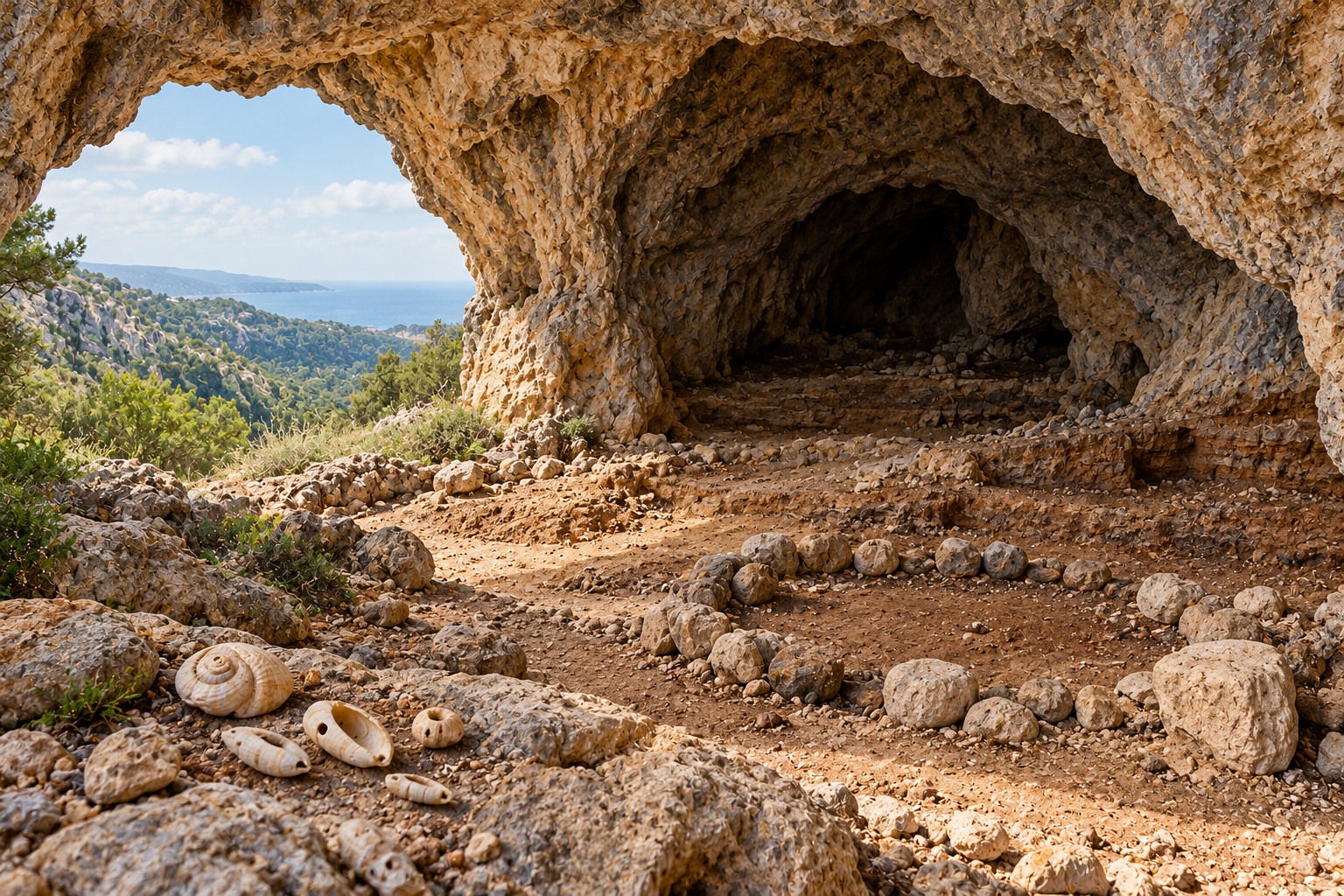
Comparing occupation deposits, grave structures and ornaments helps investigate changing relationships between some Natufian groups, their dead and significant places before widespread farming villages. Claims about social cohesion must nonetheless be tested against stratigraphy, absolute dating, osteology and comparisons between sites. The accompanying main image is a present-day imaginative illustration, not a view of the excavated site or an excavation plan.[1][2]
References and notes (3)
- Leore Grosman & Anna Belfer-Cohen (online 2022; print 2023). Insights into Natufian Social Identity: A Case Study from the Graveyard of Hayonim Cave. Cambridge Archaeological Journal 33(2), 247–264. DOI: 10.1017/S0959774322000282. Publisher full-text HTML: abstract, introduction and Natufian occupation, Grave XVII, decorated burials and discussion; journal pp. 247–264, not a page-by-page PDF reading. Return to the text ↑
- Ofer Bar-Yosef et al., “Hayonim Cave,” Quaternary of the Levant (2017), ch. 26. Publisher chapter summary only: stratigraphic sequence A–F and Natufian structures/phases. Return to the text ↑
- Baruch Arensburg, Ofer Bar-Yosef, Anna Belfer-Cohen and Yoel Rak, “Mousterian and Aurignacian Human Remains from Hayonim Cave, Israel,” Paléorient 16/1 (1990), pp. 107–109. Persée article text, pp. 107–109, especially introduction on Natufian pits cutting older layers. Return to the text ↑
Suggest a correction · Suggest a source for this record
Cite this record
IL Archive, «Hayonim Cave», https://ilarchive.com/en/sites/hayonim-cave