Site
Hayonim Cave
- Timeline
- From 13000 BCE to 9500 BCE
A Galilean cave with Natufian graves and ornaments; its long funerary use informs research on identity and place memory.
Text
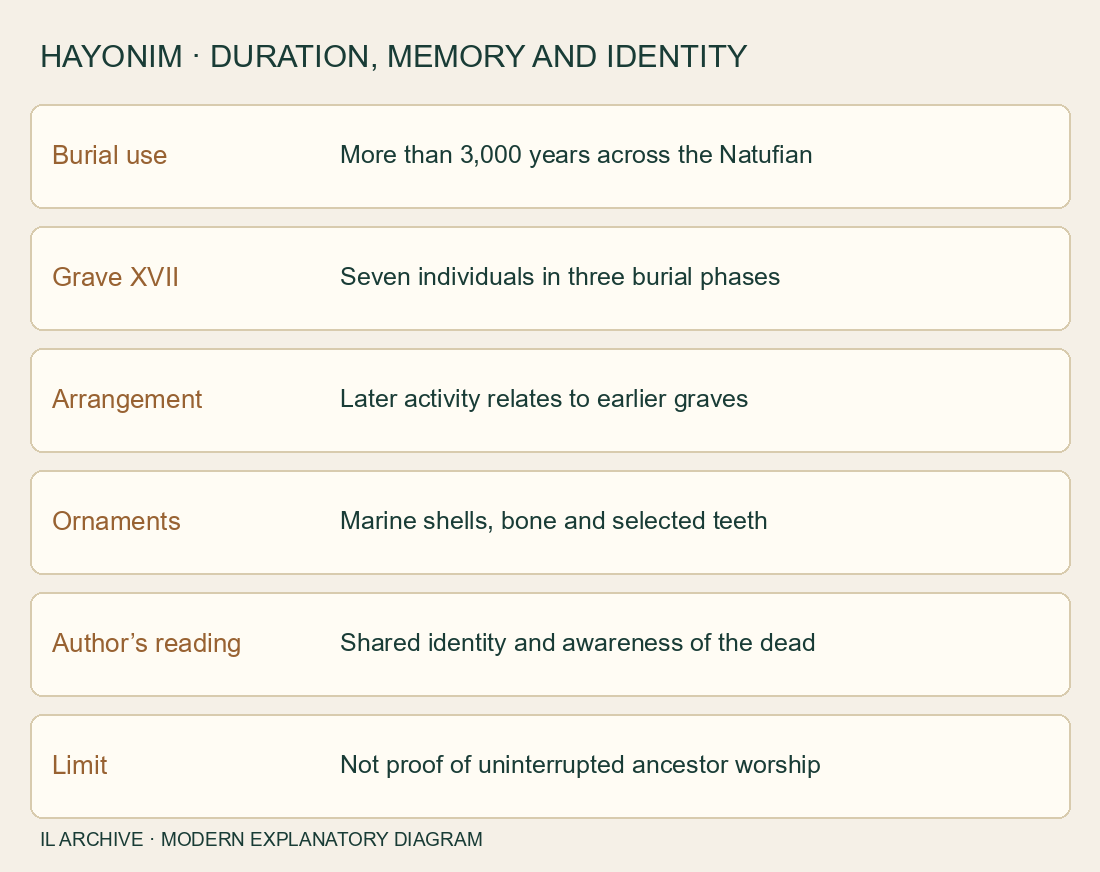
The study describes burial use over more than three thousand years within the NatufianNatufian cultureA late Epipalaeolithic Levantine archaeological culture, with some long-duration settlements before fully developed agriculture.Glossary · Click to read the explanation. Grave XVII contains seven individuals in three phases; some burials have marine shells, bone ornaments and selected teeth.[1]
The authors relate grave arrangement and persistent customs to identity and awareness of the dead. This does not demonstrate one biological group, uninterrupted memory or ancestor worship. The accompanying diagram is modern, not an excavation plan.[1]
References and notes
- Leore Grosman & Anna Belfer-Cohen (online 2022; print 2023). Insights into Natufian Social Identity: A Case Study from the Graveyard of Hayonim Cave. Cambridge Archaeological Journal 33(2), 247–264. DOI: 10.1017/S0959774322000282. Abstract, introduction, Grave XVII phases, decorated burials and discussion: burial use over three millennia, identity and memory. Not proof of uninterrupted memory, one biological group or ancestor worship. Return to the text ↑
Research history
Substantive changes are retained here. Minor copy edits remain in the internal operational log.
-
Substantive record update
Suggest a correction · Suggest a source for this record
Cite this record
IL Archive, «Hayonim Cave», Edition 2, https://ilarchive.com/en/sites/hayonim-cave