Site · Region
Punt
- Names
- Punt · Pwenet
- Timeline
- From 2500 BCE to 1170 BCE
A distant land on the southern Red Sea that Egyptian ships reached for myrrh, incense, ebony and animals for more than a thousand years. Where exactly it lay is still debated.
Estimated reading time: 6 min Published Last reviewed:
Share article
Text
Introduction
Punt was a land that the ancient Egyptians reached by sea, far to the south-east of Egypt. Egyptian records mention expeditions there for about thirteen centuries, from around 2500 BCE in the Old Kingdom until about 1170 BCE. In the inscriptions Punt is often linked with "God's Land", a name for the distant region that sent Egypt its fragrant resins. [1][5]
Everything we know about Punt comes from the Egyptian side: inscriptions, temple reliefs, a harbour on the Red Sea, and one famous story. No text written by the people of Punt survives, and no excavated site has been proven to be Punt itself. This entry sets out what the evidence shows, and where scholars still disagree. [2][5]
What the ships brought back
The richest list of goods is carved in the temple of Hatshepsut at Deir el-Bahari. It names heaps of myrrh resin and living myrrh trees, ebony, ivory, gold, fragrant woods, incense, eye paint, apes, monkeys, dogs and panther skins. It also names people of Punt and their children, who came to Egypt with the fleet. [1]
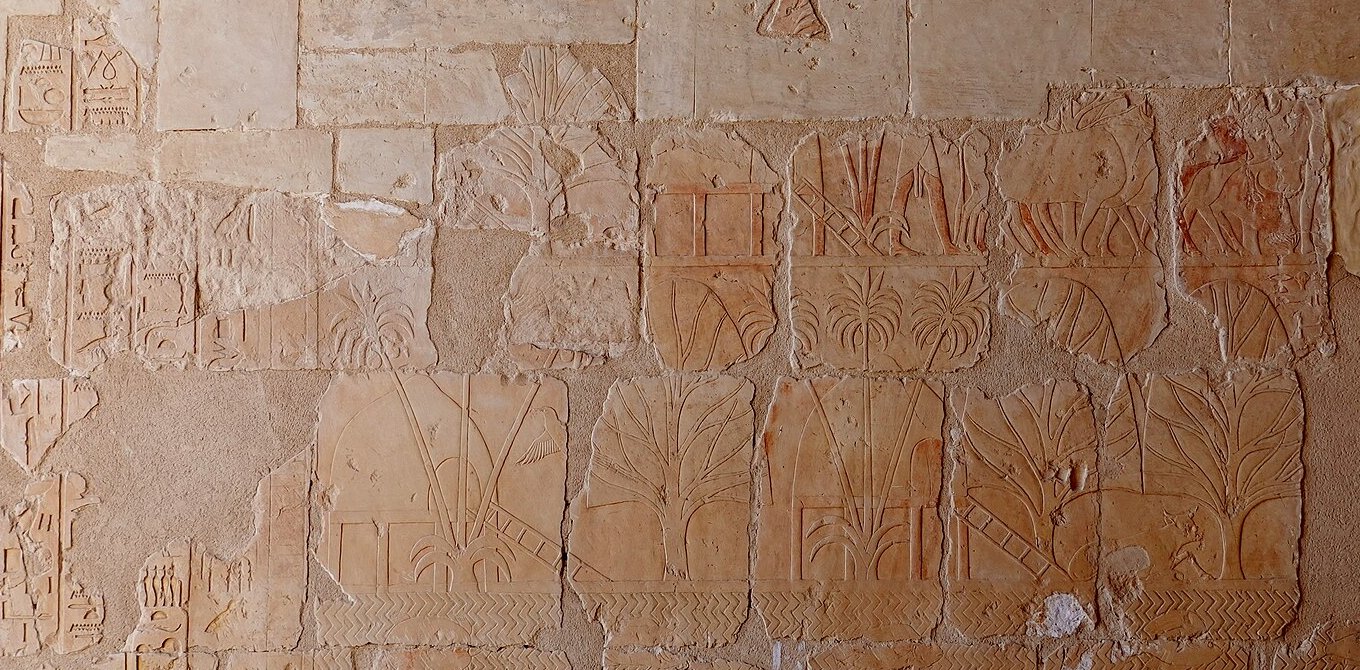
Myrrh is the dried, fragrant sap of a tree. When it is burnt, it gives a sweet smoke. Aromatic resins like this were the main prize of the Punt trade, and the reliefs say that the living trees were brought back to grow in the temple of Amun. [1][5]
A thousand years of voyages
James Henry Breasted collected the earlier mentions in 1906. A man from Punt appears as a servant of a son of King Khufu, in the Fourth Dynasty. King Sahure of the Fifth Dynasty sent an expedition, and King Isesi sent another that brought back a dancing dwarf. Under Pepi IIPepi IIPepi II was an Egyptian king of the Sixth Dynasty in the late third millennium BCEGlossary · Click to read the explanation an officer named Enenkhet was killed on the coast while he was building a ship for Punt. Later expeditions are recorded under Mentuhotep III and the kings of the Twelfth Dynasty. Most of these records give little more than the fact of the voyage. [1]
A stela, an inscribed standing stone, of the envoy Ameny from the reign of Senusret I lists 3,200 soldiers and 500 sailors in one expedition that landed at a place called the "Mines of Punt". [4]
The harbour at Mersa/Wadi Gawasis
In the 2000s an Italian-American team led by Kathryn Bard and Rodolfo Fattovich excavated an Egyptian harbour at Mersa/Wadi Gawasis on the Red Sea coast. Inscriptions and pottery date it to the Twelfth Dynasty, about 1950–1780 BCE. The team found shrines on the shore and eight caves cut into the rock above an old lagoon, used to store ship parts. [2][3]
Inside were cedar timbers, stone anchors, coils of rope and two steering-oar blades from a ship about 20 metres long. Outside the caves lay more than 40 cargo boxes. Two were painted with the name of King Amenemhat IV and the words "the wonderful things of Punt". A stela of Amenemhat III records voyages to Punt and to Bia-Punt. [3]
The ships were built at Coptos on the Nile, then taken apart, much like flat-pack furniture. Donkey caravans carried the pieces for about ten days across some 160 kilometres of desert, and the ships were put together again at the coast. [3][4]
Hatshepsut's expedition
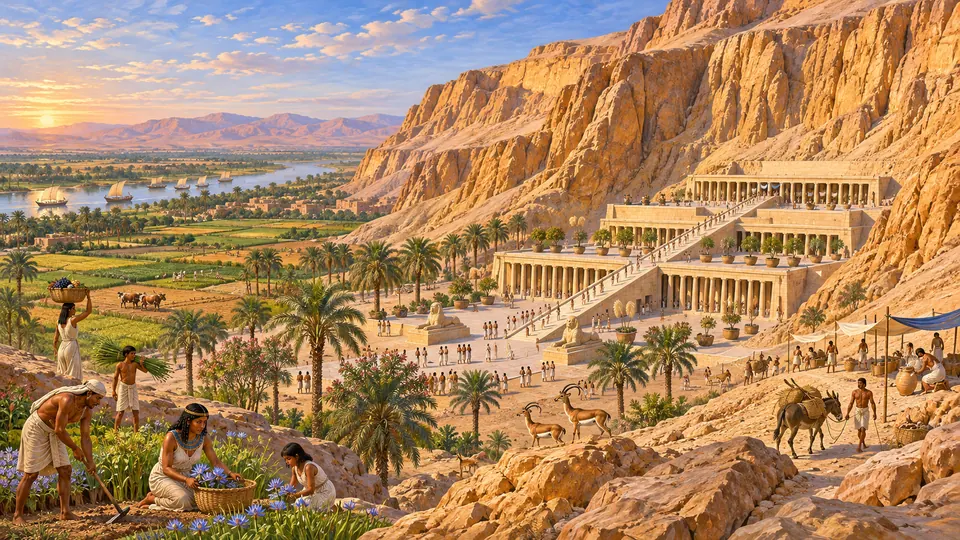
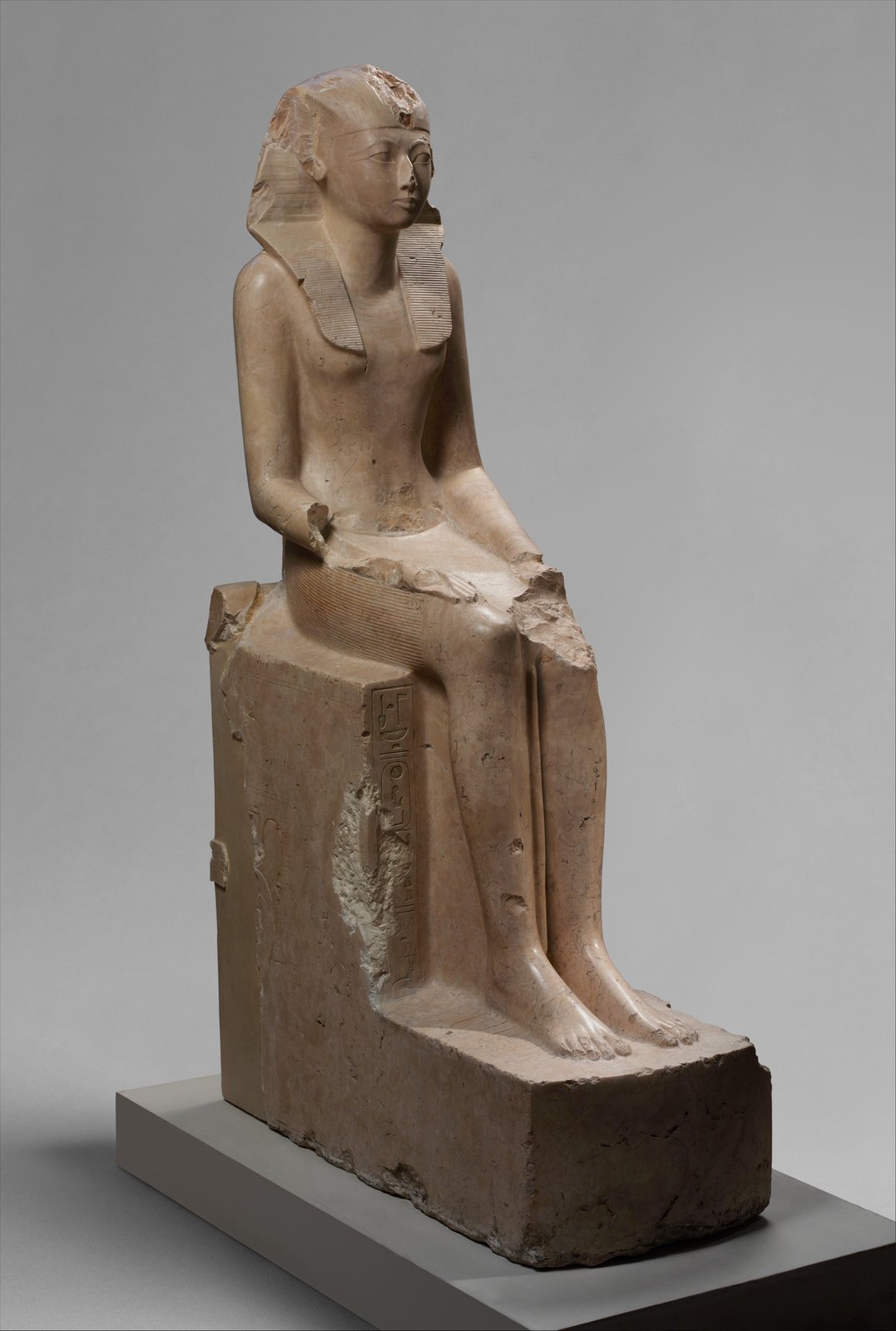
The fullest picture of Punt is on the middle terrace of Hatshepsut's temple near ThebesThebes, EgyptThebes, Egyptian Waset, was an ancient Egyptian city in the area of modern Luxor, with monuments on both banks of the Nile.Glossary · Click to read the explanation. The reliefs date the voyage to year 9 of Thutmose III. An inscription says that the expedition followed an oracle of the god AmunAmunAmun is an Egyptian deity centered on Thebes and Karnak, the “hidden one,” also worshipped as Amun-Re. His names and images were targeted under Akhenaten before royal support resumed.Glossary · Click to read the explanation, who commanded that "the ways to Punt should be searched out". [1][6]
The reliefs show Egyptian ships arriving. The expedition leader, Nehes, meets the ruler of Punt, Parehu, and his wife, Iti. Behind them is a landscape with houses raised on poles among palm and myrrh trees, above water full of fish. Hathor, "mistress of Punt", receives an offering for good winds. Then the ships are loaded, and the living trees are carried aboard to be planted for Amun. [1][6]
The artists also put words into the mouths of the people of Punt. In Breasted's translation of 1906 they ask:
These words were written by Egyptians, in Egyptian, for an Egyptian temple. They praise the queen's achievement. They do not record what the people of Punt really said. [1]
Where was Punt?
No one knows for sure. Breasted thought Punt was certainly in Africa, probably on the Somali coast. The nineteenth-century scholar Johannes Dümichen read a phrase in the reliefs, "on the two sides of the sea", as meaning that Punt lay on both shores of the Red Sea. Breasted rejected that reading as an ordinary Egyptian turn of phrase. Today many scholars place Punt in the southern Red Sea region, with eastern Sudan and the coast of Eritrea often proposed. Kathryn Bard favours eastern Sudan. [1][2][3][4]
A new kind of evidence came in 2020 from mummified baboons. Live baboons appear among the goods brought from Punt. Nathaniel Dominy and his colleagues measured strontium in their teeth. Strontium comes from the local rocks and soil, enters the food chain and is fixed in tooth enamel during childhood, a little like a fingerprint of the place where an animal grew up. One baboon, probably of the New Kingdom and now in the British Museum (EAEnkiMesopotamian deity also known as Ea, linked with Eridu and the Abzu (deep fresh waters), wisdom, incantations, and narratives of creation and cosmic order. Later written attestations do not identify the deity of Eridu’s earliest layers.Glossary · Click to read the explanation 6738), was born outside Egypt. Its values match much of present-day Ethiopia, Eritrea and Djibouti, and parts of Somalia and Yemen. [5]
The authors call this map provisional, and it shows a wide region, not a single port. It supports the long-held view that Punt lay in the Horn of Africa and the southern Red Sea, perhaps reaching both coasts. Centuries later, in Roman times, the port of Adulis near modern Massawa in Eritrea still exported baboons. [5]
Punt in a story
The Tale of the Shipwrecked Sailor was written in the Middle Kingdom and survives in one papyrus, P. Hermitage 1115. Its story is set on the Red Sea. A sailor is wrecked on a magic island and meets a giant serpent. When the sailor promises to send him incense from Egypt, the serpent laughs: he is "the Ruler of Punt", and the myrrh already belongs to him. He sends the sailor home in two months with myrrh, incense, eye paint, giraffe tails, ivory, dogs, monkeys and baboons. [4]
This is literature, not a travel record. Yet the serpent's gifts are almost the same as the goods in Hatshepsut's reliefs: for an Egyptian reader, Punt meant a far-off coast of rare and fragrant treasures. [1][4]
References and notes (6)
- James Henry Breasted, Ancient Records of Egypt, vol. II: The Eighteenth Dynasty (Chicago: University of Chicago Press, 1906) The Punt Reliefs, §§ 246–266 and 285–288 (pp. 102–110 and 116–117): Breasted's introduction with the earlier mentions of Punt and his view of its location, the departure, the reception by Parehu and Iti with the village on poles, the trade, the loading of the ships with the list of goods, the return voyage, the oracle of Amun and the speech of Amun; with his note rejecting Dümichen's reading 'on the two sides of the sea'. Return to the text ↑
- Kathryn A. Bard and Rodolfo Fattovich, “Spatial Use of the Twelfth Dynasty Harbor at Mersa/Wadi Gawasis for the Seafaring Expeditions to Punt,” Journal of Ancient Egyptian Interconnections 2, no. 3 (2010): 1–13 Abstract only (the full text refused automated access): Twelfth Dynasty date from stelae, seal impressions, ostraca and pottery; shrines along the shore; eight man-made caves above an ancient lagoon; Punt 'somewhere in the southern Red Sea region'. Return to the text ↑
- Jean Hennelly Keith, article on the Mersa/Wadi Gawasis excavations of Kathryn A. Bard and Rodolfo Fattovich, Arts & Sciences Magazine, Boston University (fall 2010 issue) Whole article: the caves found from 2004, stone anchors, cedar timbers, steering-oar blades of a ship about 65 feet long, rope coils, the stela of Amenemhat III naming Punt and Bia-Punt, more than 40 cargo boxes, two with the name of Amenemhat IV and 'the wonderful things of Punt', ships built at Coptos and carried in pieces across the desert, and Bard's view that Punt lay in eastern Sudan. Return to the text ↑
- Ronaldo G. Gurgel Pereira and Thais Rocha da Silva, “O Conto do Náufrago (P. Hermitage 1115) – tradução comentada,” Revista de História (São Paulo) 182 (2023): a12122 Introduction, pp. 8–10 (the Red Sea setting, Mersa Gawasis, ships built in sections at Coptos and Qena, the 'Mines of Punt', the expedition of Ameny under Senusret I with its numbers, and the note that there is no consensus on Punt's location); translation of lines 149–168, pp. 36–39 (the serpent as 'Ruler of Punt', its gifts and the return in two months). Return to the text ↑
- Nathaniel J. Dominy, Salima Ikram, Gillian L. Moritz, Patrick V. Wheatley, John N. Christensen, Jonathan W. Chipman and Paul L. Koch, “Mummified baboons reveal the far reach of early Egyptian mariners,” eLife 9 (2020): e60860 Read through PubMed Central (PMC7738181), all but the closing methods details and reference list: introduction on Punt, 'God's Land' and the Punt trade of about 2500–1170 BC; samples, the oxygen and strontium method, the results for British Museum EA 6736 and EA 6738, the origin area, the discussion of Adulis, and the stated limits. Return to the text ↑
- Filip Taterka, “Middle Portico South (Portico of Punt),” Polish-Egyptian Archaeological and Conservation Expedition to the Temple of Hatshepsut at Deir el-Bahari, Polish Centre of Mediterranean Archaeology, University of Warsaw Whole page: the scenes wall by wall, regnal year 9 of Thutmose III, Nehes, Parehu and Iti, the goods and animals, the oracle inscription before Amun, the later damage, and the history of publication. Return to the text ↑
Suggest a correction · Suggest a source for this record
Cite this record
IL Archive, «Punt», https://ilarchive.com/en/sites/punt
Continue reading