Person · Figure
Hatshepsut
- Names
- Hatshepsut · Maatkare
- Timeline
- From 1473 BCE to 1458 BCE
- Region
- Egypt
An Egyptian queen of the Eighteenth Dynasty who ruled as king, about 1473–1458 BCE. Her temple at Deir el-Bahari, her statues and the Punt reliefs show how she presented her rule.
Estimated reading time: 5 min Published Last reviewed:
Share article
Text
Introduction
Hatshepsut was a queen of the Eighteenth Dynasty, in the period Egyptologists call the New Kingdom. She was the daughter of King Thutmose I and the wife of King Thutmose II. After her husband died, she first acted as regent, that is, she governed for a young king who was too young to rule alone: Thutmose III, her stepson and nephew. Later she took the full titles of a king and ruled beside him. The Metropolitan Museum of Art dates her reign as king to about 1473–1458 BCE. [1][2]
Her story matters because a woman holding the title of king was rare in Egypt, and because so much of her evidence survives: a great temple near ThebesThebes, EgyptThebes, Egyptian Waset, was an ancient Egyptian city in the area of modern Luxor, with monuments on both banks of the Nile.Glossary · Click to read the explanation, statues, inscriptions and reliefs. Yet many of her images were later cut away or smashed. This entry sets out what the objects and texts show, and where scholars still disagree. [2][3]
From queen to king
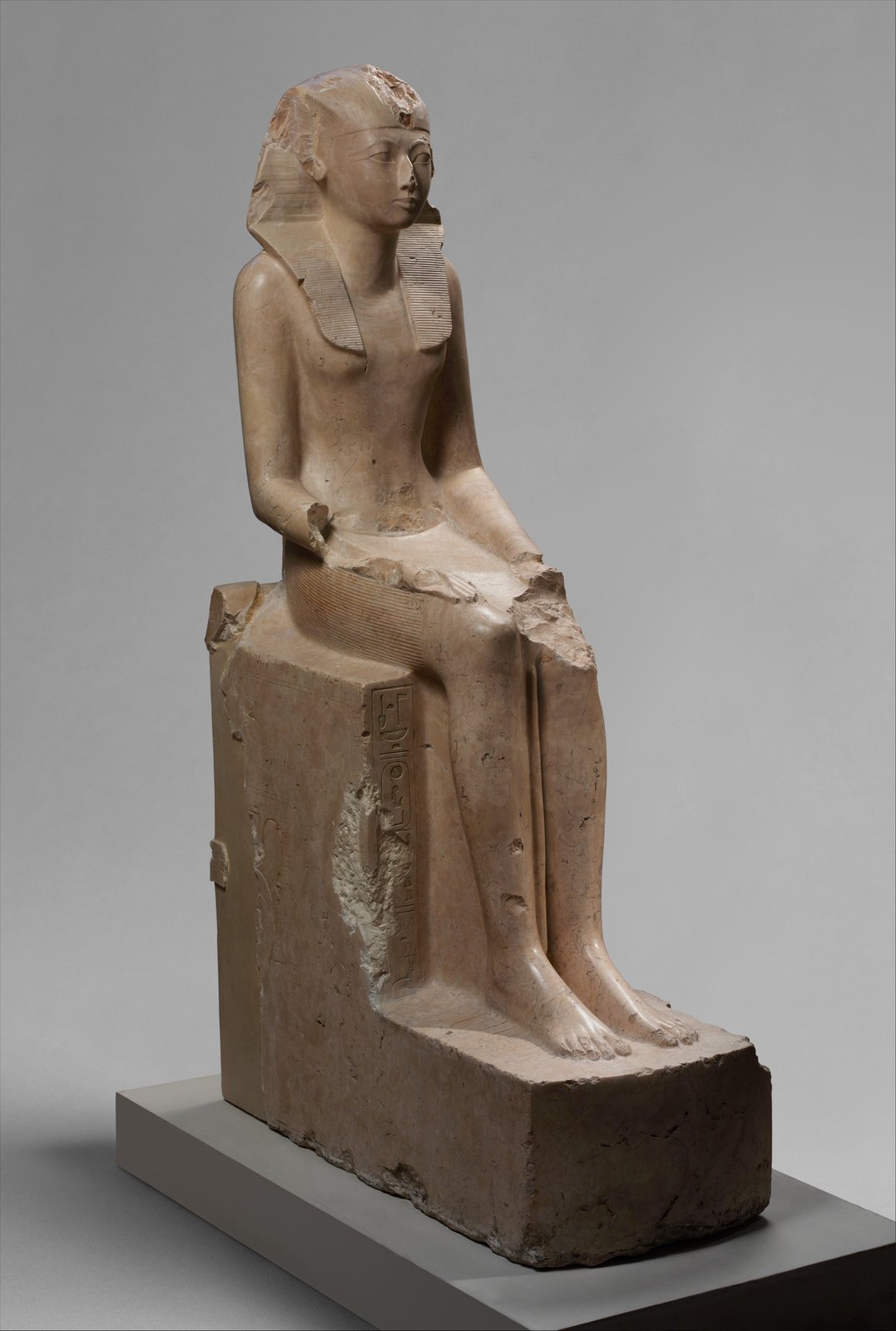
Egyptian royal titles were written for a man, such as "Lord of the Two Lands". Hatshepsut kept these titles and changed their grammar. On her statues the scribes added feminine endings, so she became "Lady of the Two Lands". Her portraits changed over the years. Earlier statues show her in a woman's dress. Later ones show her in the king's short kilt, with the bull's tail that kings wore at the belt. [2]
She also explained her right to rule. Inscriptions in her temple say that her father, Thutmose I, named her as his heir, and that her true father was the god AmunAmunAmun is an Egyptian deity centered on Thebes and Karnak, the “hidden one,” also worshipped as Amun-Re. His names and images were targeted under Akhenaten before royal support resumed.Glossary · Click to read the explanation himself. This is a statement of royal belief, carved for the temple, not a record that historians can test. [2][5]
Her daughter, Neferure, appears in the statues of Senenmut, a high official who was Neferure's tutor and the "Great Steward of Amun". Senenmut's role is debated. Later popular stories made him the queen's lover or the hidden power behind her. The objects do not show this. They show a trusted official with unusual access to the royal workshops. [2]
The seated statue in New York
The statue in the picture is now in the Metropolitan Museum of Art (29.3.2). It is carved from hard limestone and was once painted. It is just under two metres tall. The face is delicate and the chest is slightly rounded, so the figure is clearly a woman. Yet she wears the king's headcloth and kilt. Under her feet are the Nine Bows, a symbol of Egypt's enemies that appears on kings, not on queens. The statue was found broken, in a quarry near her temple. The Museum's record names two finds: the Prussian expedition of Karl Richard Lepsius in 1843–45 and the Museum's own excavations of 1926–28. [1][2]
The temple at Deir el-Bahari
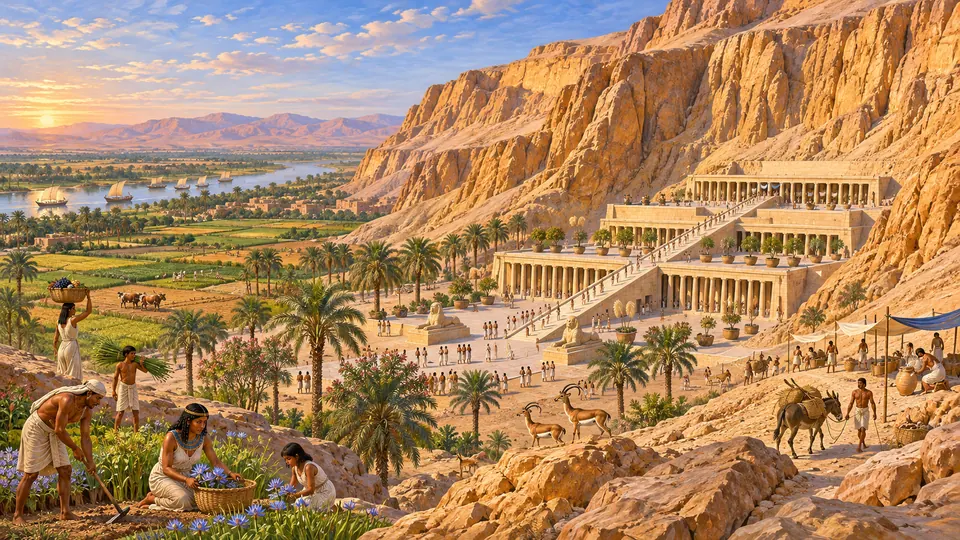
Hatshepsut's main monument is her temple at Deir el-Bahari, on the west bank of the Nile at Thebes, facing the great temple of Amun at Karnak across the river. Its ancient name, Djeser-djeseru, is usually translated "Holy of HoliesHoly of HoliesMost sacred inner zone of the biblical sanctuary. Kings places the Ark beneath its cherubim; Leviticus regulates approach behind the curtain. Wilderness and Jerusalem temple traditions describe distinct settings.Glossary · Click to read the explanation". Three terraces rise one above the other towards the cliffs. The design follows the much older temple of King Mentuhotep II next to it, a choice that linked her to a famous king of the past. [2][5][6]
The temple gave pride of place to Amun. It also had areas for the goddess Hathor, who was believed to live in these hills, for AnubisAnubisAnubis is an Egyptian deity associated with the dead and the balance in heart-weighing scenes.Glossary · Click to read the explanation, god of burial, and for the cult of Hatshepsut and her father. On the upper terrace, statues showed her in the form of OsirisOsirisOsiris was an ancient Egyptian deity associated with the dead, life after death, renewal, and kingship. His roles appear in changing funerary texts, rituals, and judgment scenes, notably the weighing of the heart.Glossary · Click to read the explanation. The Egyptian antiquities ministry names Senenmut as the designer. The catalogue of the Met's Hatshepsut exhibition is more careful: one passage credits him with the idea, another says the claim is not proven. [2][5][6]
The expedition to Punt
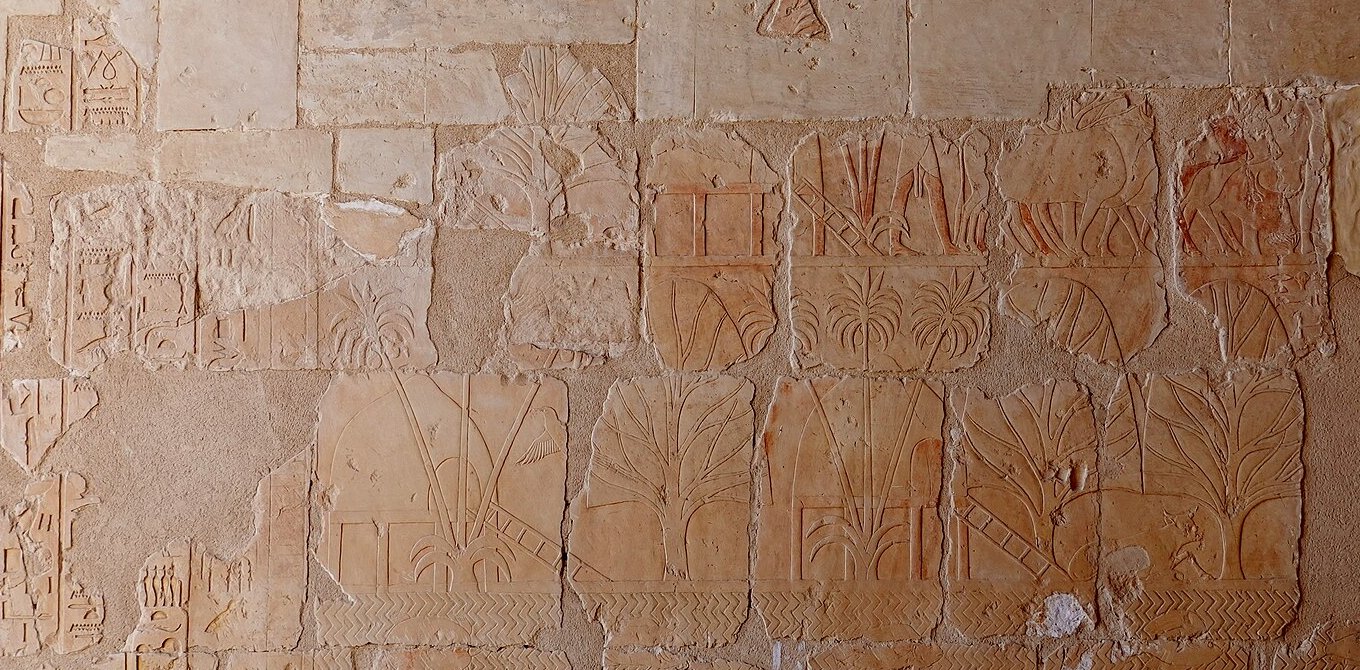
On the middle terrace, the southern portico shows an expedition to Punt, a distant land reached by sea. The Egyptian antiquities ministry describes it as believed to lie near modern Eritrea; its exact location is not certain. The reliefs date the voyage to year 9 of Thutmose III. They show the Egyptian ships arriving, the expedition leader Nehes meeting the ruler of Punt, Parehu, and his wife Iti, and the ships returning loaded with myrrh trees, ebony, ivory, electrum (a natural mix of gold and silver) and animals such as a giraffe and cheetahs. The goods were weighed and offered to Amun. [3][5]
A text above the loaded ships, in James Henry Breasted's English translation of 1906, says:
The words belong to the scene of the loaded ships. They are royal praise, not a neutral report. [4]
Erased, then found again
After Hatshepsut's death, many images of her were hacked out or recarved with the names of Thutmose I or Thutmose II. In the Punt portico, her figures and inscriptions were cut away by order of Thutmose III. Her statues at Deir el-Bahari were smashed. Many pieces ended up nearby, where excavators found them more than three thousand years later. [1][2][3]
Why this happened is debated. The older view was that Thutmose III took revenge as soon as he ruled alone. Research by Charles Nims and Peter Dorman showed that the attacks came at least 20 years after her death, and that only the images showing her as king were changed. Dorman carefully suggests two possible reasons: the problems a female king posed for the idea of kingship, or a wish to remove the memory of a rival branch of the royal family, though he also notes that no rival claimant is known. Neither reason can be proved. Some mid-twentieth-century histories described her in hostile words, as a scheming stepmother. More recent scholarship reads the evidence more calmly. [2]
Quick answers
Who was Hatshepsut?
A daughter of Thutmose I and wife of Thutmose II who first governed for the young Thutmose III and then ruled as king, about 1473–1458 BCE. [1][2]
Where was she buried?
She first prepared a tomb in the cliffs and later a tomb in the Valley of the Kings, where kings were buried. A granite sarcophagus made for her was later recarved for her father. [2]
Why were her images damaged?
It is not certain. The attacks came late in the reign of Thutmose III, and scholars weigh ideas about kingship and succession. [2]
References and notes (6)
- The Metropolitan Museum of Art, “Seated Statue of Hatshepsut,” accession number 29.3.2, collection record Object record (read through the Met's Open Access collection data): date ca. 1473–1458 BCE, Dynasty 18, joint reign of Hatshepsut and Thutmose III, indurated limestone with paint, H. 197 cm, findspot Senenmut Quarry at Deir el-Bahri, MMA excavations 1926–28 and Lepsius 1843–45, Rogers Fund 1929, public domain. Return to the text ↑
- Emily Teeter, “Hatshepsut and Her World,” review of the exhibition and catalogue Hatshepsut: From Queen to Pharaoh (ed. Catharine H. Roehrig, 2005), American Journal of Archaeology 110 (2006): 649–653 Whole review, pp. 649–653: regency and joint rule, the statue 29.3.2 (fig. 2), feminine titles, Senenmut and Neferure, the temple and Mentuhotep II, the tombs and sarcophagus, and the summary of Charles Nims's and Peter Dorman's work on the proscription and its possible motives. Return to the text ↑
- Filip Taterka, “Middle Portico South (Portico of Punt),” Polish-Egyptian Archaeological and Conservation Expedition to the Temple of Hatshepsut at Deir el-Bahari, Polish Centre of Mediterranean Archaeology, University of Warsaw Whole page: the scenes wall by wall, regnal year 9 of Thutmose III, Nehes, Parehu and Iti, the goods, the offering to Amun, the later hacking out of Hatshepsut's figures and texts, and the history of publication. Return to the text ↑
- James Henry Breasted, Ancient Records of Egypt, vol. II: The Eighteenth Dynasty (Chicago: University of Chicago Press, 1906) The Punt Reliefs, §§ 262–265 (pp. 108–109): the scene of loading the vessels and its inscription, with Breasted's notes on its position. Return to the text ↑
- Egyptian Ministry of Tourism and Antiquities, “Hatshepsut Temple” Whole page: date of Hatshepsut, the name Djeser-djeseru, Senenmut as designer, the three levels, the areas for Thutmose I, Hathor, Anubis and Ra-Horakhty, the Osiris statues, and the Punt and divine-father reliefs on the middle portico. Return to the text ↑
- Egyptian Ministry of Tourism and Antiquities, “Deir al-Bahari” Whole page: the three terraces below the cliffs, Hathor in the hills, the earlier tomb temple of Nebhepetre Mentuhotep, and the temple's role for Hatshepsut and Thutmose I. Return to the text ↑
Suggest a correction · Suggest a source for this record
Cite this record
IL Archive, «Hatshepsut», https://ilarchive.com/en/people/hatshepsut
Continue reading