Entity
Babylonian exile
A reference page linking a name, group, or concept to the materials that discuss it.
Judean deportations to Babylonia and the kingdom’s collapse in the early sixth century BCE; several phases, not everyone removed or returned at once.
Text
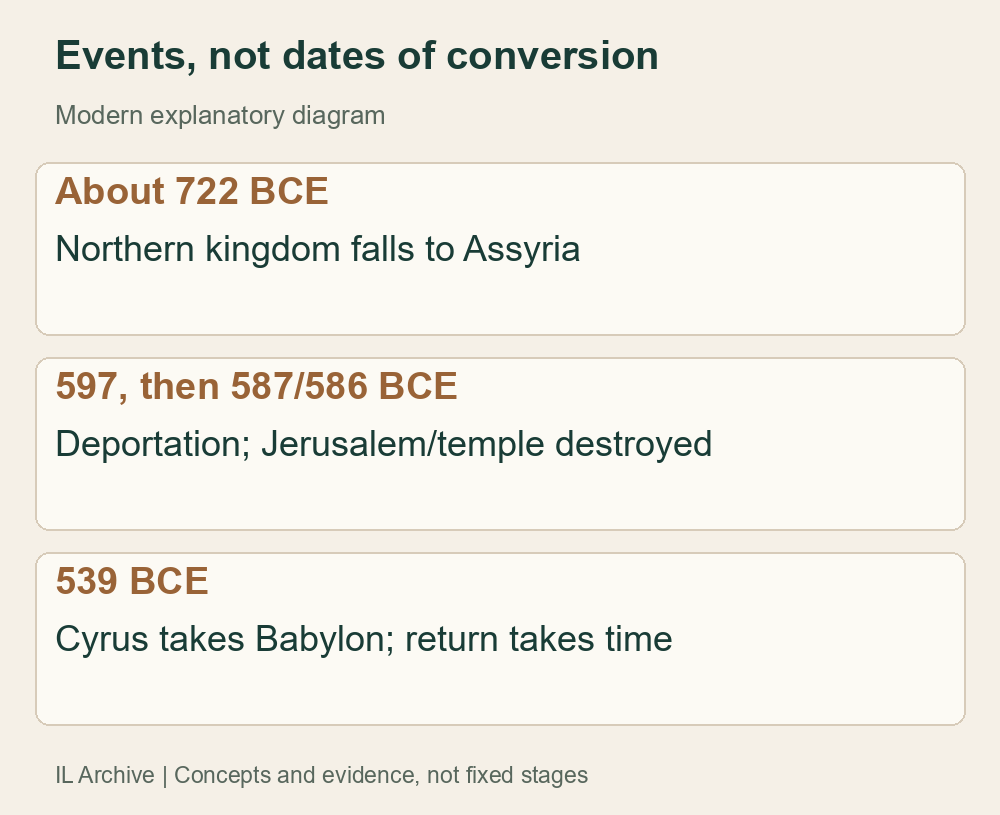
Deportation in 597 preceded JerusalemJerusalemJerusalem is a city of religious importance in Judaism, Christianity and IslamGlossary · Click to read the explanation/temple destruction in 587/586. People remained and communities formed abroad. Northern Assyrian crises and Judean Babylonian exile are distinct within a broader sequence. [1]
Cyrus’s conquest in 539 is a political marker, not everyone’s return or temple completion. Period boundaries depend on the question. Exile mattered for texts and identity; sole causation of monotheismMonotheismBelief in a single God as the only deity, rather than merely the highest among several gods.Glossary · Click to read the explanation is unproved. [1][2]
References and notes
- Rainer Albertz. Israel in Exile: The History and Literature of the Sixth Century B.C.E. Translated by David Green. Society of Biblical Literature, 2003. Introduction, pp. 1–3. Introduction pp. 1–3 and 2003 copyright page read, not full book: sequence 722, 701, 597, 587/586, 539 and limits of exile’s end. Deportation not equated with empty land or immediate return of everyone. Return to the text ↑
- British Museum. The Cyrus Cylinder, museum number 90920; registration 1880,0617.1941. Collection record. Object identity, after-539 date, Babylon and Marduk’s choice of Cyrus verified in museum record. Not a specific Jewish return decree or a text naming Yahweh. Photograph rights from photographer’s page, not museum record. Return to the text ↑
Research history
Substantive changes are retained here. Minor copy edits remain in the internal operational log.
-
Substantive record update
Suggest a correction · Suggest a source for this record
Cite this record
IL Archive, «Babylonian exile», Edition 2, https://ilarchive.com/en/entities/babylonian-exile