Entity · person
Ziusudra
A reference page linking a name, group, or concept to the materials that discuss it.
King and priest in the fragmentary Sumerian Flood Story, preserved in an Old Babylonian copy. Survives, sacrifices and receives divine life in Dilmun; historicity is unproven.
Text
Character and text
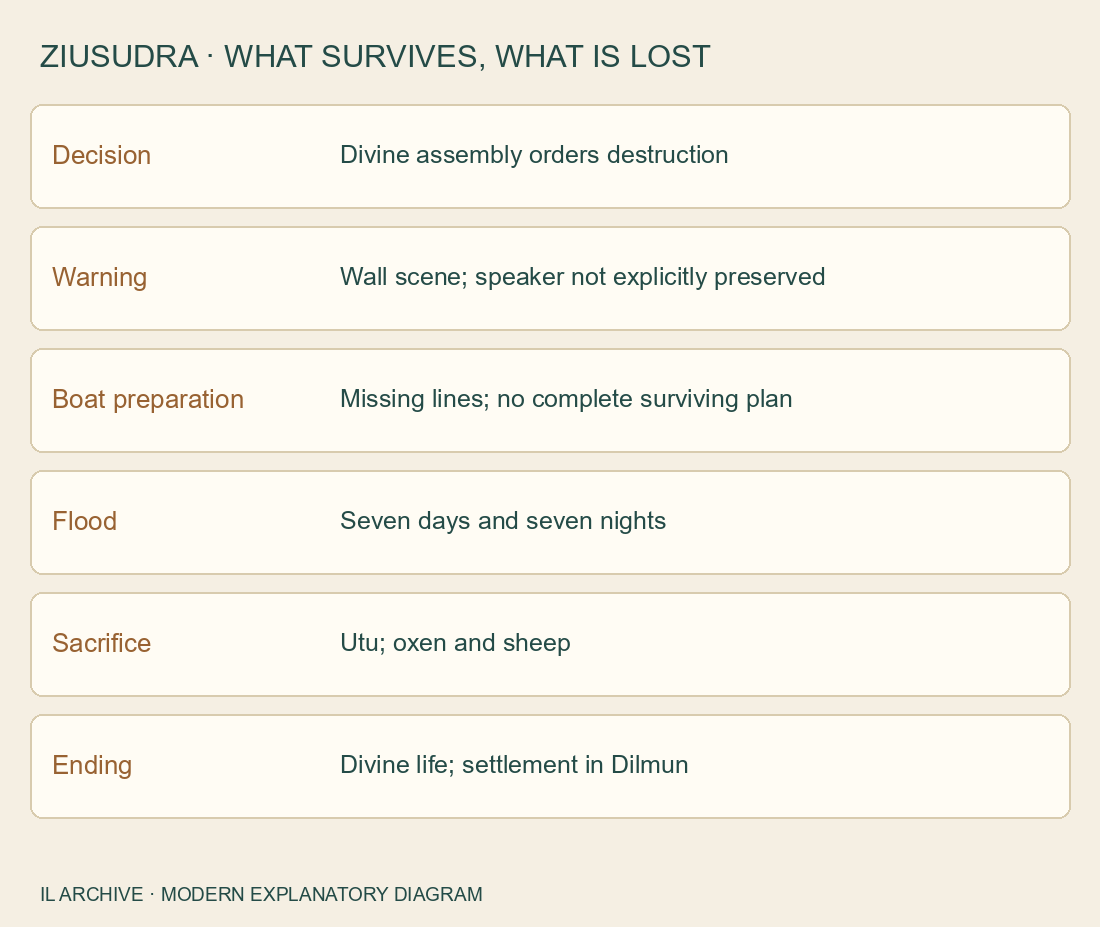
Sumerian literary king and priest in ETCSL 1.7.4: destruction decreed, wall warning, seven days and nights, sacrifice and divine life in DilmunDilmun: Ancient Gulf Land and Literary SettingAn ancient Gulf trading region linked archaeologically to Bahrain and also a Sumerian literary setting whose mythical scenes are not all historical descriptions.Glossary · Click to read the explanation.[1]
Limits
Flood motive and boat instructions are lost; warning speaker is not explicitly preserved. AtrahasisAtrahasis: Epic and HeroAkkadian epic: humans created for divine labor, multiplication, noise and flood. Atrahasis, “exceedingly wise,” survives through Enki’s warning; human reproduction is regulated afterward.Glossary · Click to read the explanation cannot automatically fill the gaps. The copy is Old Babylonian; its Sumerian language establishes no absolute priority.[2] Image: modern guide to preserved and missing material, not a portrait.
References and notes
- ETCSL, The Flood Story, 1.7.4, University of Oxford. Complete published translation, segments A–E. Gaps are marked; warning speaker and motive are not clearly preserved. Return to the text ↑
- Mehmet-Ali Ataç, The Flood Myth as Paradigm, 2018. Chapter 3, pp. 81–101; opening paragraphs on Old Babylonian and standard witnesses read, not the entire chapter or Mari painting analysis. Return to the text ↑
Research history
Substantive changes are retained here. Minor copy edits remain in the internal operational log.
-
Substantive record update
Suggest a correction · Suggest a source for this record
Cite this record
IL Archive, «Ziusudra», Edition 2, https://ilarchive.com/en/entities/ziusudra