Site
Eanna at Uruk
An archaeological precinct and institutional centre at Uruk associated with Inanna; its name does not fix every early building’s function.
Text
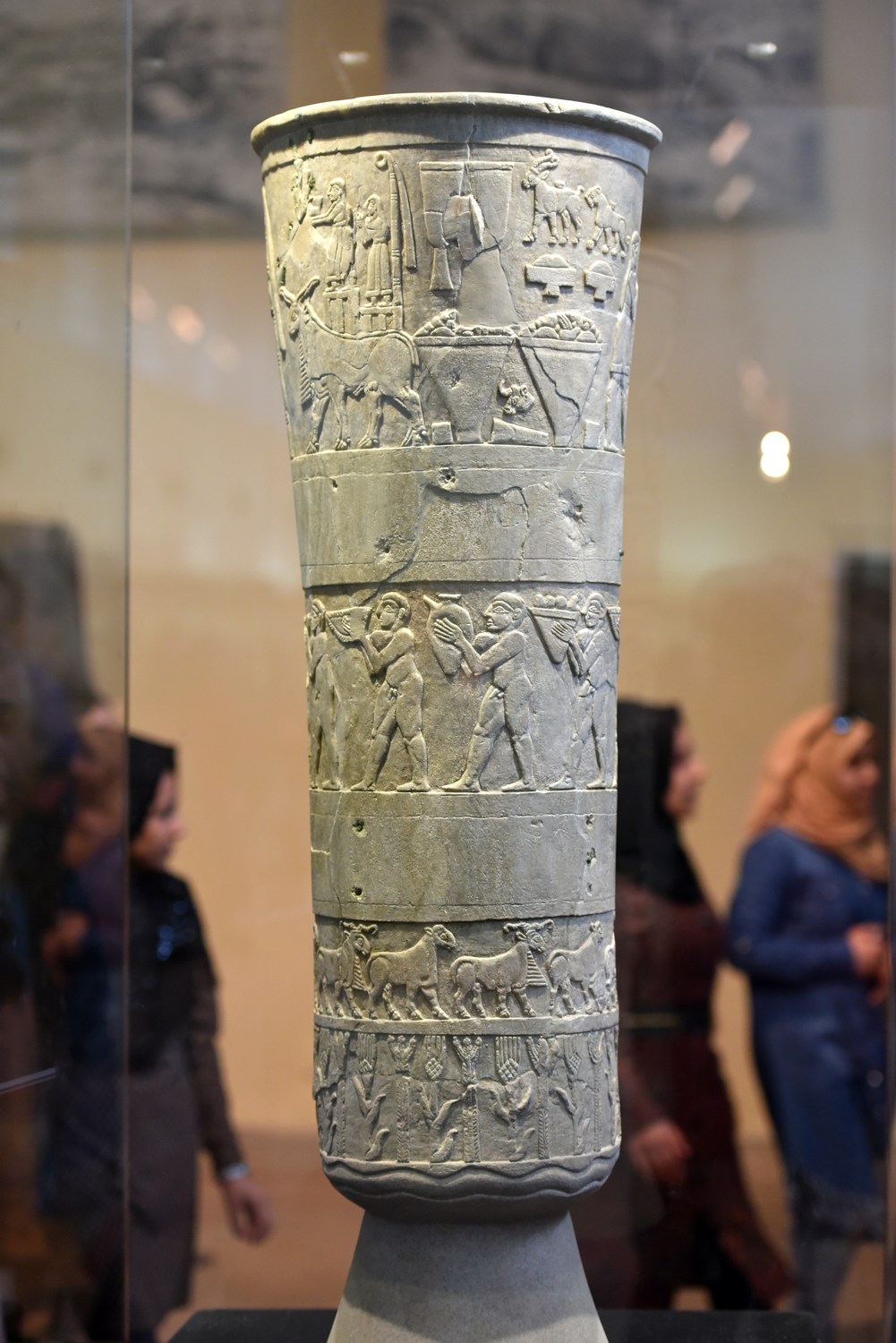
Eanna is a precinct at UrukUrukAncient city at Warka in southern Iraq, a major urban centre around 3200 BCE that preserved early writing and accounting tablets.Glossary · Click to read the explanation known for architecture, objects and its historical association with InannaInanna / IshtarProminent Mesopotamian goddess with a major centre at Uruk, whose parentage and cult traditions vary rather than forming one fixed genealogy.Glossary · Click to read the explanation. The Warka Vase and female head come from this precinct’s archaeological contexts and are associated in scholarship with late Uruk levels.
Find context must be distinguished from the interpretation of each building or image. Not every monumental structure is automatically a securely identified temple, nor every female face Inanna. Emblems, contexts and comparisons inform interpretation while architectural functions and image identities remain debated. The photograph shows a vessel from the precinct, not an Eanna building or reconstructed plan.[1][2]
References and notes
- Ann Louise Perkins (1949). The Comparative Archeology of Early Mesopotamia. Studies in Ancient Oriental Civilization 25. University of Chicago. Printed pp. 135–136: vase, ruler and priestess possibilities; pp. 150–151: marble head, inlays, wig/headdress fastenings and modelling. Selected passages, not the entire book. Older chronology and terminology balanced against a modern catalogue. Return to the text ↑
- Renate Marian van Dijk-Coombes (2018). The Architectural Origin of Mesopotamian Standards in Late Uruk/Jemdet Nasr Period Iconography. Antiguo Oriente 16, 117–146. Selected printed pp. 117–126: standards, ring-post with streamer, MUŠ3, Inanna’s space and seals. Pp. 123–124, notes 19–20: priest-king/EN terminology, female identity and ancient headdress damage. Figure 1 inspected visually. Architectural/reed origin is an argued interpretation. Return to the text ↑
Research history
Substantive changes are retained here. Minor copy edits remain in the internal operational log.
-
Substantive record update
Suggest a correction · Suggest a source for this record
Cite this record
IL Archive, «Eanna at Uruk», Edition 2, https://ilarchive.com/en/sites/eanna