Artifact
The Copper Scroll 3Q15: Cutting the Metal and the Limits of Reading an Inventory
An object record bringing together its image, metadata, rights, and context.
- Names
- The Copper Scroll (3Q15)
- Region
- Qumran Cave 3, Judaean Desert (near the Dead Sea)
An archaeological account of the Copper Scroll from Qumran Cave 3, found as two rolls in 1952 and cut into 23 strips at Manchester; it separates the claim that the valuables existed from proof or an identified owner.
Estimated reading time: 6 min Published Last reviewed:
Share article
Photograph
Photo: Osama Shukir Muhammed Amin FRCP(Glasg) / Wikimedia Commons · CC BY-SA
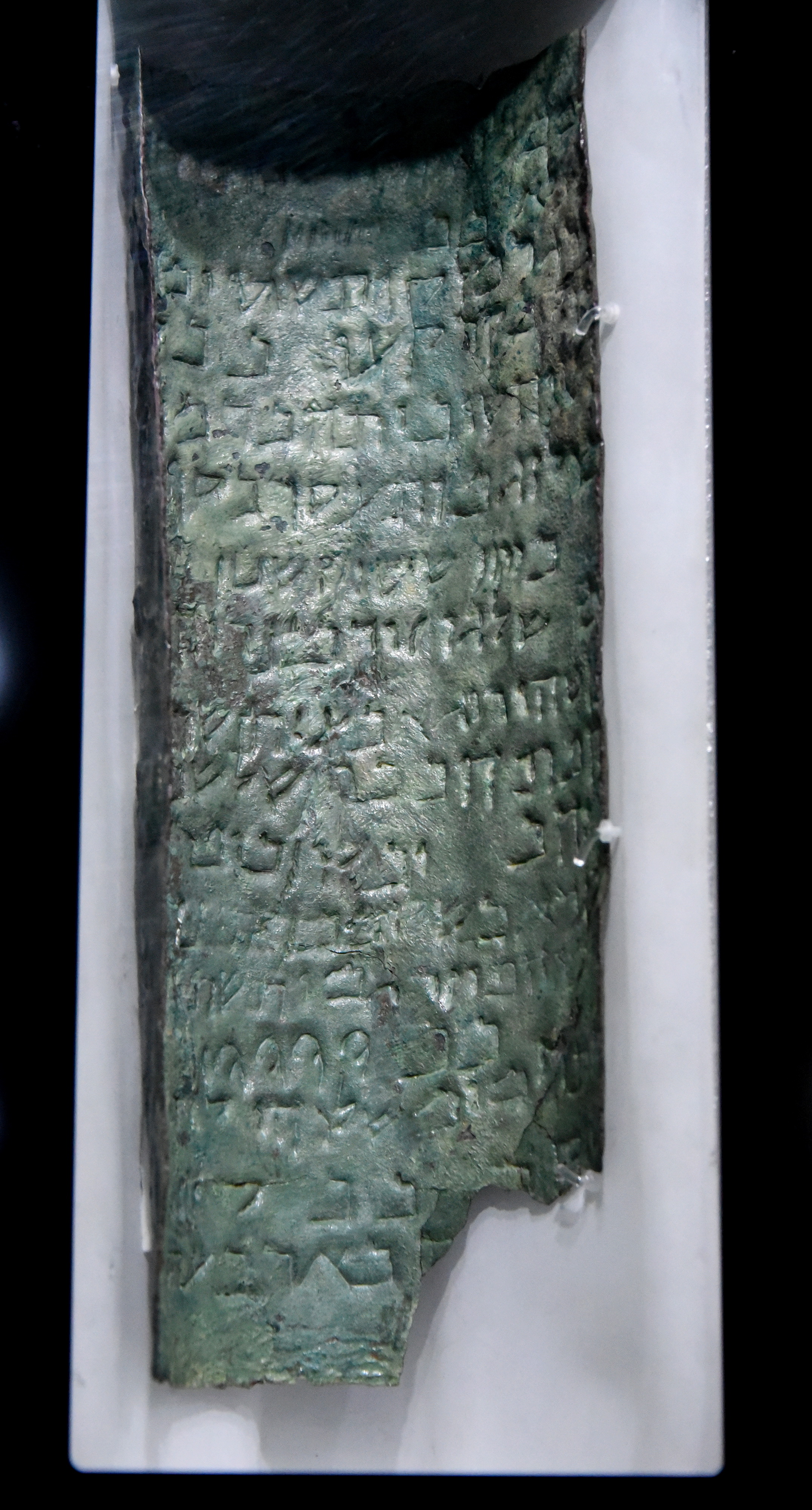
One strip of the Copper Scroll (3Q15), photographed at the Jordan Museum in Amman. Rows of inscription and metal curvature are visible; this photograph does not identify the strip number or independently establish a reading
Image source · LicenseObject details
- Title
- The Copper Scroll 3Q15: Cutting the Metal and the Limits of Reading an Inventory
- Region
- Qumran Cave 3, Judaean Desert (near the Dead Sea)
- Rights
- CC BY-SA
Text
Introduction
How did two corroded copper rolls found in a cave near the Dead SeaDead SeaThe Dead Sea is a salt lake in the Jordan Rift Valley, near sites where ancient manuscripts were foundGlossary · Click to read the explanation become a readable list of locations, depths and weights? And how does an ancient text's assertion that something was hidden differ from proof that it was actually deposited there? This article examines the Copper Scroll, 3Q15, from its material survival to the publication of its inventory, distinguishing the ancient witness from modern interventions and from theories about the objects it names.
A witness from Qumran Cave 3
The designation 3Q15 identifies the fifteenth item catalogued among the finds from Qumran Cave 3. The Israel Antiquities Authority's catalogue metadata identifies copper, square HebrewHebrewA Northwest Semitic language of the Canaanite group, encompassing Iron Age epigraphy, Biblical, Rabbinic, medieval and Modern Hebrew; its scripts and pronunciations changed over time.Glossary · Click to read the explanation script, a non-biblical text and a broad Roman-period classification. These are identifiers and classification terms, not a precise date for the composition of every line or a verdict that its statements are true. The metal support also distinguishes this witness from most of the parchment and papyrus documents among the Dead Sea Scrolls. [1]
Archaeologists discovered it in Cave 3 in 1952, where remains of other writings were also found. The place of discovery establishes where this object survived until its recovery; it does not by itself identify the author of the inventory, the reason for depositing it, or its ownership. Nor does a find in the Qumran caves automatically make it an administrative record produced by one community occupying the nearby settlement. [2]
Two rolls that could not be opened by hand
The find did not initially take the form of a flat sheet. In his review of a later scholarly publication, P. Kyle McCarter describes two corroded copper cylinders too fragile to unroll with methods used on leather scrolls. The University of Southern California's presentation explains that the writing was incised on thin copper sheets joined before their survival as two rolls. That describes the physical object, not the date on which the inventory was composed. [3]
During 1955–1956, specialists at the University of Manchester opened the rolls by cutting them lengthwise in stages. Adhesive was applied to the outer, uninscribed side to reduce fragmentation. The procedure yielded 23 curved strips. That is a count resulting from modern intervention, not 23 independent ancient scrolls or 23 separate ancient documents. The writing became accessible, but cutting permanently altered the physical form in which the artefact had been discovered. [4]
Conservation, imaging and the reconstructed surface
Corrosion continued to threaten the metal, and some early consolidants lost effectiveness. From 1994 to 1996, the EDF Valectra laboratory worked under the supervision of Jordan's Department of Antiquities to stabilize the strips, address corrosion and remove or replace older materials where the object's condition permitted. Conservation did not recreate the surface as it had been nearly two thousand years earlier or settle every disputed letter. [5]
The project produced visible-light photographs and X-rays of both sides, before and after treatment. Radiography could assist the study of features obscured by corrosion and help correct distortions caused by the curved metal. Moulds and metal reproductions were also made by electrotyping, permitting approximate flattened or reassembled representations. The archaeological strips remain the original; a reassembled copy, flattened image and edited transcription are distinct research products with their own methods and limitations. These stages are described in McCarter's published review. [6]
What does an inventory entry actually say?
The West Semitic Research Project at the University of Southern California publishes an English rendering of the beginning of the first column. Paraphrased rather than retranscribed from Hebrew, it describes a fortress in the Valley of Achor, steps leading eastwards, a depth of forty cubits, then a money chest and contents weighing seventeen talents. Place, orientation, depth, receptacle and recorded quantity appear together. This is a description mediated through that published English translation, not an independent collation of the incised Hebrew or a verified identification of each topographic term. [7]
The project's home page gives another example, explicitly assigned to column 8, cut 15: an irrigation cistern at a place called Shaveh, its outlet, a depth of eleven cubits, and seventy talents of silver. This example has its own published identification; neither its cut number nor its wording can be transferred to the strip photographed for the present article. Differences between the entries show variety in what is described, not a compulsory template followed by every line. [8]
A cubit was an ancient measure of length, while a talent was a large unit of weight. Bare numbers do not yield a certain modern depth in metres or a definite present-day monetary value. Some technical terms and place names resist secure interpretation or identification, as USC itself explains. One may grasp the syntax of an entry while the precise geographical reference remains obscure. [9]
A written claim is not an excavation report
An inventory speaks about items represented as being located in particular places. It is not thereby a modern excavation report verifying those items, nor a deed identifying their legal owner. The formula does not itself name the compiler or establish that its chests and silver were ever recovered. It documents a way of recording places and amounts on metal; it does not furnish field confirmation for each entry. [10]
Consequently, interpretations diverge. Some scholars relate the alleged wealth to the JerusalemJerusalemJerusalem is a city of religious importance in Judaism, Christianity and IslamGlossary · Click to read the explanation Temple, others to the Qumran group, and still others explore a literary or symbolic composition rather than literal geographical instructions. USC explicitly states that the owner remains unknown even if one assumes the valuables existed. Jesper Høgenhaven, in the accessible abstract of a 2016 article, advances a literary reading grounded in Jewish traditions of landscape and remembered treasure. The proposal rests here on the published abstract; it does not independently establish deposits or ownership. [11]
What does the photograph show?
The modern photograph shows one greenish, corroded metal strip with rows of recessed marks, mounted against a pale background at the Jordan Museum in Amman. Its curvature and irregular edges are visible. The image alone, however, does not establish this strip's number among the twenty-three or allow a verified transcription of its lines. Surface colour reflects both the object's present condition and its photography; it cannot establish the original alloy's detailed composition or the history of every conservation treatment. [12]
The photograph conveys the strip’s overall form and the arrangement of its lines but cannot establish every fine character. Reading the text depends on editions, careful imaging and comparison rather than guessed words from one museum photograph. The photograph's stated licence applies to that image, not to every institutional photograph or scholarly facsimile of the Scroll. [12]
A different witness among the Qumran texts
The surrounding collection helps define the contrast. The Archive's Dead Sea Scrolls entry introduces the range of material and texts, while its study of Qumran's textual plurality concerns variation between versions of scriptural books. With 3Q15 the central question is instead how an incised inventory was made, opened and interpreted, and how much historical weight its claims can bear. Interpretations of another Qumran text should not be transferred to this list merely because both were found in the same region. [13]
Conclusion: what did reading recover?
We know that two copper rolls were found in Cave 3 in 1952, that the Manchester operation left twenty-three strips, and that subsequent conservation and imaging made improved scholarly readings possible. Published translations show a succession of locations, depths, vessels and weights. The exact composition and deposition history, the owner of the purported valuables, and whether those valuables actually occupied the stated places remain open questions. 3Q15 preserves the language of an inventory and its unusual metal carrier. Its historical value does not depend on turning every written assertion into an independently verified event.
References and notes
- Israel Antiquities Authority, “3Q Copper Scroll (3Q15),” object catalogue. Material, square Hebrew script, non-biblical category and broad Roman-period dating come from an earlier review of the catalogue card; the page view available for this article displayed only its title, without a readable Hebrew text or image. Catalogue entry 3Q15; material, script, category and period as recorded on the card; available page view showed only its title Return to the text ↑
- Israel Antiquities Authority, “Discovery Sites,” Qumran Cave 3: the 1952 excavation, two-part Copper Scroll and other fragments. Discovery Sites, Qumran Cave 3 (3Q), complete paragraph Return to the text ↑
- P. Kyle McCarter Jr., review of Brizemeure, Lacoudre and Puech, Le Rouleau de cuivre… (3Q15), 2011; discovery and fragility, not the reviewed volumes themselves. Opening paragraphs on the 1952 discovery and corroded rolls Return to the text ↑
- McCarter, same review: Manchester cutting undertaken during 1955–1956, 23 strips and adhesive consolidation of the outer surface. Paragraph on Manchester and the 23 segments Return to the text ↑
- George J. Brooke, “The Conservation of the Copper Scroll,” complete short public essay; EDF’s 1994–1996 stabilization and limitations of intervention. Complete article, 1994–1996 conservation paragraphs Return to the text ↑
- McCarter, same review, visible-light photographs, radiographs, electrotypes and the volumes’ contents; not a direct reading of Émile Puech’s 2006 edition. Sections on EDF, radiographies and galvanoplasty; reviewer’s references to vol. 1 pp. 169–227 and vol. 2 pp. 369–424 Return to the text ↑
- USC West Semitic Research Project, “Copper Scroll,” English rendering of the first entry in column 1; discussion here paraphrases that rendering without independent Hebrew collation. The Copper Scroll (3Q15), first-column opening and published English translation Return to the text ↑
- USC West Semitic Research Project home page, “3Q15 Copper Scroll, Cut 15, Column 8,” a translated example about a cistern, depth and silver. Home page, “3Q15 Copper Scroll, Cut 15, Column 8,” complete paragraph Return to the text ↑
- USC WSRP, “Copper Scroll,” on ancient weights, specialized vocabulary and uncertain sites; its older dollar estimate is not treated as a modern conversion. Treasure, paragraphs on weights, technical vocabulary and locations Return to the text ↑
- USC WSRP, “Copper Scroll,” concluding discussion of the unverified existence of the deposits and the unknown owner. Treasure, final two paragraphs on existence and ownership Return to the text ↑
- Jesper Høgenhaven, “Kobberrullen (3Q15) fra Qumran i dens litterære sammenhæng,” Dansk Teologisk Tidsskrift 79/1 (2016), pp. 61–78. Only the journal’s English abstract and bibliographic record were read, not the article. English abstract and bibliographic information only; pp. 61–78 not directly read Return to the text ↑
- Wikimedia Commons, exact Copper Scroll strip photograph by Osama Shukir Muhammed Amin FRCP(Glasg), own work, CC BY-SA 4.0; no cut number established. Summary, Licensing and Original file, 2152×4000 JPEG Return to the text ↑
- IL Archive, “Qumran,” existing study on textual plurality, consulted for scope and non-duplication, not an edition of 3Q15. Introduction and relevant sections on textual plurality; identities 111, 207 and 949 checked Return to the text ↑
Archive records may be reviewed and refined as better evidence or sources become available. Suggest a correction
Suggest a correction · Suggest a source for this record
Cite this record
IL Archive, «The Copper Scroll 3Q15: Cutting the Metal and the Limits of Reading an Inventory», https://ilarchive.com/en/artifacts/copper-scroll-3q15