Artifact · Manuscript
The Derveni Papyrus: From a Poem of the Gods to Its Interpretation
An object record bringing together its image, metadata, rights, and context.
- Names
- Papyrus of Derveni · The Derveni Papyrus · Πάπυρος του Δερβενίου
- Timeline
- From 340 BCE to 320 BCE
- Region
- Derveni, north of Thessaloniki, ancient Macedonia (present-day Greece)
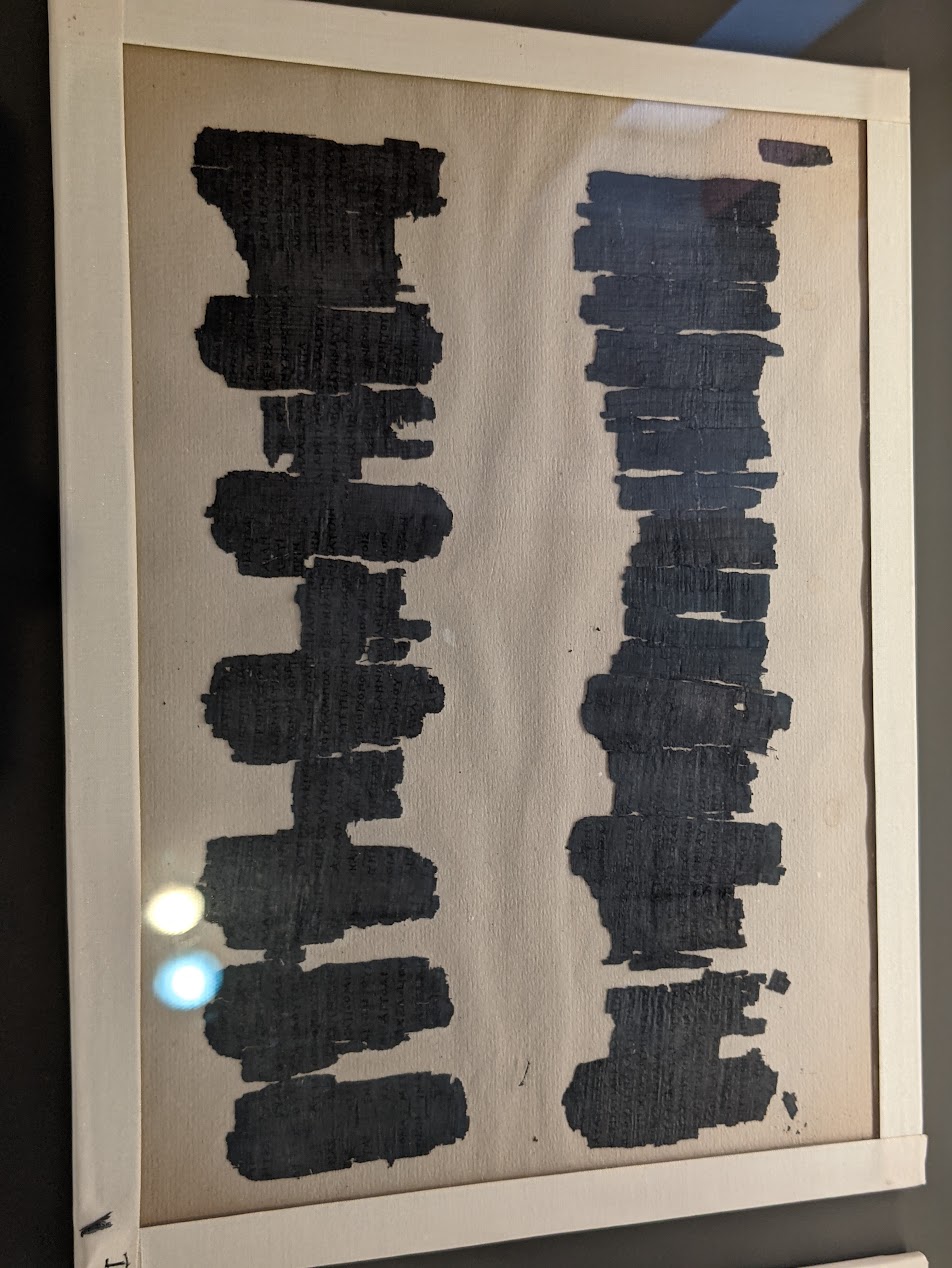
A charred Greek papyrus roll found near Thessaloniki in 1962 and copied c. 340–320 BCE, preserving excerpts from a poem attributed to Orpheus with an ancient commentary that reads divine names and images through nature.
Estimated reading time: 6 min Published Last reviewed:
Share article
Photograph
Photograph by Katolophyromai, 18 July 2023, via Wikimedia Commons, CC BY 4.0; artifact held by the Archaeological Museum of Thessaloniki.
Section I of the Derveni Papyrus: charred fragments arranged on a board in a modern display frame at the Archaeological Museum of Thessaloniki, with visible glass reflections. Photograph taken on 18 July 2023; neither an intact roll nor proof of the original position of every letter
License · Image sourceObject details
- Title
- The Derveni Papyrus: From a Poem of the Gods to Its Interpretation
- Timeline
- From 340 BCE to 320 BCE
- Region
- Derveni, north of Thessaloniki, ancient Macedonia (present-day Greece)
- Rights
- CC BY
Text
Introduction
Does the charred Derveni Papyrus preserve an ancient poem about gods or a book explaining such a poem? It preserves both voices within one physical witness: verses from a poem attributed to Orpheus and an unidentified commentator's attempt to explain them through nature and reasoning. This entry examines that particular manuscript, not “Orphism” as a single doctrinal system, and asks where quotation ends and interpretation begins.
A roll saved by fire, but not intact
The papyrus was discovered in 1962 in cist grave A at the Derveni cemetery north of Thessaloniki, among the remains of a funeral pyre. It is now kept at the Archaeological Museum of Thessaloniki. Partial carbonisation paradoxically helped preserve writing that would normally have perished in the Greek climate, while leaving the material exceptionally fragile. The object displayed today is not an intact, unrolled scroll: it consists of fragments painstakingly separated, partly reassembled, and presented in modern frames. [1]
Editors have reconstructed text in 26 columns, but fire destroyed their lower portions. Greece's national monument record lists 266 pieces and a surviving height of 9.4 cm, compared with an estimated original roll height of 16–17 cm. Those figures describe survival and reconstruction; they do not establish the original book's complete number of columns. Neither can a photograph of a modern display frame establish the former position of every letter. [2] [3]
Several dates for one object
Palaeographical dating places the physical copy around 340–320 BCE. The work copied is older: the museum suggests approximately 420–410 BCE, while Kyriakos Tsantsanoglou places its composition towards the end of the fifth century BCE. These estimates concern the commentator's work, not the date when each poetic verse was first composed. The copy date is separate from its discovery in 1962 and from any modern exhibition photograph. [1] [2]
The funeral pyre is an archaeological context, not proof that the person buried there wrote the text or belonged to one unified group called the “Orphics”. Discussions of souls and offerings make the burial context relevant, but do not turn the text into a universal Greek funeral manual.
Whose voice appears in the columns?
The opening columns, especially I–VI in the conventional numbering, discuss offerings, souls and ritualRitualAn organised or distinguished practice meaningful to a community; it may leave traces, but its form alone does not reveal an associated doctrine.Glossary · Click to read the explanation practices. Column VII leads into the interpretation of a religious poem attributed to the legendary singer Orpheus: the commentator describes the poetic language as riddling and requiring an understanding beyond its surface. Much of the later text quotes hexameter verses and proceeds to explain them in natural-philosophical terms. Thus Orpheus is an attribution attached to the cited poem, not a signature identifying the author of the entire roll. [4] [5] [6]
Three layers must remain distinct: actual Greek traces on charred papyrus, an edited Greek text assembled with conjectural supplements, and a modern translation reflecting an editor's choices. Differences over a letter or the opening of a line cannot be silently treated as words visible in full on the artifact.
Example one: “Olympos” becomes time
In column XII the commentator introduces a verse referring to a dwelling on “snowy Olympos”, a poetic location of the gods. But the next voice is no longer the poem. The commentator declares that Olympos and time are the same, then argues from the adjectives involved: the sky can be called wide, whereas time can properly be called long. His interpretation shifts a mythic setting into a temporal one. [4] [5]
The Greek χρόνος, “time”, should not be mistaken for Κρόνος, KronosKronosGreek divine figure and Zeus’s father; Hesiod connects his reign with struggles between divine generations.Glossary · Click to read the explanation, the god in divine succession narratives. The equivalence is the commentator's interpretive claim, not an established modern etymology or an assertion about the geographical Mount Olympus. The apparatus in Vojtěch Hladký's 2024 edition records competing readings for the verse's opening. The example therefore uses only the short passage necessary to demonstrate the shift in voice, rather than presenting a disputed full verse as certain. [4]
Example two: generation interpreted through the sun
Column XIII quotes a poetic line involving someone who “swallowed the phallus” in a narrative connected to the transfer of divine power to ZeusZeusZeus is the sky god and leading deity in many Greek traditions. In the Iliad he presides over divine gatherings while others can still speak and object.Glossary · Click to read the explanation. The commentator then explains why such a bodily image might be chosen: people regard sexual organs as necessary for generation, and he applies an analogy to the sun's role in bringing beings into existence. That analogy belongs to the commentator. It is neither a prose statement by the poetic speaker nor a rule for every Greek story about Zeus. [4] [5]
The Greek editions signal uncertain letters and supplements, especially where the explanation continues beyond this passage. The present reading covers the opening quotation and adjacent interpretation in column XIII, not every line of the roll or every published edition. The publicly accessible preview of Hladký's study includes the Greek, an English translation, and textual variants for this column, allowing these levels to be compared. [4]
Divine names made into a theory of nature
Column X illustrates another tool: the commentator relates the verbs for “uttering”, “speaking”, and “teaching” when explaining an epithet of Night. He contrasts the sun's dissolving heat with the night's gathering cold. In column XXIII he states, as part of his interpretation, that Oceanus is air, and air is Zeus. Such identifications do not follow automatically wherever a divine name occurs. They belong to one reader's attempt to explain mythic speech in the vocabulary of physical processes. [5]
The manuscript is therefore a significant witness to allegorical exegesisAllegorical exegesisInterpretation of a pre-existing text that relates narrative or linguistic elements to further ethical, philosophical, or religious meanings; it does not necessarily cancel plain meaning or observance.Glossary · Click to read the explanation, but in a particular material form: a Greek papyrus that carries both excerpts and their interpretation. It also matters for textual transmission. What survives of the cited poem here is not an independent complete copy, but verses selected and embedded within someone else's argument.
Disputed authorship, breaks, and changing readings
The museum's public description tentatively assigns the work to Euthyphron of Prospalta, but the Harvard introduction does not establish a definitive name, and scholars have advanced other attributions. “Anonymous or disputed commentator” is consequently the more accurate description. Richard Janko's published conference abstract explains how fragment placement and microscopy can affect readings, and challenges the supposed column numbers in upper margins as cracks or shadows. This report is based on the published abstract, not on an unexamined lecture or a full article. [1] [2] [7]
For this entry I read columns VII, X, XII and XIII, together with relevant passages of XIV and XXIII, in the Greek text displayed by Tsantsanoglou and Parássoglou. I compared selected passages of VII, X, XII and XIII with the accessible Greek text, translation and apparatus in Hladký's 2024 book preview. Mention of the 2006 Kouremenos–Parássoglou–Tsantsanoglou edition does not imply that the entire printed volume or its intermittently inaccessible digital interface was read. [4] [5]
What this object actually demonstrates
The Derveni Papyrus demonstrates that an ancient Greek reader could treat a poem about the gods as discourse requiring explanation, using poetic language to describe the formation and operation of the natural world. Its importance lies in the coexistence of quotation and commentary on one excavated, albeit broken, manuscript. It supplies neither a complete Orphic poem nor a securely named author, nor proof of a uniform Orphic creed or a direct line of influence upon any later religion. The distinction between the two voices can instead be tested against actual surviving traces and transparent editorial reconstructions. [4] [6]
References and notes
- Archaeological Museum of Thessaloniki, “Our highlights,” section “The Derveni Papyrus”; institutional description of the find, dating and proposed authorship. Entire section “The Derveni Papyrus” within “Our highlights.” Return to the text ↑
- Kyriakos Tsantsanoglou, “Introduction to the Text,” Center for Hellenic Studies, Harvard, Derveni Papyrus project. Full publicly available introduction; not the entire printed 2006 edition. Return to the text ↑
- Greek National Archive of Monuments, “The papyrus of Derveni,” object metadata via SearchCulture; fragment count, dimensions and separate official image rights. Object description, dimensions, dates and rights fields; not the protected repository media. Return to the text ↑
- Vojtěch Hladký, On the Gods and the World: Orpheus and the Presocratics in the Derveni Papyrus, Oxford University Press, 2024, publisher preview. Preview PDF pages 9, 11–12, 26–27, 32–33 and 36–39; especially Greek text, English translation and apparatus for cols. XII–XIII. Not the full book. Return to the text ↑
- K. Tsantsanoglou and G. M. Parássoglou, “Derveni Papyrus, Text,” Greek transcription hosted by the Center for Hellenic Studies. Columns VII, X, XII, XIII and relevant passages of XIV and XXIII; not a full critical reading of all columns. Return to the text ↑
- Valeria Piano, “Derveni papyrus,” Oxford Research Encyclopedia / Oxford Classical Dictionary, 2020. Published abstract only; not the full article. Return to the text ↑
- Richard Janko, “New Readings in the Derveni Papyrus,” abstract of a paper for SCS 146. Entire published abstract; neither full paper nor lecture. Return to the text ↑
Archive records may be reviewed and refined as better evidence or sources become available. Suggest a correction
Suggest a correction · Suggest a source for this record
Cite this record
IL Archive, «The Derveni Papyrus: From a Poem of the Gods to Its Interpretation», https://ilarchive.com/en/artifacts/derveni-papyrus-commentary