Artifact · Inscription
The Taylor Prism: Sennacherib and Judah in a Royal Inscription
An object record bringing together its image, metadata, rights, and context.
- Names
- Sennacherib’s Taylor Prism · Taylor Prism
- Timeline
- 691 BCE
- Region
- Nineveh (Assyria)
An Assyrian prism dated to 691 BCE that tells, among Sennacherib’s campaigns, of Judah in 701 BCE. The entry separates its claims of 46 towns taken and Hezekiah shut in Jerusalem from what critical comparison can establish.
Estimated reading time: 9 min Published Last reviewed:
Share article
Photograph
Photograph by Gary Todd, via Wikimedia Commons; file previously extracted from a wider photograph. · CC0
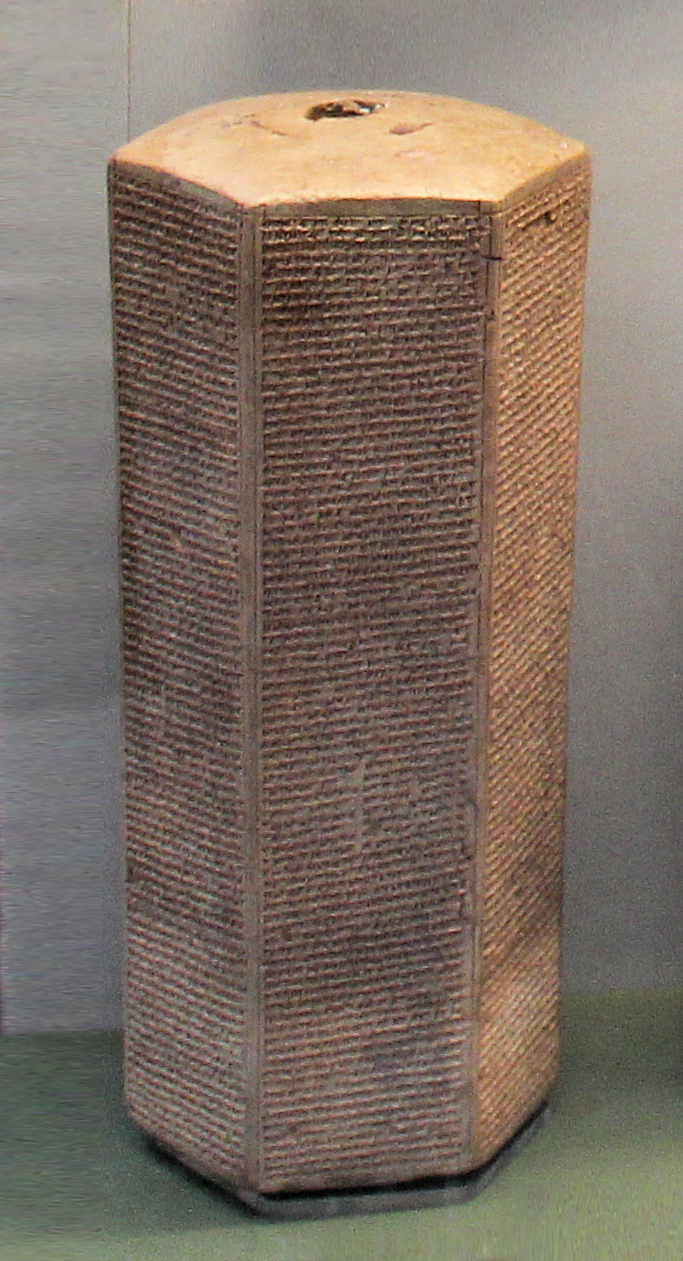
The original Taylor Prism, British Museum BM 91032: three inscribed faces and the top are visible. The photograph neither shows all six faces nor permits independent sign-by-sign reading. This Commons file was previously extracted from a wider photograph
License · Image sourceObject details
- Title
- The Taylor Prism: Sennacherib and Judah in a Royal Inscription
- Timeline
- 691 BCE
- Region
- Nineveh (Assyria)
- Rights
- CC0
Text
Introduction
The Taylor Prism is not a field report written during the siege of JerusalemJerusalemJerusalem is a city of religious importance in Judaism, Christianity and IslamGlossary · Click to read the explanation. It is a six-sided Assyrian clay object on which a royal account was inscribed after the events it narrates. The inscription names SennacheribSennacherib, king of AssyriaAssyrian king, 704–681 BCE; part of Ahiqar’s story is set at his court.Glossary · Click to read the explanation and his campaign in Judah against HezekiahHezekiah, king of JudahKing of Judah in the late eighth century BCE, named in Sennacherib’s Assyrian accounts of the 701 BCE campaign.Glossary · Click to read the explanation, but it speaks in the voice of a king proclaiming the subjugation of opponents and the success of his rule. This entry begins with the particular object, BM 91032, and distinguishes its physical text from a scholarly edition assembled using several witnesses, the king's claims from historical inference, and the date of the military event from the date of this copy. It is neither a biography of Sennacherib nor a retelling of the whole war of 701 BCE. [1][2]
A six-sided object with its own identity
The Taylor Prism is an upright, six-sided clay prism bearing six columns of cuneiformCuneiformWriting with wedge-shaped signs, developed from Mesopotamian recording traditions and used for several languages from the third millennium BCE.Glossary · Click to read the explanation writing in AkkadianAkkadianAn ancient East Semitic language written in cuneiform from the third millennium BCE; its varieties include Babylonian and Assyrian, and it served in international diplomacy.Glossary · Click to read the explanation, specifically Neo-Assyrian. The British Museum assigns it museum number 91032 and registration number 1855,1003.1. It measures 38.10 cm in height, 16.51 cm at its greatest width, and 8.57 cm across a face. The catalogue gives 82 + 83 + 82 + 80 + 85 + 75 lines in its six columns, 487 lines by that count. These are the columns of one inscription, not six independent texts. The photograph accompanying this article shows parts of three inscribed faces and the top, not all six columns. [1]
“Taylor” is not an ancient author's name. It refers to a former owner, Colonel R. Taylor. The museum's acquisition information says the prism is said to have been found at Nebi Yunus, in the NinevehNineveh and KuyunjikNineveh is an ancient Assyrian city near Mosul in northern Iraq; Kuyunjik is one of its archaeological moundsGlossary · Click to read the explanation area, and that Taylor acquired it in 1830. The museum purchased it in 1855 from his widow through Henry Rawlinson. The cautious provenance formula does not amount to a documented scientific excavation or to proof that this exact specimen lay in an identified foundation deposit. The catalogue's conservation record also notes treatment on 28 September 1964; this must not be recast as evidence of a fire in Assyrian antiquity. [1]
Four dates, not one
Sennacherib ruled approximately 705–681 BCE. His third campaign, including the Judah episode, is assigned historically to 701 BCE. The Taylor copy itself is dated in the museum catalogue to 691 BCE, a later inscription recalling previous campaigns. The dates 1830 and 1855 belong instead to the object's modern collecting history. A narrative of a 701 event on clay dated 691 shows how the royal court presented that campaign by the latter date; it does not turn every sentence into a contemporaneous field transcript. [1][3]
Taylor should not be conflated with the Chicago Prism, A2793, dated 689 BCE, or with a separate prism in Jerusalem, IMJ 71.72.249. Similarity of their accounts does not abolish their different material identities, dates, signs, or editorial histories. In particular, the date of the Chicago witness must not be transferred to BM 91032. [3][4]
A composite edition and a physical witness
A. Kirk Grayson and Jamie Novotny edit the account as RINAP 3/1, Sennacherib 022, made available as a composite text through ORACC, identifier Q003496. The actual Taylor prism has CDLI identifier P421809, and the edition's bibliographical witness list associates BM 91032 with Sennacherib 022, exemplar 002. The current ORACC witness interface labels BM 91032 EX004 and Chicago A2793 EX001. These labels index particular witnesses in a digital presentation, not new objects; nor do they mean that the surviving signs in every exemplar are precisely identical. Another inscription, Sennacherib 023, is associated with the Jerusalem exemplar and should not be silently relabelled as an exact duplicate of 022. [2][3]
The varying line numbers illustrate the stakes. The Judah passage begins at column iii, line 18 in the ORACC composite, but at column iii, line 11 in CDLI's transliteration specifically of Taylor. The image “like a bird in a cage,” situated around iii 27–29 in the composite, occurs at iii 20–21 in Taylor's witness transcription. This is a difference between editorial numbering of witnesses, not evidence that one account was invented. The photograph does not permit us to collate all cuneiform signs independently on each side. [2][5]
A foundation record addressed beyond its own generation
The prism belongs to the genre of Assyrian royal foundation inscriptions. Exemplars of this genre were deposited in building foundations or walls, in part to memorialize royal deeds before the gods and future rulers rather than to provide a readable newspaper in a public square. That generic purpose does not independently establish the archaeological position of this particular prism when first installed. Royal titles at its opening praise dominion over the world and the four quarters and present Assur as the source of military success. Such formulas construct legitimacy; they are not literal measurements of the empire's geographical reach. [5][6]
The account extends far beyond Judah. Earlier portions narrate campaigns in Babylonia and other regions, then the western third campaign; subsequent episodes treat highland and Mesopotamian conflicts, while the narrative also celebrates the king's extensive building projects. The recurring motifs of encirclement, defeat, tribute, deportation, and political reorganization belong to a crafted royal voice. The inscription is a major source for the rhetoric and practices of Assyrian domination, but not a neutral census jointly approved by the people of the defeated cities. [3][6]
The approach to Judah through the western cities
The third campaign does not begin in Jerusalem. Sennacherib describes interventions in Phoenician and Philistine coastal cities, the removal or restoration of rulers, and conflict near Eltekeh involving Egyptian forces, before turning to Hezekiah. He also says that Padi, ruler of Ekron, had been kept prisoner in Jerusalem and was subsequently returned to his throne. This detail locates Judah's relations with other southern Levantine rulers within the campaign. The geographical sequence should not be reduced to an isolated account of a single city's encirclement. [6][7]
Judah's cities and the problem of royal numbers
According to the ORACC composite at iii 18–27, the king claims to have besieged and captured 46 fortified cities of Hezekiah, plus innumerable smaller settlements, and to have removed 200,150 people, alongside animals described without a comparable final count. Siege ramps, attacks, and engineering measures are included in the military account. These numbers really occur in the transmitted royal text; they were not added by modern historians. Yet they remain the king's numerical claims, not an independently audited population register. Neither dismissing them out of hand nor accepting them as exact counts is justified without comparison with other kinds of evidence. On the physical Taylor witness the relevant passage occupies approximately column iii, lines 11–20. [7][8]
“Like a bird in a cage”: what the claim does not say
The royal speaker says he confined Hezekiah inside Jerusalem, his royal city, comparing him to a bird in a cage, and portrays the restriction of access and movement. The inscription then boasts that portions of Judah's territory were granted to rulers of Ashdod, Ekron, and Gaza, and that additional obligations were imposed. The phrase is part of a developed claim of military and political coercion, not an isolated proverb. Yet, unlike the language used for other captured cities, this passage does not claim that the Assyrians stormed and plundered Jerusalem. Its silence provides no textual basis for saying the city fell according to this version, but the cause and exact conclusion of the confrontation cannot be inferred from that silence alone. [8][9]
A brief example: signs, transcription, and inference
In the published transliteration of Taylor column iii, line 20, CDLI renders the short sequence sza2-a-szu2 gin7 muszen qu-up-pi, followed by the city's name; line 21 continues with the verb of confinement. The comparable position in the ORACC composite is about iii 27b–29. A concise translation of the simile is “like a bird in a cage.” The Latin-character sequence is an editor's representation of the cuneiform signs, not the signs themselves. The wider assertion “confined within Jerusalem” comes from the full clause and context, not from these four words taken alone. Calling this blockade or siege is historical characterization; concluding that Jerusalem's capture is not claimed here depends on comparison with the text's explicit language for taken towns. This article does not profess a fresh Akkadian reading from the photograph or reproduce the entire modern translation. [2][9]
Tribute, discrepancies, and narrative order
The inscription subsequently says that Hezekiah sent tribute to Nineveh: 30 talents of gold and 800 talents of silver, as well as valuable timber, ivory furniture, precious goods, palace women, male and female singers, and a messenger of submission. This list follows territorial seizures and intimidation in the royal narrative, which also comments on defensive measures in Jerusalem after Sennacherib's departure. The order of this literary account should not be flattened into a proven hour-by-hour sequence. The passage stands at iii 37–49 in the ORACC composite and column iii, lines 29–41 in the Taylor transcription. [10]
By contrast, 2 Kings 18:14–16 names 30 talents of gold but 300 talents of silver, relating Hezekiah's payment to his message to the king at Lachish and to resources from temple and palace. The gold totals agree, whereas the silver amounts do not, and the narrative placement of the payment differs. We cannot simply change one number to harmonize the accounts, or decree that different weighing standards or two installments explain the disagreement without independent evidence. Nor does the royal inventory alone verify that every listed item arrived in precisely the stated amount. [10][11]
Comparing narratives without imposing one ending
The Books of Kings, in 2 Kings 18–19, tell of the invasion and payment, followed by envoys and speeches, the city's deliverance, and the Assyrian king's return. Isaiah 36–37 offers a broadly parallel representation of the confrontation. 2 Chronicles 32 condenses the campaign and foregrounds Hezekiah's preparations and divine intervention within its own narrative. These works differ in focus and literary development; they are not contemporary annotations engraved beside the Assyrian prism. Dan'el Kahn's study argues for distinguishing layers of the biblical tradition rather than presuming a single seamless report; for that chapter only its publicly available publisher summary was consulted, not the full text. [11][12][13]
The sources can be compared on the presence of an Assyrian campaign in Judah, severe pressure upon Hezekiah, and tribute in both traditions. Differences over the silver total, timing, and interpreted outcome need their own analysis. BM 91032 does not independently prove or refute supernatural intervention, a medical cause of an army's withdrawal, or every assertion of either literary account. The absence of a claim to capture Jerusalem cannot automatically be turned into a narrated Assyrian battlefield defeat. [9][11][13]
The artifact's contribution—and its limits
As a dated object registered in a museum, the Taylor Prism establishes that by 691 BCE Sennacherib's court had chosen to memorialize its campaign of 701 BCE in a Neo-Assyrian royal account naming Hezekiah, Jerusalem, captured towns, mass removals, and tribute. It does not by itself establish the actual number deported, a precise daily chronology of the blockade, or why the writer never says Jerusalem was captured. Its value grows when the readings specific to Taylor are distinguished from the composite edition, and when the entry is compared with the separate Siloam Tunnel Inscription, a material witness to water engineering rather than an inscription naming Sennacherib. The historical task is to interpret royal testimony critically, not to mistake a ruler's victorious voice for the entire history of Judah. [1][2][8]
References and notes
- British Museum, catalogue entry for Taylor Prism BM 91032, registration 1855,1003.1; material, dimensions, column counts, dating, provenance, acquisition. Consulted the institution-page text saved with the provided attachment; direct fetching here was blocked. Fields Object details, Dimensions, Acquisition, and Condition in the saved museum-page text; not a firsthand excavation report. Return to the text ↑
- CDLI, P421809, physical Taylor Prism BM 091032 and its published transliteration; not an independent collation of signs from the photograph. Artifact record and column iii, lines 11–41; distinguished physical-witness numbering from the ORACC composite. Return to the text ↑
- A. Kirk Grayson and Jamie Novotny, The Royal Inscriptions of Sennacherib, King of Assyria (704–681 BC), Part 1, RINAP 3/1 (2012), edition metadata for Sennacherib 022 and the online ORACC text. The entire printed PDF was not read. Online edition and witness bibliography, with selected ORACC passages; full book PDF could not be accessed for complete reading. Return to the text ↑
- Journal of Near Eastern Studies 84/2 (2025), DOI 10.1086/738763, cover/metadata identifying Chicago prism A2793 dated 689 BCE; contextual distinction, not a source identifying the Taylor object. Jerusalem witness separately identified from Israel Museum metadata; article not read. Public issue-cover metadata only; neither the complete article nor a Taylor-specific dating study was consulted. Return to the text ↑
- ORACC RINAP 3/1, Sennacherib 022, Q003496; editorial composite compared against CDLI’s physical Taylor transcription. Composite column iii 18–49, especially iii 27b, with corresponding Taylor iii 11–41; no independent sign-by-sign autopsy. Return to the text ↑
- Grayson and Novotny’s Sennacherib 022 on ORACC; royal titulary, the broader campaign and building programme, and foundation-inscription context, not independent testimony from conquered communities. Composite column i 1–19 and selected campaign/building sections; genre function does not identify this exemplar’s excavated deposit. Return to the text ↑
- ORACC edition of Sennacherib 022; western third campaign preceding Judah, and the claimed numbers of towns and deportees. Selected western-campaign sections of column ii and composite iii 18–27; figures 46 and 200,150 occur in royal rhetoric. Return to the text ↑
- CDLI transliteration of actual BM 91032, column iii, compared with the composite. The digital editors’ sign readings were used, not new readings from our image. Physical Taylor column iii, lines 11–28, on 46 towns, 200,150 people, and Jerusalem; compare ORACC iii 18–36. Return to the text ↑
- CDLI physical Taylor transcription, checked alongside the ORACC composite, for the bird-in-a-cage simile and confinement of Jerusalem; the lack of an explicit storming claim is a limited observation. Taylor iii 20–28 and composite iii 27b–36; the short transcription sequence sza2-a-szu2 gin7 muszen qu-up-pi is attributed to CDLI. Return to the text ↑
- ORACC composite Sennacherib 022 and comparison with CDLI’s Taylor witness; Hezekiah’s tribute and court goods. Composite column iii 37b–49 (30 talents gold, 800 silver); Taylor physical column iii 29–41. Return to the text ↑
- 2 Kings 18:14–16 in NET Bible, directly consulted for 30 talents gold, 300 silver, and Lachish. Other parts of chapters 18–19 used for narrative context, not a critical Hebrew collation. Chapter 18, verses 14–16, directly read; broader 18–19 narrative context was not independently collated in Hebrew. Return to the text ↑
- 2 Chronicles 32 in the United States Conference of Catholic Bishops’ Bible; preparation and deliverance according to this literary source. Chapter 32, notably verses 1–23 and 30, read on the published page; not used to date the Taylor artifact. Return to the text ↑
- Dan’el Kahn, chapter in Sennacherib’s Campaign against Judah, Cambridge University Press; publisher summary only consulted on the different historical and literary layers. Cambridge Core chapter abstract/summary only; neither the full chapter nor unsupported internal page numbers were consulted. Return to the text ↑
Archive records may be reviewed and refined as better evidence or sources become available. Suggest a correction
Suggest a correction · Suggest a source for this record
Cite this record
IL Archive, «The Taylor Prism: Sennacherib and Judah in a Royal Inscription», https://ilarchive.com/en/artifacts/taylor-prism-bm91032